
Windsurf Wave 13: Parallel Agents and Arena Mode Redefine AI Coding
Windsurf's Wave 13 update introduces parallel multi-agent sessions via Git worktrees, Arena Mode for blind model comparison, and free SWE-1.5 access.
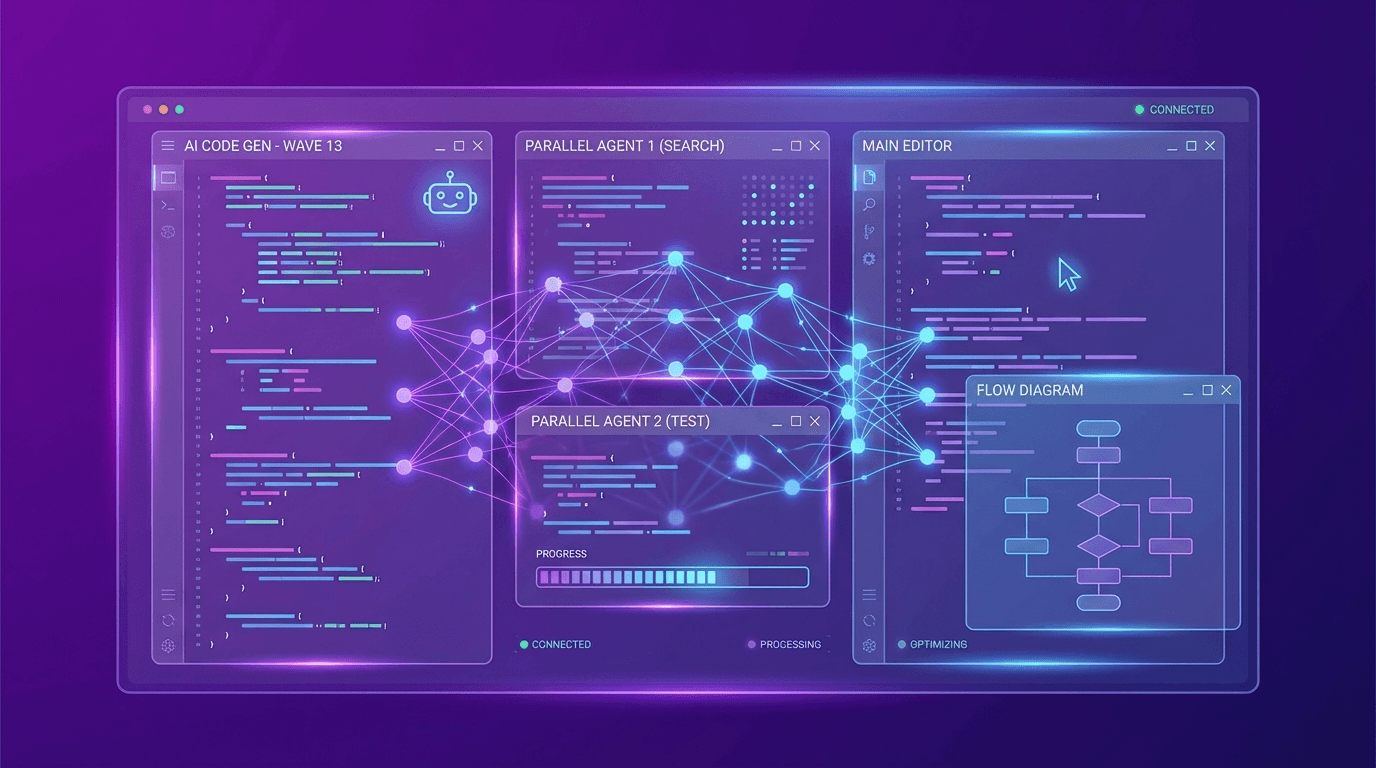
Windsurf's Wave 13 update introduces parallel multi-agent sessions via Git worktrees, Arena Mode for blind model comparison, and free SWE-1.5 access.
Windsurf Takes the Lead in the AI IDE War
Windsurf has released Wave 13, its most significant update yet, and it directly addresses the biggest bottleneck in AI-assisted development: developers can generate code faster than they can review it. With first-class support for parallel multi-agent sessions, a new Arena Mode for blind model comparison, and free access to the SWE-1.5 model, Wave 13 positions Windsurf at the top of the AI coding IDE rankings for February 2026.
The update arrives during an exceptionally competitive period for AI coding tools. Cursor, GitHub Copilot, and Google's Antigravity are all vying for developer attention, but Windsurf's Wave 13 introduces capabilities that none of its competitors currently match.
Parallel Multi-Agent Sessions: The Headline Feature
The most impactful feature in Wave 13 is the ability to run five separate Cascade agents simultaneously through Git worktrees integration. Each agent operates on a different branch within separate directories while sharing Git history, which eliminates the merge conflicts that previously blocked parallel AI development.
In practice, this means a developer can assign five different bugs to five different agents and have them all working at the same time. Each agent runs in its own Cascade pane with a dedicated terminal profile, ensuring reliable execution without cross-contamination between tasks.
Git worktrees are the enabling technology here. Unlike traditional branching, where switching between branches requires stashing or committing work-in-progress changes, worktrees maintain separate working directories for each branch. Windsurf builds on this by binding each Cascade agent to its own worktree, creating isolated environments that prevent the conflicts and context confusion that plagued earlier attempts at parallel AI coding.
Why This Matters
According to recent industry data, 95 percent of developers now use AI coding tools. However, a critical constraint has emerged: pull request review time has increased by 91 percent as code generation velocity outpaces human review capacity. Parallel agents do not solve the review bottleneck directly, but they do allow developers to maximize their productive time by running multiple tasks concurrently rather than sequentially.
Arena Mode: Blind Model Comparison
Arena Mode is Wave 13's second major innovation. It enables side-by-side model comparison with hidden identities and voting, letting developers discover which models actually work best for their specific workflows.
When Arena Mode is activated, Windsurf runs the same prompt through two different models simultaneously, displaying results in adjacent panes without revealing which model produced which output. The developer evaluates both outputs and votes for the one they prefer. Over time, this builds a personal ranking that reflects real-world performance rather than synthetic benchmarks.
This feature addresses a genuine pain point. With dozens of AI models available, from Claude Opus 4.6 to GPT-5.2 to open-source options like SWE-1.5, developers have no practical way to determine which model works best for their codebase, language, and coding style. Arena Mode provides empirical data based on actual development work.
SWE-1.5: Free Access to Near-Frontier Performance
Windsurf is offering free access to its SWE-1.5 model for three months through March 2026. SWE-1.5 achieves 950 tokens per second at maximum speed and delivers near-frontier performance matching Claude Sonnet 4.5 on coding tasks.
The model was trained using end-to-end reinforcement learning on real-world development tasks rather than synthetic benchmarks. This training approach means SWE-1.5 performs particularly well on practical coding scenarios like debugging, refactoring, and feature implementation, which are the tasks developers actually perform daily.
SWE-1.5 replaces SWE-1 as Windsurf's default model, offering substantial improvements in code understanding, context retention, and output quality. The free access period is clearly a competitive strategy to attract developers from Cursor and GitHub Copilot, but it also gives Windsurf a large dataset of real-world usage to improve future model versions.
Plan Mode: Think Before You Code
Plan Mode adds smarter task planning before code generation begins. Rather than immediately generating code in response to a prompt, Plan Mode first outlines the approach, identifies affected files, considers edge cases, and presents a structured plan for the developer to review and approve.
This addresses the common frustration of AI coding assistants that generate plausible-looking code without fully understanding the broader context. By separating planning from execution, Plan Mode gives developers more control over the AI's approach before any code is written.
Pricing: Aggressively Competitive
Wave 13's pricing structure undercuts major competitors across the board:
| Tool | Monthly Price | Key Differentiator |
|---|---|---|
| Windsurf | Free (SWE-1.5 for 3 months) | Parallel agents, Arena Mode |
| Google Antigravity | Free | Google ecosystem integration |
| Cursor | $20/month | Established user base |
| GitHub Copilot Individual | $10/month | GitHub integration |
| GitHub Copilot Business | $19/month | Team features |
The free SWE-1.5 offer is temporary, but even at its standard pricing of $10 to $15 per month, Windsurf remains competitive while offering features that premium-priced competitors lack.
The Review Bottleneck Problem
Wave 13's parallel agents highlight an uncomfortable truth about the current state of AI-assisted development. The 91 percent increase in PR review time suggests that the industry has optimized code generation without adequately addressing the downstream review and quality assurance processes.
Parallel agents make this tension more visible. When five agents can produce code changes simultaneously, the human reviewer faces five times the review load. Junior developers managing multiple parallel agents simultaneously may lack the experience to effectively evaluate all outputs, creating a potential quality risk.
Windsurf has not directly addressed this challenge in Wave 13, but the Plan Mode feature represents an indirect mitigation by front-loading quality decisions to the planning phase rather than the review phase.
Limitations and Considerations
Despite its strong feature set, Wave 13 has notable limitations. The parallel agent system requires familiarity with Git worktrees, which many developers have never used. The free SWE-1.5 offer expires in March 2026, and the pricing structure afterward has not been fully detailed. Arena Mode's usefulness depends on having access to multiple paid model subscriptions, which adds cost.
The broader question of whether parallel AI agents improve or complicate developer workflows remains open. For experienced developers managing well-defined tasks, parallel agents offer clear productivity gains. For teams without strong code review processes, the increased code volume could introduce quality issues that take longer to identify and resolve.
Conclusion
Windsurf Wave 13 delivers three features that collectively push the AI coding IDE category forward. Parallel multi-agent sessions through Git worktrees enable genuine concurrent development. Arena Mode provides the first practical tool for empirically comparing AI models on real development work. And free SWE-1.5 access removes the financial barrier to trying a near-frontier coding model. The update is most valuable for experienced developers working on multi-branch projects who want to maximize their productive time, and for teams evaluating which AI models best fit their workflows.
Editor's Verdict
Windsurf Wave 13: Parallel Agents and Arena Mode Redefine AI Coding earns a solid recommendation within the ai tools space.
The strongest case for paying attention is parallel multi-agent sessions enable genuine concurrent development on multiple branches simultaneously, which raises the bar for what readers should now expect from peers in this space. Reinforcing that, arena Mode provides empirical, real-world model comparison data instead of relying on synthetic benchmarks adds practical value rather than just headline appeal. The broader signal worth registering is straightforward: parallel multi-agent sessions via Git worktrees enable five concurrent AI agents working on separate branches without merge conflicts. On the other side of the ledger, parallel agents require familiarity with Git worktrees, a concept many developers have not used is a real constraint, not a marketing footnote, and it should factor into any serious decision. Layered on top of that, the 91% increase in PR review time suggests parallel agents could overwhelm code review processes narrows the set of teams for whom this is an obvious yes.
For product teams, content creators, and knowledge workers looking to upgrade a specific workflow, this is a serious evaluation candidate, not just a curiosity to bookmark. For everyone else, the safer posture is to monitor coverage and revisit once the use cases that matter to your team are demonstrated in the wild.
Pros
- Parallel multi-agent sessions enable genuine concurrent development on multiple branches simultaneously
- Arena Mode provides empirical, real-world model comparison data instead of relying on synthetic benchmarks
- Free SWE-1.5 access through March 2026 removes financial barriers to entry
- Plan Mode reduces wasted code generation by front-loading quality decisions
- Git worktrees integration ensures isolated agent environments without cross-contamination
Cons
- Parallel agents require familiarity with Git worktrees, a concept many developers have not used
- The 91% increase in PR review time suggests parallel agents could overwhelm code review processes
- Free SWE-1.5 offer expires in March 2026 with unclear pricing afterward
- Arena Mode requires access to multiple paid model subscriptions to be fully useful
References
Comments0
Key Features
Windsurf Wave 13 introduces parallel multi-agent sessions supporting up to five concurrent Cascade agents through Git worktrees integration, Arena Mode for blind side-by-side model comparison with hidden identities and voting, free access to the SWE-1.5 model achieving 950 tokens per second with near-frontier performance, and Plan Mode for structured task planning before code generation. The update aggressively undercuts competitors with free SWE-1.5 access through March 2026.
Key Insights
- Parallel multi-agent sessions via Git worktrees enable five concurrent AI agents working on separate branches without merge conflicts
- Arena Mode provides the first practical tool for empirically comparing AI models on real development work with blind evaluation
- SWE-1.5 achieves 950 tokens per second and near-frontier performance matching Claude Sonnet 4.5, offered free for three months
- PR review time has increased 91% as code generation velocity outpaces human review capacity, highlighting the industry's review bottleneck
- 95% of developers now use AI coding tools, making AI IDE competition one of the fastest-growing software markets
- Plan Mode separates planning from execution, giving developers control over the AI's approach before code generation begins
- SWE-1.5 was trained using end-to-end reinforcement learning on real-world tasks rather than synthetic benchmarks
- The free SWE-1.5 offer is a strategic move to attract developers from Cursor and GitHub Copilot while building training data
Was this review helpful?
Share
Related AI Reviews

Daydream Adds iOS 27 Photo Shopping and Siri Search
Fashion app Daydream uses Apple's iOS 27 tools to turn saved outfit photos into shoppable matches, plus Siri natural-language search.

Roland Melody Flip: Free AI Melody Plug-In With Sony CSL
Roland's free Melody Flip plug-in uses Sony CSL music analysis and 250+ Palettes to help musicians generate MIDI melody, chord, bass, and drum ideas.

Microsoft's MAI-Transcribe-2: Cheap, Fast Speech-to-Text
Microsoft's MAI-Transcribe-2 tops the FLEURS benchmark across 60 languages and costs $0.10 per audio hour, undercutting OpenAI, Google and ElevenLabs.

Testers Praise Instinct AI Agent but Flag Privacy Risks
TechCrunch: testers praise Instinct AI agent for autonomous task skill but flag its data-license terms, unapproved actions, and phishing exposure.