
Cursor 3 Launch: Parallel Agents Window Redefines AI-Native Code Editing
Cursor 3 launched April 2, 2026 with a ground-up rebuild around parallel AI agents, introducing the Agents Window, Design Mode, and the proprietary Composer 2 model at 200+ tok/s.
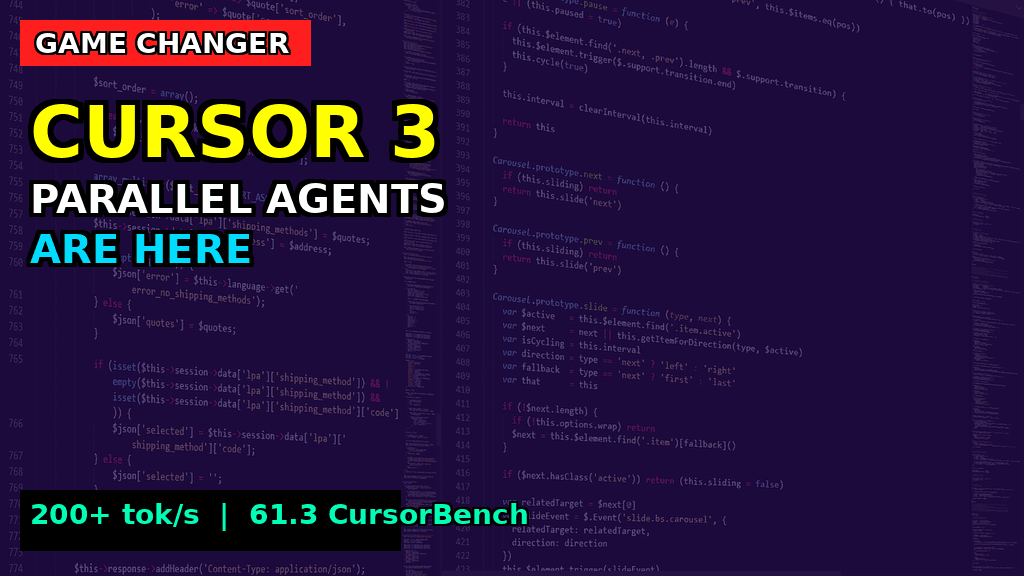
Cursor 3 launched April 2, 2026 with a ground-up rebuild around parallel AI agents, introducing the Agents Window, Design Mode, and the proprietary Composer 2 model at 200+ tok/s.
Introduction
On April 2, 2026, Anysphere released Cursor 3 — not as an incremental update, but as a complete architectural reinvention. Where previous versions bolted AI features onto a Visual Studio Code fork, Cursor 3 treats the AI agent as the primary interaction model. The editor has been rebuilt from the ground up around the idea that most code in 2026 is written by AI agents, and the developer's core job is to orchestrate those agents — not write every line.
The release comes at a pivotal moment. The AI coding tool market has fragmented into a heated three-way race between Cursor, GitHub Copilot, and the rising Claude Code. Cursor 3 is Anysphere's answer to the competitive pressure: an agent-first interface with capabilities no other IDE currently matches.
Feature Overview
The Agents Window
The centerpiece of Cursor 3 is the Agents Window — a dedicated full-screen workspace that replaces the previous Composer pane. Accessible via Cmd+Shift+P → Agents Window, it provides a tiled layout where you can run and monitor multiple AI agents simultaneously across different repositories, branches, and environments.
In previous Cursor versions — and in virtually every competing AI IDE — you could only run one agent task at a time. Cursor 3 removes that constraint entirely. Each agent in the window operates independently, meaning you can have one agent refactoring a backend service, another debugging a failing test suite, and a third scaffolding a new API endpoint, all running in parallel and all visible in the same workspace.
Unified sidebar management brings together all local and cloud agents, including those initiated from external platforms like Slack, GitHub, Linear, mobile devices, and the Cursor web interface. Every active agent is visible in a single pane regardless of where it was started.
Composer 2: The Proprietary Coding Model
Cursor 3 ships with Composer 2, Anysphere's in-house frontier coding model trained specifically for code-editing tasks. The key performance numbers are notable: 61.3 on CursorBench (a 39% improvement over Composer 1.5), and delivery at 200+ tokens per second via custom GPU kernel optimizations.
For context, 200 tok/s puts Composer 2 in the upper tier of inference speed among deployed coding models. While Windsurf's SWE-1.5 on Cerebras still leads at approximately 950 tok/s, Composer 2 achieves its speed on standard GPU infrastructure, making it consistently available without Cerebras-specific routing constraints.
The /best-of-n command, new in Cursor 3, lets developers run the same prompt across multiple models — including Claude Sonnet 4.5, GPT-5.4, and Composer 2 — and compare outputs side by side before accepting any of them.
Design Mode
Design Mode, activated via Cmd+Shift+D, bridges the longstanding gap between AI coding and UI iteration. Rather than describing a visual change in text ('make the navbar sticky and change the button to blue'), you click directly on browser elements to annotate what you want changed, then direct the agent to the exact UI component.
Cloud agents automatically generate screenshots and demo videos of their work at each step, so you can verify visual output without needing to run the application locally. This dramatically reduces the feedback loop for frontend development tasks that previously required constant context switching between the IDE, browser, and design tools.
Cloud and Local Agent Handoff
Agents in Cursor 3 can seamlessly transition between cloud infrastructure and local machines. A task started in the cloud can be handed off to a local agent for testing, and vice versa. The /worktree command creates isolated git worktrees for experimental branches, allowing risky refactors or exploratory changes to run in parallel without touching the main working tree.
Usability Analysis
For developers who spend significant time on multi-component systems, the Agents Window is a genuine workflow improvement. The ability to run agents in parallel across different concerns — say, running a test-fix agent on one service while a feature-development agent works on another — compresses tasks that previously required sequential context switching into concurrent execution.
Design Mode lowers the barrier for frontend iteration substantially. The annotation-based interface is more precise than text descriptions and more accessible than writing explicit CSS or component code from scratch.
The credit pool pricing model introduced in Cursor 3 replaces per-model billing with a flat monthly budget, which simplifies cost prediction for Pro and Pro+ subscribers. Auto mode (using Cursor's model routing) is unlimited; manually selecting premium models draws from the credit pool.
Pros and Cons
Pros:
- Parallel agent execution across repositories and environments is a first among mainstream AI IDEs
- Composer 2 delivers 200+ tok/s with competitive benchmark scores (61.3 CursorBench)
- Design Mode annotation interface significantly reduces friction in UI iteration
- Unified sidebar aggregates all agents regardless of origin platform
/best-of-ncommand enables direct model comparison in workflow
Cons:
- Pro plan at $20/month is more expensive than GitHub Copilot ($10/month) and lacks parity on raw inference speed compared to Windsurf/Cerebras stack
- Composer 2 availability is not explicitly guaranteed in free Hobby tier
- Cloud agent hand-off works best in monorepo setups; multi-repo workflows require additional configuration
- Design Mode currently limited to locally-running frontend apps; remote URL support is on the roadmap
Outlook
Cursor 3 represents the most significant architectural shift in the AI coding tool market since GitHub Copilot introduced inline suggestions in 2022. The parallel agents model is the correct abstraction for how complex software development actually works — concurrent, multi-concern, multi-environment — and Cursor is the first mainstream IDE to build its UX around that reality rather than retrofitting it.
The question going forward is whether Anysphere can sustain the inference cost of running parallel cloud agents at scale while keeping Pro pricing at $20/month. The competitive pressure from Claude Code (free usage for Claude Max subscribers), Windsurf (now owned by Cognition AI with Cerebras-speed inference), and GitHub Copilot (deeply integrated into Microsoft tooling) will intensify through 2026.
Google I/O 2026, scheduled for May 19, is expected to showcase Antigravity — Google's AI-native IDE with Gemini 3.1 Pro integration and Firebase agent orchestration. That announcement will be the next major pressure test for Cursor's positioning.
Conclusion
Cursor 3 is the most compelling AI coding IDE available as of May 2026 for developers who run complex, multi-component projects. The Agents Window and parallel execution model solve a real bottleneck in AI-assisted development, and Composer 2's speed and benchmark performance make it a credible default model. Developers who primarily work on single-file or single-service projects may not feel the full benefit, but for anyone orchestrating multiple concerns simultaneously, Cursor 3 sets a new standard.
Rating: 4.5/5
Editor's Verdict
Cursor 3 Launch: Parallel Agents Window Redefines AI-Native Code Editing stands out as one of the more compelling ai tools developments we've covered recently.
The strongest case for paying attention is parallel agent execution across repos and environments is unprecedented in mainstream AI IDEs, which raises the bar for what readers should now expect from peers in this space. Reinforcing that, composer 2 delivers industry-competitive speed (200+ tok/s) and coding benchmark performance adds practical value rather than just headline appeal. The broader signal worth registering is straightforward: cursor 3 is the first mainstream AI IDE to make parallel multi-agent execution a first-class UX feature, not a power-user option. On the other side of the ledger, pro plan at $20/month is 2x GitHub Copilot's price with less deep IDE integration in Microsoft tooling is a real constraint, not a marketing footnote, and it should factor into any serious decision. Layered on top of that, raw inference speed still trails Windsurf/Cerebras stack (~950 tok/s) for latency-sensitive workflows narrows the set of teams for whom this is an obvious yes.
For product teams, content creators, and knowledge workers looking to upgrade a specific workflow, the answer here is to pilot now and plan for production use. For everyone else, the safer posture is to monitor coverage and revisit once the use cases that matter to your team are demonstrated in the wild.
Pros
- Parallel agent execution across repos and environments is unprecedented in mainstream AI IDEs
- Composer 2 delivers industry-competitive speed (200+ tok/s) and coding benchmark performance
- Design Mode substantially reduces friction in AI-assisted UI development
- Unified agent sidebar eliminates context switching across platforms
- Credit pool pricing improves cost predictability over per-model billing
Cons
- Pro plan at $20/month is 2x GitHub Copilot's price with less deep IDE integration in Microsoft tooling
- Raw inference speed still trails Windsurf/Cerebras stack (~950 tok/s) for latency-sensitive workflows
- Design Mode limited to localhost apps; remote URL support not yet available
- Multi-repo parallel agent setup requires additional configuration vs. monorepo usage
References
Comments0
Key Features
1. **Agents Window**: Full-screen parallel agent workspace replacing the Composer pane — run multiple agents simultaneously across different repos and environments 2. **Composer 2**: Proprietary in-house coding model at 200+ tok/s with 61.3 CursorBench score (39% improvement over v1.5) 3. **Design Mode**: Annotation-based UI iteration that lets you click directly on browser elements to direct agent changes 4. **Cloud-Local Handoff**: Seamless transition of agent sessions between cloud infrastructure and local machines 5. **Unified Agent Sidebar**: All agents from Slack, GitHub, mobile, web, and desktop visible in one pane
Key Insights
- Cursor 3 is the first mainstream AI IDE to make parallel multi-agent execution a first-class UX feature, not a power-user option
- Composer 2 at 61.3 CursorBench is a 39% improvement over Composer 1.5, putting it competitive with Claude Sonnet 4.5 and GPT-5.4 on coding tasks
- Design Mode's annotation-based approach is a meaningful improvement over text-based UI change requests, reducing ambiguity and iteration cycles
- The shift from per-model billing to a credit pool simplifies cost predictability for Pro and Pro+ subscribers
- Cloud agent auto-generated screenshots and demos enable visual verification without local execution — critical for distributed or remote development workflows
- The /best-of-n command formalizes multi-model comparison into the development workflow, reducing the need for external prompt engineering tools
- Cursor's $50 billion valuation (April 2026) reflects investor confidence in the company's positioning ahead of the Google Antigravity challenge at I/O 2026
Was this review helpful?
Share
Related AI Reviews

Roland Melody Flip: Free AI Melody Plug-In With Sony CSL
Roland's free Melody Flip plug-in uses Sony CSL music analysis and 250+ Palettes to help musicians generate MIDI melody, chord, bass, and drum ideas.

Microsoft's MAI-Transcribe-2: Cheap, Fast Speech-to-Text
Microsoft's MAI-Transcribe-2 tops the FLEURS benchmark across 60 languages and costs $0.10 per audio hour, undercutting OpenAI, Google and ElevenLabs.

Testers Praise Instinct AI Agent but Flag Privacy Risks
TechCrunch: testers praise Instinct AI agent for autonomous task skill but flag its data-license terms, unapproved actions, and phishing exposure.

GitHub Copilot Brings Agentic AI Coding Into Slack
GitHub brought Copilot's agentic coding into Slack, letting teams triage bugs, review diffs, and open pull requests via @GitHub in channels and DMs.