
Google Antigravity: The Free Agent-First IDE That Treats AI as the Primary Developer
Google's Antigravity IDE, built on a VS Code fork and powered by Gemini 3, introduces an agent-first paradigm where AI autonomously plans, executes, and verifies complex coding tasks.
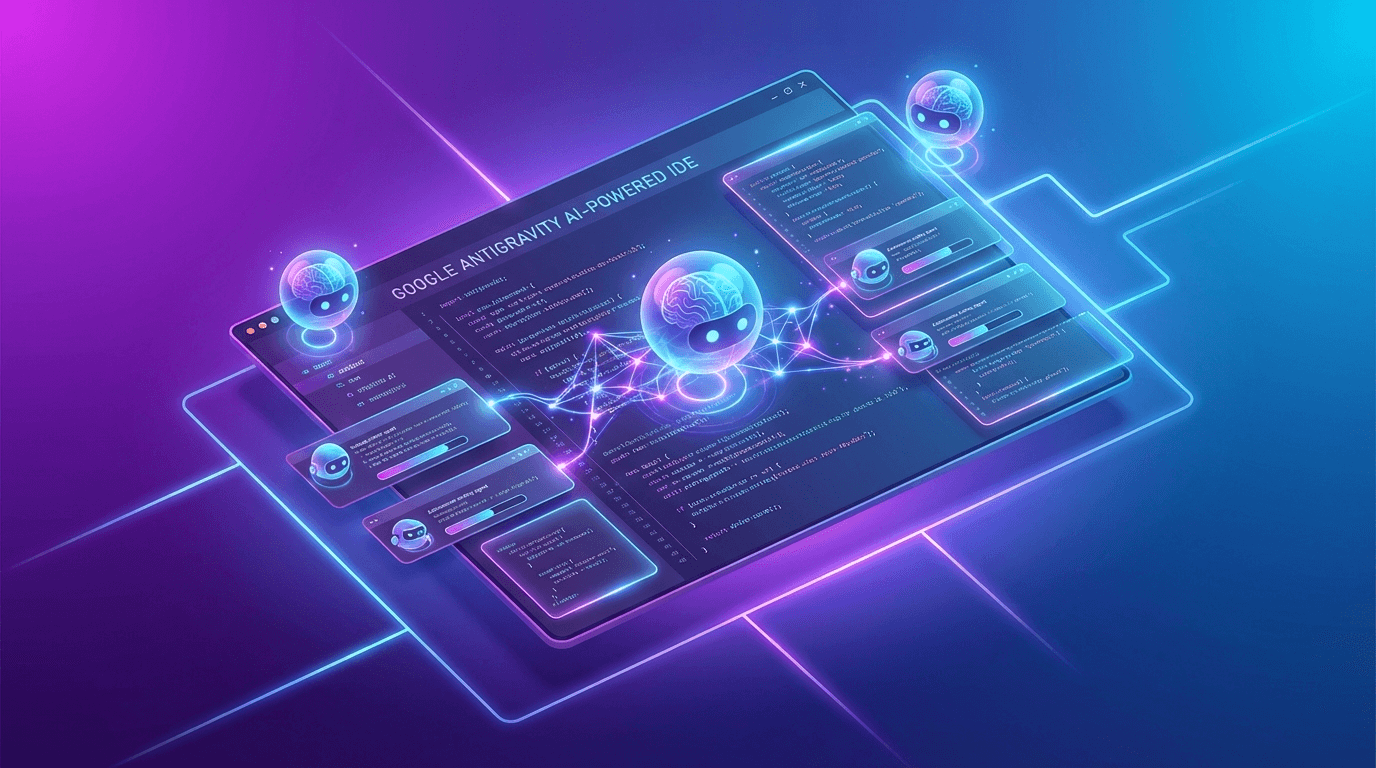
Google's Antigravity IDE, built on a VS Code fork and powered by Gemini 3, introduces an agent-first paradigm where AI autonomously plans, executes, and verifies complex coding tasks.
A New Paradigm: The Developer as Architect, Not Typist
Google Antigravity is not another AI code-completion tool. Announced on November 18, 2025, alongside the release of Gemini 3, and now receiving its February 2026 update with agent skills and enhanced customizability, Antigravity represents a fundamentally different approach to software development. Built on a Visual Studio Code fork, it shares DNA with competitors like Cursor and Windsurf, but its design philosophy diverges sharply: the AI agent is the primary developer, and the human is the architect.
The IDE is available for free during public preview on macOS, Windows, and Linux, downloadable at antigravity.google. Its February 2026 update introduces agent skills for enhanced customizability, tab model updates, new conversation settings, and higher rate limits for Google Workspace AI Ultra for Business subscribers.
Dual-Mode Architecture: Editor View and Manager Surface
Antigravity operates through two distinct interfaces. The Editor View provides the familiar synchronous coding experience: tab completions, inline commands, and direct code editing. This is the mode developers already know from VS Code, enhanced with Gemini-powered assistance.
The Manager Surface is where Antigravity differentiates itself. This dedicated interface lets developers spawn, orchestrate, and observe multiple AI agents working asynchronously across different workspaces. Each agent operates independently, planning its approach, writing code, running tests, and verifying results without requiring constant human oversight.
Within the Manager Surface, developers can switch between Plan Mode for complex tasks that benefit from a review stage and Fast Mode for quick edits that need immediate execution. The Agent Manager displays active tasks, reasoning steps, and status indicators in real time, giving developers visibility into what their AI agents are doing and why.
Artifacts: Tangible Proof of Agent Work
One of Antigravity's most distinctive features is its Artifacts system. Rather than simply producing code, agents generate tangible deliverables: task lists, implementation plans, screenshots, browser recordings, and code diffs. These artifacts serve as verifiable proof of the agent's logic and progress.
Developers can review artifacts at a glance, leave feedback directly on them, and the agent incorporates that input without stopping its execution flow. This creates a review-driven development workflow where the human validates and guides rather than writes every line. The Artifacts Panel stores these logs persistently, building a project history that both humans and agents can reference.
Self-Improving Knowledge Base
Antigravity agents are not stateless. They save context, code snippets, and learned patterns into a knowledge base that persists across sessions. Over time, agents become more accurate and context-aware for a specific project, learning coding patterns, architecture decisions, and team conventions.
This self-improving capability addresses one of the biggest frustrations with AI coding assistants: the need to repeatedly explain project context. As the knowledge base grows, the agents require less guidance and produce more project-appropriate code.
Model Ecosystem and Flexibility
Antigravity is powered primarily by Google's Gemini 3 model family: Gemini 3 Pro for complex reasoning, Gemini 3 Deep Think for difficult analytical tasks, and Gemini 3 Flash for fast responses. Gemini 3 Pro is available with generous rate limits during the preview period.
Critically, Antigravity is not locked into Google's models. It supports Anthropic's Claude Sonnet 4.5 and OpenAI's GPT-4o with full integration, allowing developers to choose the model best suited to their task. For browser-based testing and verification, the IDE uses Gemini 2.5 Computer Use, enabling agents to interact with running applications through a real browser.
The Windsurf Connection
Antigravity's technical DNA includes technology from Windsurf, the AI coding startup Google acquired for $2.4 billion. Windsurf had already proven that an AI-first approach to development could work; Antigravity takes that foundation and adds Google's model infrastructure, scale, and ecosystem integration. Google co-founder Sergey Brin reportedly returned to active development on the project, working in what has been described as "Founder Mode."
Production Reality Check
Despite its capabilities, Antigravity is explicitly in public preview. Independent assessments highlight a gap between prototyping and production readiness. The IDE lacks built-in deployment pipelines, automated security hardening, and database scalability review. Manual setup is still required for authentication and user management.
These limitations are expected for an early-access tool, but they matter for teams evaluating Antigravity for production workloads. The IDE dramatically accelerates prototyping and feature development, but the path from a working Antigravity prototype to a production-ready application still requires traditional engineering discipline.
Competitive Positioning
Antigravity enters a crowded market. GitHub Copilot, Cursor, and the original Windsurf all compete for developer attention. What sets Antigravity apart is the combination of free pricing during preview, Google's model ecosystem, multi-agent parallelism, and the deep integration potential with Google Cloud, Workspace, and Android Studio.
The free pricing model is particularly aggressive. Cursor charges $20 per month for its Pro tier, and Windsurf's premium features were similarly priced. By offering Antigravity for free during preview with generous Gemini 3 Pro rate limits, Google is positioning the IDE as a gateway to its broader developer platform.
Conclusion
Google Antigravity is not an incremental improvement to AI coding assistants. It is a bet that the entire development workflow should be restructured around autonomous AI agents, with humans shifting from typists to architects and reviewers. The February 2026 update with agent skills makes this vision more practical, and the free pricing removes the barrier to experimentation. For developers curious about agent-first development, Antigravity is the most accessible entry point available today. For production teams, it is a powerful prototyping tool that still requires traditional engineering judgment for deployment readiness.
Editor's Verdict
Google Antigravity: The Free Agent-First IDE That Treats AI as the Primary Developer earns a solid recommendation within the ai tools space.
The strongest case for paying attention is free during public preview with generous Gemini 3 Pro rate limits, making it the most accessible agent-first IDE, which raises the bar for what readers should now expect from peers in this space. Reinforcing that, multi-model support (Gemini 3, Claude, GPT-4o) gives developers flexibility to choose the best model per task adds practical value rather than just headline appeal. The broader signal worth registering is straightforward: antigravity treats AI agents as primary developers rather than assistants, representing a fundamental shift from code-completion to autonomous development. On the other side of the ledger, currently in public preview with reported errors and stability issues in complex workflows is a real constraint, not a marketing footnote, and it should factor into any serious decision. Layered on top of that, no built-in deployment pipeline, security hardening, or database scalability review for production use narrows the set of teams for whom this is an obvious yes.
For product teams, content creators, and knowledge workers looking to upgrade a specific workflow, this is a serious evaluation candidate, not just a curiosity to bookmark. For everyone else, the safer posture is to monitor coverage and revisit once the use cases that matter to your team are demonstrated in the wild.
Pros
- Free during public preview with generous Gemini 3 Pro rate limits, making it the most accessible agent-first IDE
- Multi-model support (Gemini 3, Claude, GPT-4o) gives developers flexibility to choose the best model per task
- Artifacts and review-driven workflow provide transparency and control over autonomous agent actions
- Cross-platform availability on macOS, Windows, and Linux with VS Code familiarity
- Deep integration potential with Google Cloud, Workspace, Android Studio, and the broader Google ecosystem
Cons
- Currently in public preview with reported errors and stability issues in complex workflows
- No built-in deployment pipeline, security hardening, or database scalability review for production use
- Post-preview pricing model has not been announced, creating uncertainty for teams considering adoption
- Requires significant system resources for local inference and multi-agent operation
References
Comments0
Key Features
Google Antigravity is a free, agent-first IDE built on a VS Code fork, powered by Gemini 3 Pro, Deep Think, and Flash models. It features a dual-mode architecture with Editor View for synchronous coding and Manager Surface for asynchronous multi-agent orchestration. Agents generate Artifacts (task lists, screenshots, browser recordings) for verification. A self-improving knowledge base lets agents learn project patterns over time. Supports Claude Sonnet 4.5 and GPT-4o alongside Gemini models. Built on technology from the $2.4B Windsurf acquisition.
Key Insights
- Antigravity treats AI agents as primary developers rather than assistants, representing a fundamental shift from code-completion to autonomous development
- The Artifacts system provides tangible, reviewable proof of agent work including screenshots, browser recordings, and implementation plans
- Multi-agent parallelism allows multiple AI agents to work on different tasks simultaneously across separate workspaces
- The self-improving knowledge base means agents become more project-aware over time, reducing repetitive context-setting
- Free pricing during public preview undercuts Cursor ($20/month) and other paid AI coding tools significantly
- Built on technology from the $2.4 billion Windsurf acquisition, combining Windsurf's proven AI-first approach with Google's model infrastructure
- February 2026 update introduces agent skills for enhanced customizability and higher rate limits for Workspace AI Ultra subscribers
Was this review helpful?
Share
Related AI Reviews

Daydream Adds iOS 27 Photo Shopping and Siri Search
Fashion app Daydream uses Apple's iOS 27 tools to turn saved outfit photos into shoppable matches, plus Siri natural-language search.

Roland Melody Flip: Free AI Melody Plug-In With Sony CSL
Roland's free Melody Flip plug-in uses Sony CSL music analysis and 250+ Palettes to help musicians generate MIDI melody, chord, bass, and drum ideas.

Microsoft's MAI-Transcribe-2: Cheap, Fast Speech-to-Text
Microsoft's MAI-Transcribe-2 tops the FLEURS benchmark across 60 languages and costs $0.10 per audio hour, undercutting OpenAI, Google and ElevenLabs.

Testers Praise Instinct AI Agent but Flag Privacy Risks
TechCrunch: testers praise Instinct AI agent for autonomous task skill but flag its data-license terms, unapproved actions, and phishing exposure.