
Galileo Launches Agent Control: Open-Source Governance for Enterprise AI Agents
Galileo releases Agent Control under Apache 2.0, an open-source control plane that lets enterprises write AI agent policies once and enforce them across CrewAI, Glean, and Cisco integrations.
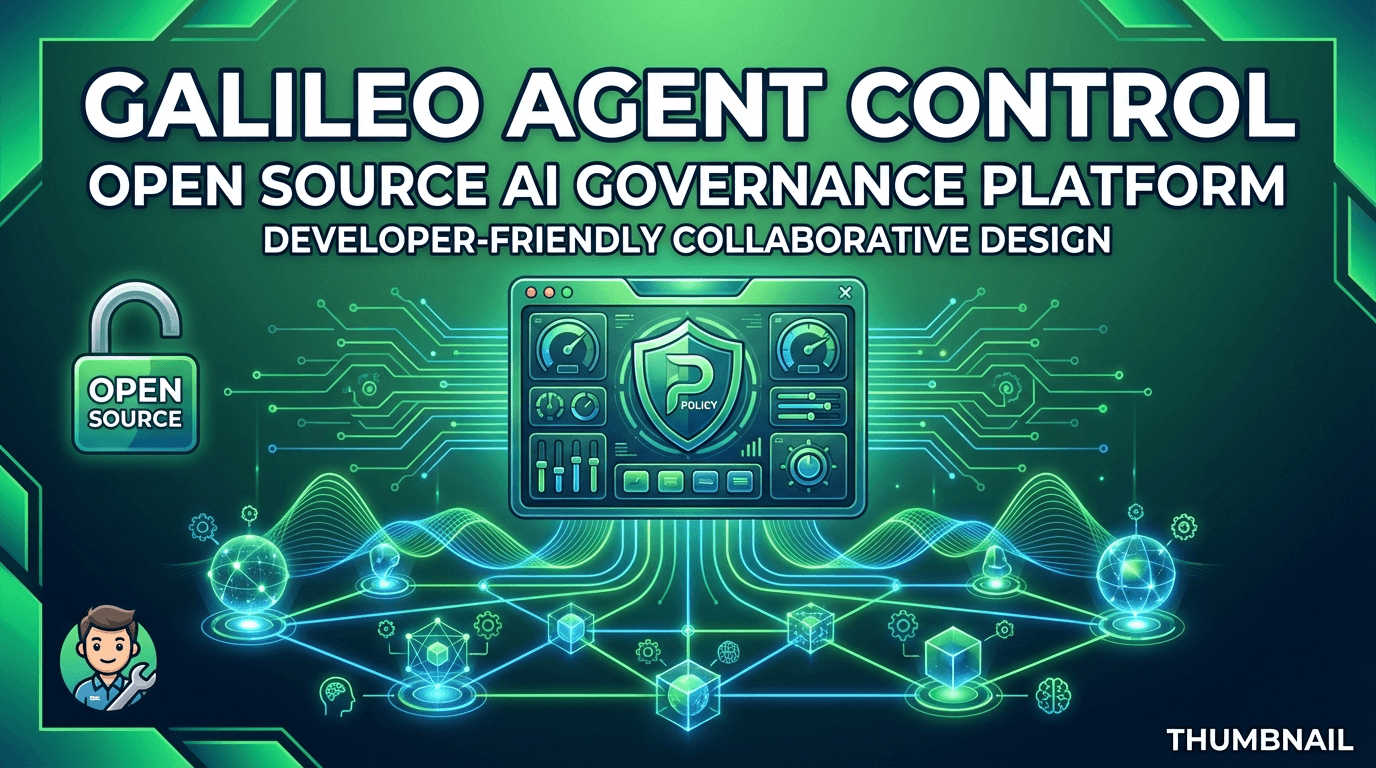
Galileo releases Agent Control under Apache 2.0, an open-source control plane that lets enterprises write AI agent policies once and enforce them across CrewAI, Glean, and Cisco integrations.
Key Takeaways
On March 11, 2026, Galileo released Agent Control, an open-source control plane that enables enterprises to define and enforce behavioral policies across all their AI agents from a single location. Released under the Apache License 2.0, Agent Control is vendor-neutral and designed to eliminate the fragmented approach most organizations currently take to AI agent governance.
The launch includes initial integrations with Strands Agents, CrewAI, Glean, and Cisco AI Defense, establishing Agent Control as a cross-platform governance layer rather than a tool tied to any single agent framework.
Feature Overview
1. Centralized Policy Management
Agent Control's core capability is write-once, deploy-everywhere policy management. Organizations can define behavioral rules, safety constraints, and compliance requirements in a single location and apply them consistently across all their AI agents regardless of the underlying framework.
This addresses a real pain point for enterprises that deploy multiple agent frameworks across different teams. Without centralized governance, each team independently implements safety checks, leading to inconsistent enforcement and gaps that create risk.
2. Runtime Policy Updates Without Downtime
One of Agent Control's most practical features is the ability to update policies at runtime without taking agents offline. When a new vulnerability is discovered or a compliance requirement changes, teams can push updated policies immediately without interrupting production agents.
This is critical for enterprise environments where agent downtime directly impacts business operations. Traditional approaches require redeploying agents with new configurations, which can take hours or days depending on the deployment pipeline.
3. Comprehensive Security Use Cases
Agent Control addresses multiple security and governance scenarios:
| Use Case | Description |
|---|---|
| Hallucination Prevention | Detect and block LLM-generated false information before it reaches users |
| Data Leak Prevention | Block PII exposure and sensitive data leakage from agent responses |
| Cost Optimization | Steer agents toward cost-efficient LLM usage through policy-based routing |
| Tool Error Handling | Manage failures when agents interact with external tools and APIs |
| Brand Consistency | Enforce tone, messaging, and brand guidelines across all agent interactions |
| Human Approval Gates | Require human sign-off on sensitive transactions before agent execution |
4. Vendor-Neutral Architecture
Agent Control supports guardrail evaluators from any vendor alongside custom enterprise evaluators. This vendor-neutral approach means organizations are not locked into a specific AI provider's safety tooling. Teams can mix evaluators from different sources and build custom rules specific to their industry or regulatory requirements.
The Apache 2.0 license ensures that enterprises can modify, extend, and deploy Agent Control without licensing restrictions.
5. Initial Integrations
The launch partners represent a cross-section of the AI agent ecosystem:
- Strands Agents: AWS-backed open-source agent framework
- CrewAI: Popular multi-agent orchestration platform
- Glean: Enterprise AI search and knowledge management
- Cisco AI Defense: Enterprise security infrastructure
These integrations demonstrate that Agent Control can operate across different agent architectures, from developer-focused frameworks to enterprise security platforms.
Usability Analysis
For enterprise AI teams, Agent Control fills a genuine gap. Most organizations deploying AI agents today rely on ad-hoc safety measures, custom wrappers around LLM calls, or framework-specific guardrails that do not extend across the organization. Agent Control provides a standardized approach that scales with the number of agents and frameworks in use.
The open-source model lowers the barrier to adoption. Teams can evaluate and deploy Agent Control without procurement cycles or vendor commitments. The Apache 2.0 license also means enterprises can fork and customize the project for their specific needs.
However, the project is new, and the documentation, SDK, and community are still in early stages. Organizations considering adoption should expect to invest time in integration and configuration. The quality and responsiveness of community support will be a key factor in long-term adoption.
Competitive Context
The AI agent governance space is emerging rapidly. OpenAI's acquisition of Promptfoo (announced the same week) takes a different approach by integrating security testing into a proprietary platform. Anthropic's constitutional AI framework provides built-in safety but is model-specific. Google's Vertex AI has its own safety controls but they are tightly coupled to the Google Cloud ecosystem.
Galileo's approach is distinctive because it is both open-source and framework-agnostic. This positions Agent Control as the neutral governance layer that can sit above any combination of agent frameworks and LLM providers.
Pros
- Apache 2.0 license ensures full open-source freedom with no vendor lock-in or licensing restrictions
- Write-once policies across all agent frameworks eliminates inconsistent governance across teams
- Runtime policy updates without downtime enables rapid response to new threats or compliance changes
- Vendor-neutral evaluators allow mixing guardrails from any provider alongside custom enterprise rules
- Strong initial integrations with CrewAI, Glean, Strands Agents, and Cisco validate cross-platform applicability
Limitations
- Early-stage project with limited production track record and nascent community support
- Integration depth with each partner framework may vary, with some requiring more configuration than others
- Documentation and SDK are still maturing, which may increase initial adoption friction
- Performance overhead of centralized policy enforcement on latency-sensitive agent workflows is not yet benchmarked publicly
Outlook
Agent Control arrives at a critical moment for enterprise AI governance. As organizations move from deploying single AI agents to running fleets of autonomous agents across departments, the need for centralized governance will only increase. Regulatory pressure from frameworks such as the EU AI Act and emerging U.S. state-level AI regulations makes standardized governance tooling a near-term necessity, not a future consideration.
Galileo's open-source approach could make Agent Control the de facto standard for AI agent governance if the community grows quickly and integrations deepen. The Apache 2.0 license removes adoption barriers, and the vendor-neutral architecture avoids the platform lock-in that enterprises resist.
The risk is that frontier labs continue to build proprietary governance into their own platforms, making standalone governance tools less relevant. The counter-argument is that most enterprises use multiple LLM providers and agent frameworks, making a vendor-neutral layer essential.
Conclusion
Galileo's Agent Control is a well-timed open-source project that addresses the growing challenge of governing AI agents at enterprise scale. The write-once policy model, runtime updates without downtime, and vendor-neutral architecture solve real problems that enterprise AI teams face today. While the project is early-stage and the community needs to grow, the Apache 2.0 license and strong initial integrations with CrewAI, Glean, and Cisco provide a solid foundation. For enterprises deploying multiple AI agents across different frameworks, Agent Control is worth evaluating as a centralized governance layer.
Editor's Verdict
Galileo Launches Agent Control: Open-Source Governance for Enterprise AI Agents earns a solid recommendation within the open source space.
The strongest case for paying attention is apache 2.0 license ensures full open-source freedom with no vendor lock-in, which raises the bar for what readers should now expect from peers in this space. Reinforcing that, write-once policies across all agent frameworks eliminates inconsistent governance adds practical value rather than just headline appeal. The broader signal worth registering is straightforward: enterprise AI agent governance is shifting from ad-hoc safety measures to centralized policy management. On the other side of the ledger, early-stage project with limited production track record and nascent community is a real constraint, not a marketing footnote, and it should factor into any serious decision. Layered on top of that, documentation and SDK are still maturing, increasing initial adoption friction narrows the set of teams for whom this is an obvious yes.
For developers building locally, infrastructure engineers, and anyone preferring transparent, modifiable software, this is a serious evaluation candidate, not just a curiosity to bookmark. For everyone else, the safer posture is to monitor coverage and revisit once the use cases that matter to your team are demonstrated in the wild.
Pros
- Apache 2.0 license ensures full open-source freedom with no vendor lock-in
- Write-once policies across all agent frameworks eliminates inconsistent governance
- Runtime policy updates without downtime enables rapid threat response
- Vendor-neutral evaluators allow mixing guardrails from any provider
- Strong initial integrations with CrewAI, Glean, Strands Agents, and Cisco
Cons
- Early-stage project with limited production track record and nascent community
- Documentation and SDK are still maturing, increasing initial adoption friction
- Integration depth with each partner framework may vary
- Performance overhead of centralized policy enforcement not yet publicly benchmarked
References
Comments0
Key Features
1. Centralized write-once, deploy-everywhere policy management for AI agent governance across all frameworks 2. Runtime policy updates without downtime for rapid response to new threats or compliance changes 3. Vendor-neutral architecture supporting guardrail evaluators from any provider plus custom enterprise rules 4. Apache 2.0 open-source license with no vendor lock-in or licensing restrictions 5. Initial integrations with Strands Agents, CrewAI, Glean, and Cisco AI Defense
Key Insights
- Enterprise AI agent governance is shifting from ad-hoc safety measures to centralized policy management
- Agent Control's write-once policy model addresses the fragmentation problem of multi-framework agent deployments
- The Apache 2.0 license positions Agent Control as a neutral standard that competes with proprietary safety tools
- Runtime policy updates without downtime is a critical feature for production AI agent environments
- Initial integrations with CrewAI, Glean, and Cisco demonstrate cross-platform viability from day one
- The project launched the same week as OpenAI's Promptfoo acquisition, highlighting the convergence of AI safety and governance
- Regulatory pressure from the EU AI Act and U.S. state laws makes standardized AI governance tooling increasingly urgent
- Vendor-neutral governance layers may become essential as enterprises deploy agents across multiple LLM providers
Was this review helpful?
Share
Related AI Reviews

Nvidia PAIR Routes Local AI Across Your Idle Home PCs
Nvidia's free open-source PAIR sends local AI requests to idle home PCs, but it does not pool GPU memory or shard a model across machines.

MCP's New Roadmap Sets Five Priorities for Late 2026
MCP maintainers published a new roadmap on August 22, prioritizing agentic messaging, HTTP-native transport, and enterprise identity.

Qwen3.8-27B Review: Alibaba's Dense Vision-LLM
Alibaba released Qwen3.8-27B, a 27B open-weight dense vision-language model with 262K context under Apache 2.0.

AMD Instella-MoE-16B-A3B Review: Fully Open MoE on ROCm
AMD released Instella-MoE-16B-A3B, a fully open MoE trained end-to-end on Instinct GPUs — competitive benchmarks, research-only weight license.