
AI2 Releases Olmo Hybrid: 2x Data Efficiency by Merging Transformers with Linear RNNs
AI2's Olmo Hybrid 7B combines transformer attention with Gated DeltaNet linear recurrence, matching Olmo 3 accuracy on MMLU using 49% fewer tokens.
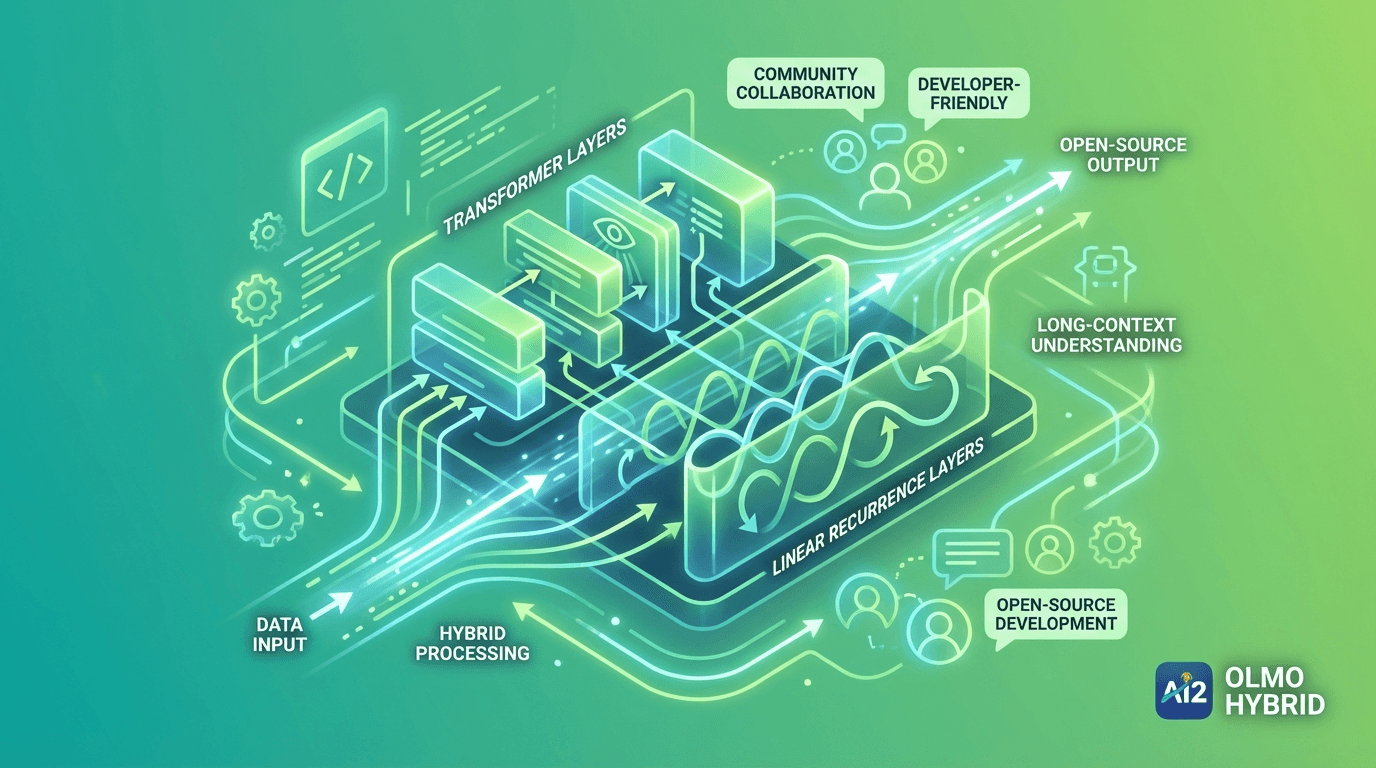
AI2's Olmo Hybrid 7B combines transformer attention with Gated DeltaNet linear recurrence, matching Olmo 3 accuracy on MMLU using 49% fewer tokens.
A New Architecture for Efficient Language Models
On March 5, 2026, the Allen Institute for AI (AI2) released Olmo Hybrid, a fully open 7-billion-parameter language model that combines traditional transformer attention layers with Gated DeltaNet linear recurrent layers. The result is a model that achieves the same accuracy as its predecessor Olmo 3 7B while requiring 49% fewer training tokens, effectively doubling data efficiency.
Olmo Hybrid arrives as the AI research community increasingly explores alternatives to pure transformer architectures. Projects like Samba, Nemotron-H, Qwen3-Next, and Kimi Linear have all experimented with hybrid designs, but AI2's contribution stands out for its fully open release and rigorous controlled comparison against Olmo 3.
Architecture: Gated DeltaNet Meets Transformers
Olmo Hybrid's architecture is built on the Olmo 3 7B foundation but replaces 75% of the attention layers with Gated DeltaNet heads. The model alternates three DeltaNet layers with one full multi-head attention layer, creating a repeating pattern that balances the long-range context capture of attention with the computational efficiency of linear recurrence.
Gated DeltaNet is a modern linear RNN design that remains parallelizable during training, avoiding the sequential bottleneck that historically made recurrent architectures difficult to scale. Each DeltaNet head includes standard queries, keys, and values plus a learned gate that maintains a linear recurrent state. This gate allows the model to selectively retain or forget information across sequence positions without the quadratic memory cost of full attention.
The architectural choice is significant because it addresses one of the fundamental limitations of transformers: their O(n-squared) memory and computation cost with respect to sequence length. By replacing three-quarters of attention layers with linear recurrence, Olmo Hybrid reduces this cost substantially while preserving the representational power of the remaining attention layers.
Performance Benchmarks
The headline result is MMLU parity with 49% fewer tokens, but the improvements extend well beyond a single benchmark. In a controlled comparison against Olmo 3 7B using the same training data mix, Olmo Hybrid shows consistent gains:
| Benchmark | Olmo Hybrid | Olmo 3 7B | Improvement |
|---|---|---|---|
| MedQA MC | 48.7% | 41.6% | +7.1 points |
| MBPP Code | 50.3% | 43.6% | +6.7 points |
| MMLU STEM | 70.8% | 66.3% | +4.5 points |
| MMLU Humanities | 73.9% | 69.2% | +4.7 points |
These are not marginal gains. A 7.1-point improvement on MedQA and 6.7-point improvement on MBPP represent meaningful advances in medical reasoning and code generation, respectively. The consistency of improvement across diverse benchmarks suggests that the hybrid architecture provides genuine representational advantages, not just efficiency gains on specific task types.
Training at Scale on Blackwell GPUs
Olmo Hybrid was trained on 3 trillion tokens using 512 NVIDIA GPUs, starting on H100s before migrating to the newer HGX B200 Blackwell systems. The training was completed in partnership with Lambda, using 64 HGX B200 nodes. The entire training run took just 6.19 days (December 25-31, 2025), with an active training uptime of 97%.
The infrastructure reliability metrics are noteworthy: median recovery time from hardware failures was 3 minutes 42 seconds, with automated GPU health checks that quarantine failed hardware and resume training with minimal disruption. These numbers reflect the increasing maturity of large-scale training infrastructure.
Training used Hybrid Sharded Data Parallelism (HSDP) with a global batch size of approximately 4 million tokens and a sequence length of 8,192 tokens. The model leveraged the improved data mix from Olmo 3 32B, applying the higher-quality training recipes developed for AI2's larger model to the 7B scale.
Fully Open Release
True to AI2's commitment to open science, Olmo Hybrid is released with everything needed for full reproducibility:
- Base model weights
- Supervised fine-tuning (SFT) stage weights
- Direct preference optimization (DPO) stage weights
- All intermediate training checkpoints
- Complete training code
This level of openness goes beyond what most open-source model releases provide. While many projects release final weights and sometimes training code, the inclusion of intermediate checkpoints enables researchers to study training dynamics and potentially resume training from any point in the process.
Why Hybrid Architectures Matter
The broader significance of Olmo Hybrid lies in what it reveals about the future of language model architectures. Pure transformers have dominated since 2017, but their quadratic scaling with sequence length creates fundamental constraints on context window size and inference cost.
Hybrid architectures like Olmo Hybrid suggest a middle path: retain some attention layers for tasks that genuinely benefit from global token-to-token interaction, while using linear recurrence for the majority of processing. The 2x data efficiency improvement indicates that this combination is not just computationally cheaper but actually learns more effectively from the same data.
As models scale to trillions of parameters and are deployed on edge devices, the efficiency advantages of hybrid architectures become increasingly critical. Training with 49% fewer tokens translates directly to lower costs, shorter training cycles, and reduced energy consumption.
Pros
- Achieves MMLU parity with Olmo 3 7B using 49% fewer tokens, representing a 2x improvement in data efficiency
- Consistent benchmark improvements across medical reasoning (+7.1 on MedQA), coding (+6.7 on MBPP), and STEM (+4.5 on MMLU STEM)
- Fully open release includes weights, checkpoints, and training code for complete reproducibility
- Gated DeltaNet remains parallelizable during training, avoiding the sequential bottleneck of traditional RNNs
- Trained in just 6.19 days on 512 GPUs with 97% active uptime, demonstrating practical scalability
Cons
- Currently limited to the 7B parameter scale, with no confirmed plans for larger hybrid variants
- The hybrid architecture adds implementation complexity compared to standard transformers
- Long-context performance beyond the 8K training sequence length has not been extensively benchmarked
- Ecosystem support for hybrid architectures lags behind pure transformers in frameworks and deployment tools
Outlook
Olmo Hybrid represents a significant data point in the ongoing debate about post-transformer architectures. The 2x data efficiency improvement is compelling enough to drive further research into hybrid designs, and AI2's fully open release ensures that the broader research community can build on these results.
The next milestones to watch are whether AI2 scales the hybrid architecture to larger parameter counts and whether the efficiency gains hold at the 32B and 70B scales. If they do, hybrid architectures could become the default choice for new model training runs, fundamentally changing the economics of foundation model development.
Conclusion
Olmo Hybrid is one of the most important open-source model releases of early 2026. By demonstrating that a hybrid transformer-linear RNN architecture can match pure transformer performance with half the training data, AI2 has provided strong evidence that the era of monolithic transformer architectures may be approaching its end. For researchers and practitioners, the fully open release makes Olmo Hybrid an essential reference point for understanding the next generation of efficient language model designs.
Editor's Verdict
AI2 Releases Olmo Hybrid: 2x Data Efficiency by Merging Transformers with Linear RNNs earns a solid recommendation within the open source space.
The strongest case for paying attention is 2x data efficiency: matches Olmo 3 7B accuracy on MMLU using 49% fewer training tokens, which raises the bar for what readers should now expect from peers in this space. Reinforcing that, consistent benchmark gains across medical reasoning, coding, STEM, and humanities tasks adds practical value rather than just headline appeal. The broader signal worth registering is straightforward: olmo Hybrid matches Olmo 3 7B on MMLU with 49% fewer training tokens, delivering 2x data efficiency through hybrid architecture. On the other side of the ledger, limited to 7B parameter scale with no confirmed plans for larger variants is a real constraint, not a marketing footnote, and it should factor into any serious decision. Layered on top of that, hybrid architecture adds implementation complexity compared to standard transformers narrows the set of teams for whom this is an obvious yes.
For developers building locally, infrastructure engineers, and anyone preferring transparent, modifiable software, this is a serious evaluation candidate, not just a curiosity to bookmark. For everyone else, the safer posture is to monitor coverage and revisit once the use cases that matter to your team are demonstrated in the wild.
Pros
- 2x data efficiency: matches Olmo 3 7B accuracy on MMLU using 49% fewer training tokens
- Consistent benchmark gains across medical reasoning, coding, STEM, and humanities tasks
- Fully open release with all weights, intermediate checkpoints, and complete training code
- Gated DeltaNet maintains parallelizable training, avoiding traditional RNN sequential bottlenecks
- Practical training scalability demonstrated in 6.19 days with 97% active uptime on 512 GPUs
Cons
- Limited to 7B parameter scale with no confirmed plans for larger variants
- Hybrid architecture adds implementation complexity compared to standard transformers
- Long-context performance beyond the 8K training sequence length remains unproven
- Ecosystem support for hybrid architectures lags behind pure transformers in tooling
References
Comments0
Key Features
AI2 released Olmo Hybrid on March 5, 2026, a 7B-parameter model that combines transformer attention with Gated DeltaNet linear recurrent layers. The architecture replaces 75% of attention layers with DeltaNet heads, alternating three DeltaNet layers with one full attention layer. Olmo Hybrid matches Olmo 3 7B accuracy on MMLU using 49% fewer tokens (2x data efficiency) and shows improvements of +7.1 points on MedQA and +6.7 points on MBPP code generation. Trained on 512 GPUs in 6.19 days on 3 trillion tokens, with a fully open release including all weights, checkpoints, and training code.
Key Insights
- Olmo Hybrid matches Olmo 3 7B on MMLU with 49% fewer training tokens, delivering 2x data efficiency through hybrid architecture
- 75% of transformer attention layers are replaced with Gated DeltaNet linear recurrent layers while maintaining parallelizable training
- MedQA medical reasoning improved by 7.1 points and MBPP coding improved by 6.7 points over the pure transformer baseline
- Training completed in 6.19 days on 512 NVIDIA GPUs (H100 to B200 migration) with 97% active uptime
- AI2 releases everything: base weights, SFT weights, DPO weights, intermediate checkpoints, and training code
- The hybrid architecture addresses transformers' quadratic O(n^2) scaling with linear recurrence for most processing layers
- Olmo Hybrid follows a growing trend of hybrid designs including Nemotron-H, Qwen3-Next, and Kimi Linear
- Training used the improved data mix from Olmo 3 32B applied at the 7B scale
Was this review helpful?
Share
Related AI Reviews

NVIDIA Open-Sources Run:ai GPU Orchestration Platform
NVIDIA released the full Run:ai platform as open source under its DSX AI Factory org, with four modules that can be adopted independently.
Nemotron 3 Diarization: NVIDIA's Open 100M Speaker Model
NVIDIA's open-weight 100M-param diarization model tracks up to 8 speakers live or offline, ranking #1 on VoiceArena's initial benchmark at 14.72% DER.

Nvidia PAIR Routes Local AI Across Your Idle Home PCs
Nvidia's free open-source PAIR sends local AI requests to idle home PCs, but it does not pool GPU memory or shard a model across machines.
MCP's New Roadmap Sets Five Priorities for Late 2026
MCP maintainers published a new roadmap on August 22, prioritizing agentic messaging, HTTP-native transport, and enterprise identity.