
Model Context Protocol Hits 97 Million Monthly Downloads: How Anthropic's Open Standard Won the AI Integration Layer
MCP reached 97 million monthly SDK downloads in March 2026, up from 2 million at launch 16 months ago, becoming the universal standard for AI agent integration.
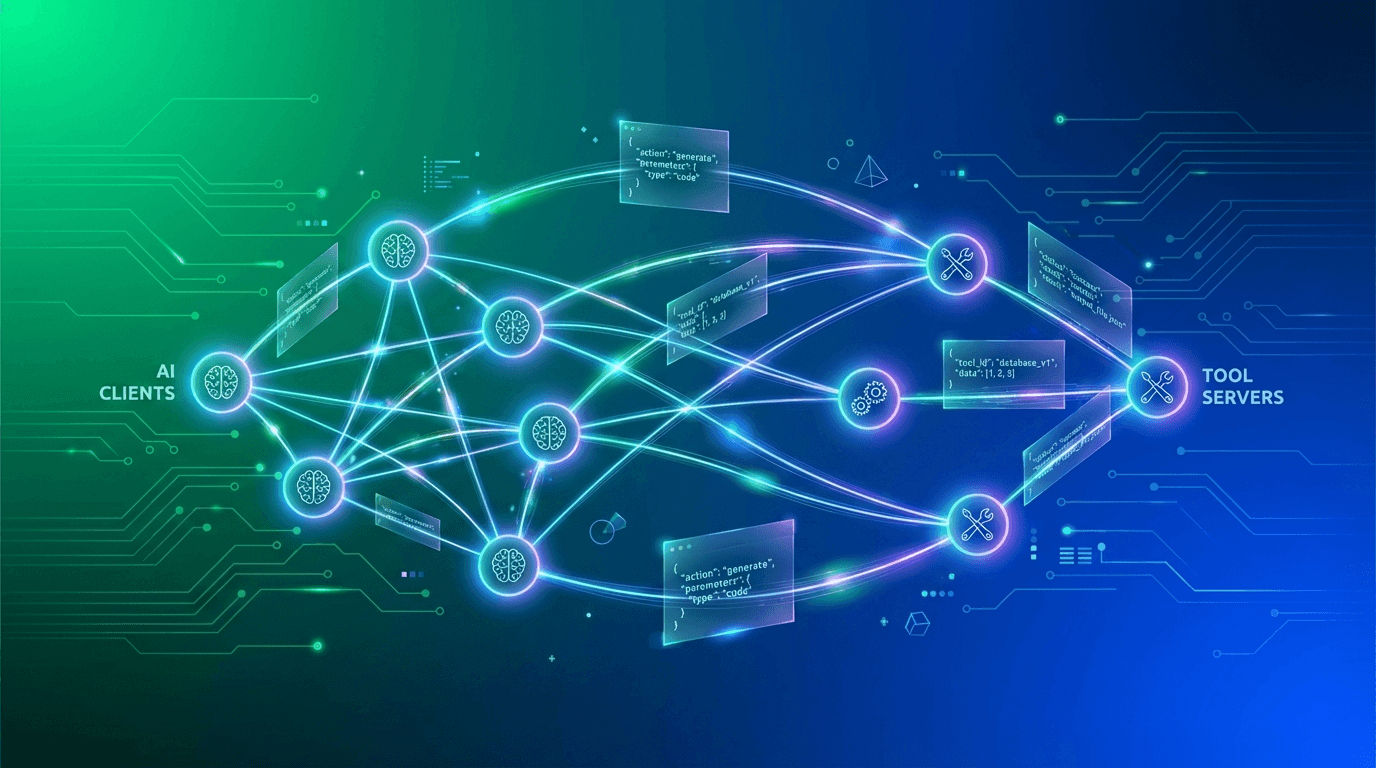
MCP reached 97 million monthly SDK downloads in March 2026, up from 2 million at launch 16 months ago, becoming the universal standard for AI agent integration.
From Internal Experiment to Industry Standard
In November 2024, Anthropic quietly released the Model Context Protocol as an open-source specification for connecting AI models to external tools and data sources. Sixteen months later, MCP has reached 97 million monthly SDK downloads, with native support in Claude, ChatGPT, Gemini, Microsoft Copilot, Cursor, and VS Code. An ecosystem of over 10,000 active public MCP servers covers everything from developer tools to Fortune 500 enterprise deployments.
This is one of the fastest infrastructure protocol adoptions in software history. The growth rate of 4,750% in 16 months mirrors the adoption curves of foundational standards like npm packages and REST APIs. MCP has effectively won the agent-to-tool integration layer, and its trajectory shows no signs of slowing.
What MCP Solves
Before MCP, every AI application that needed to interact with an external tool, database, or API required a custom integration. If you wanted Claude to read your Jira tickets, you built a Jira integration for Claude. If you wanted GPT to query your PostgreSQL database, you built a database connector for GPT. Every combination of AI model and external tool was a separate engineering effort.
MCP eliminates this N-by-M integration problem. It defines a standard client-server interface through which any AI model can access any external capability: API calls, database queries, file system operations, web search, code execution, and anything else a developer exposes through an MCP server. Build one MCP server for Jira, and every MCP-compatible AI client can use it.
The architecture reuses the message-flow ideas of the Language Server Protocol (LSP), the standard that powers IDE features like autocomplete and go-to-definition across editors. MCP communicates via JSON-RPC 2.0, making it lightweight, language-agnostic, and compatible with existing developer tooling.
Adoption Timeline
The pace of industry adoption has been remarkable.
| Date | Milestone | Monthly Downloads |
|---|---|---|
| November 2024 | Anthropic launches MCP | ~2 million |
| January 2025 | Claude Desktop integrates MCP natively | 8 million |
| March 2025 | OpenAI announces MCP support | 15 million |
| April 2025 | Google DeepMind adopts MCP | 22 million |
| July 2025 | Microsoft Copilot Studio integration | 45 million |
| November 2025 | AWS Bedrock adds MCP support | 68 million |
| December 2025 | Anthropic donates MCP to Agentic AI Foundation | 72 million |
| March 2026 | Full cross-provider adoption | 97 million |
The inflection point came in March 2025 when OpenAI CEO Sam Altman publicly endorsed MCP, stating that people love MCP and OpenAI was excited to add support across its products. When the protocol's creator's primary competitor adopted the standard, it sent a clear signal that MCP was the industry consensus rather than a proprietary play.
The Ecosystem: 10,000+ Servers and Growing
MCP's server ecosystem has expanded to cover virtually every category of business software and developer tooling.
| Category | Server Count |
|---|---|
| Developer Tools | 1,200+ |
| Business Applications | 950+ |
| Web and Search | 600+ |
| AI and Automation | 450+ |
| Databases | 400+ |
| Cloud Providers | 350+ |
| Productivity Tools | 300+ |
| Other Categories | 5,750+ |
Official SDKs are available in Python, TypeScript, C#, Java, Kotlin, Go, PHP, Perl, Ruby, Rust, and Swift, covering virtually every mainstream programming language. This breadth of language support lowers the barrier for developers to build MCP servers in their preferred stack.
The practical impact is significant. MCP has reduced estimated integration development time by 60-70% for multi-tool agent deployments, according to developer surveys. Instead of building custom connectors for each AI platform, developers build one MCP server and it works everywhere.
Governance: The Linux Foundation and AAIF
In December 2025, Anthropic donated MCP to the newly formed Agentic AI Foundation (AAIF), a directed fund under the Linux Foundation. The AAIF was co-founded by Anthropic, Block, and OpenAI, with support from Google, Microsoft, Amazon Web Services, Cloudflare, and Bloomberg.
This governance transition was strategically essential. An open protocol controlled by a single company, even one as well-intentioned as Anthropic, faces adoption friction from competitors. By placing MCP under the Linux Foundation's neutral stewardship, Anthropic removed the single biggest objection to industry-wide adoption. The co-founding role of OpenAI in the AAIF was particularly significant, as it transformed MCP from an Anthropic project into a genuine industry standard.
The AAIF's 2026 roadmap focuses on three priorities: enterprise authentication standards (OAuth 2.1, SAML/OIDC integration), multi-agent coordination capabilities, and a verified server registry with security audits. These priorities reflect MCP's evolution from a developer tool into enterprise infrastructure.
Security Considerations
MCP's rapid adoption has not been without challenges. Security researchers identified prompt injection and tool poisoning risks as early as April 2025. Because MCP servers can expose arbitrary capabilities to AI models, a compromised or malicious server could potentially manipulate model behavior.
The AAIF's verified server registry, planned for later in 2026, is designed to address this by providing security audits and trust scores for public MCP servers. In the meantime, enterprise deployments typically run MCP servers within their own infrastructure rather than relying on public servers.
Why MCP Won
Several factors explain MCP's dominance over alternative protocols.
First, timing. MCP launched just as the agentic AI wave was beginning, positioning it as the default choice for developers building tool-using AI agents.
Second, simplicity. The JSON-RPC 2.0 foundation and LSP-inspired architecture made MCP immediately familiar to developers who had worked with language servers or similar protocols.
Third, Anthropic's decision to open-source MCP from day one and then donate it to a neutral foundation removed competitive objections. OpenAI, Google, and Microsoft could adopt MCP without feeling they were endorsing a competitor's proprietary technology.
Fourth, network effects. Once the major AI platforms supported MCP, developers had strong incentives to build MCP servers rather than platform-specific integrations. Each new server made MCP more valuable, attracting more clients, which attracted more servers.
Conclusion
MCP's rise from 2 million to 97 million monthly downloads in 16 months represents one of the fastest infrastructure protocol adoptions in software history. With native support from every major AI platform, governance under the Linux Foundation, and an ecosystem of over 10,000 servers, MCP has established itself as the universal standard for connecting AI agents to the tools and data they need to be useful. For developers building AI-powered applications, MCP is no longer optional. It is the integration layer.
Editor's Verdict
Model Context Protocol Hits 97 Million Monthly Downloads: How Anthropic's Open Standard Won the AI Integration Layer stands out as one of the more compelling open source developments we've covered recently.
The strongest case for paying attention is universal adoption across all major AI platforms eliminates the need for platform-specific integrations, which raises the bar for what readers should now expect from peers in this space. Reinforcing that, open-source governance under the Linux Foundation ensures vendor-neutral evolution of the standard adds practical value rather than just headline appeal. The broader signal worth registering is straightforward: MCP's 4,750% growth in 16 months mirrors the adoption curves of foundational infrastructure protocols like npm and REST APIs. On the other side of the ledger, prompt injection and tool poisoning vulnerabilities remain active security concerns until the verified server registry launches is a real constraint, not a marketing footnote, and it should factor into any serious decision. Layered on top of that, the rapid growth has outpaced documentation and best practices for enterprise-grade deployments narrows the set of teams for whom this is an obvious yes.
For developers building locally, infrastructure engineers, and anyone preferring transparent, modifiable software, the answer here is to pilot now and plan for production use. For everyone else, the safer posture is to monitor coverage and revisit once the use cases that matter to your team are demonstrated in the wild.
Pros
- Universal adoption across all major AI platforms eliminates the need for platform-specific integrations
- Open-source governance under the Linux Foundation ensures vendor-neutral evolution of the standard
- SDKs in 11 programming languages lower the barrier for developers in any tech stack
- The 60-70% reduction in integration time delivers immediate productivity gains for AI application developers
- Network effects from 10,000+ servers create a self-reinforcing ecosystem that benefits all participants
Cons
- Prompt injection and tool poisoning vulnerabilities remain active security concerns until the verified server registry launches
- The rapid growth has outpaced documentation and best practices for enterprise-grade deployments
- The protocol's dominance creates a single point of failure if fundamental architectural limitations are discovered
- Enterprise authentication standards are still in development with OAuth 2.1 and SAML/OIDC support pending
References
Comments0
Key Features
1. MCP reached 97 million monthly SDK downloads in March 2026, up 4,750% from 2 million at launch in November 2024 2. Native support in Claude, ChatGPT, Gemini, Microsoft Copilot, Cursor, and VS Code across all major AI platforms 3. Over 10,000 active public MCP servers covering developer tools, business apps, databases, and cloud providers 4. Official SDKs available in 11 programming languages including Python, TypeScript, Java, Go, and Rust 5. Governance transferred to the Agentic AI Foundation under the Linux Foundation, co-founded by Anthropic, Block, and OpenAI
Key Insights
- MCP's 4,750% growth in 16 months mirrors the adoption curves of foundational infrastructure protocols like npm and REST APIs
- OpenAI's adoption of a competitor's protocol in March 2025 was the critical inflection point that signaled industry consensus
- Anthropic's decision to donate MCP to the Linux Foundation removed the single biggest barrier to universal adoption
- The 60-70% reduction in integration development time explains developer enthusiasm for MCP over custom connectors
- MCP's ecosystem of 10,000+ servers creates a self-reinforcing network effect that makes alternative protocols increasingly unviable
- The 2026 AAIF roadmap focusing on enterprise auth and security audits signals MCP's evolution from developer tool to enterprise infrastructure
- MCP's JSON-RPC 2.0 and LSP-inspired architecture was deliberately designed to feel familiar to existing developer tooling patterns
Was this review helpful?
Share
Related AI Reviews

Nemotron 3 Diarization: NVIDIA's Open 100M Speaker Model
NVIDIA's open-weight 100M-param diarization model tracks up to 8 speakers live or offline, ranking #1 on VoiceArena's initial benchmark at 14.72% DER.

Nvidia PAIR Routes Local AI Across Your Idle Home PCs
Nvidia's free open-source PAIR sends local AI requests to idle home PCs, but it does not pool GPU memory or shard a model across machines.

MCP's New Roadmap Sets Five Priorities for Late 2026
MCP maintainers published a new roadmap on August 22, prioritizing agentic messaging, HTTP-native transport, and enterprise identity.

Qwen3.8-27B Review: Alibaba's Dense Vision-LLM
Alibaba released Qwen3.8-27B, a 27B open-weight dense vision-language model with 262K context under Apache 2.0.