
Open Source
Explore the latest AI open-source projects from GitHub and HuggingFace.
Explore the latest AI open-source projects from GitHub and HuggingFace.
LangGraph is a low-level orchestration framework from LangChain for building, managing, and deploying long-running, stateful agents. With more than 36,000 GitHub stars and daily commits, it has become one of the most widely adopted foundations for production agent systems — trusted by companies such as Klarna, Replit, and Elastic to run agents that persist state, recover from failures, and keep a human in the loop. Unlike higher-level 'build an agent in five lines' toolkits, LangGraph deliberately exposes the underlying control flow so developers can model exactly how their agent thinks and acts.
LangGraph models an agent as a stateful graph: nodes are steps (LLM calls, tool executions, or arbitrary Python functions) and edges — including conditional ones — define how control moves between them based on the evolving state. This graph abstraction makes cycles, branching, and retries first-class rather than something bolted onto a linear chain, which is what makes reliable multi-step and multi-agent behavior tractable. Because state is explicit, the same graph can pause, resume, and be inspected at any point.
The framework's defining features center on reliability for agents that run for minutes, hours, or across sessions. Durable execution lets an agent persist through crashes and automatically resume from exactly where it left off. Human-in-the-loop support allows a workflow to be interrupted so a person can inspect and even modify the agent's state before it continues — essential for approvals and oversight. Comprehensive memory provides both short-term working memory for ongoing reasoning and long-term persistent memory across sessions.
LangGraph can be used entirely standalone, but it also anchors a broader stack. It pairs with Deep Agents (a higher-level package built on top of LangGraph for planning, subagents, and file-system use), integrates with LangChain's component and integration library, and connects to LangSmith for tracing, evaluation, and observability of complex agent runs. A dedicated deployment platform scales long-running stateful workflows, and a fully featured LangGraph.js port brings the same model to the JavaScript/TypeScript ecosystem. Installation is a single pip install -U langgraph.
LangGraph's low-level design is a double-edged sword: the explicit graph-and-state model carries a steeper learning curve than opinionated agent builders, and simple assistants may not need its machinery. Getting the full benefit of durable execution, memory, and observability nudges teams toward the surrounding LangChain/LangSmith ecosystem and, for managed deployment and tracing at scale, paid services — so evaluate how much of that stack you want to adopt versus running the open-source core on your own infrastructure.
LangGraph is aimed at engineering teams building production-grade, long-running agents that need reliability, state persistence, human oversight, and deep observability rather than a quick prototype. If your use case involves multi-agent coordination, complex branching workflows, or agents that must survive failures and run for extended periods, LangGraph provides the control and durability to do it — with the option to graduate to Deep Agents for higher-level ergonomics.
OpenClaw is an open-source, local-first AI gateway with 366K GitHub stars that routes AI responses through WhatsApp, Telegram, Slack, Discord, iMessage, Teams, and 15+ other platforms — zero cloud dependency.
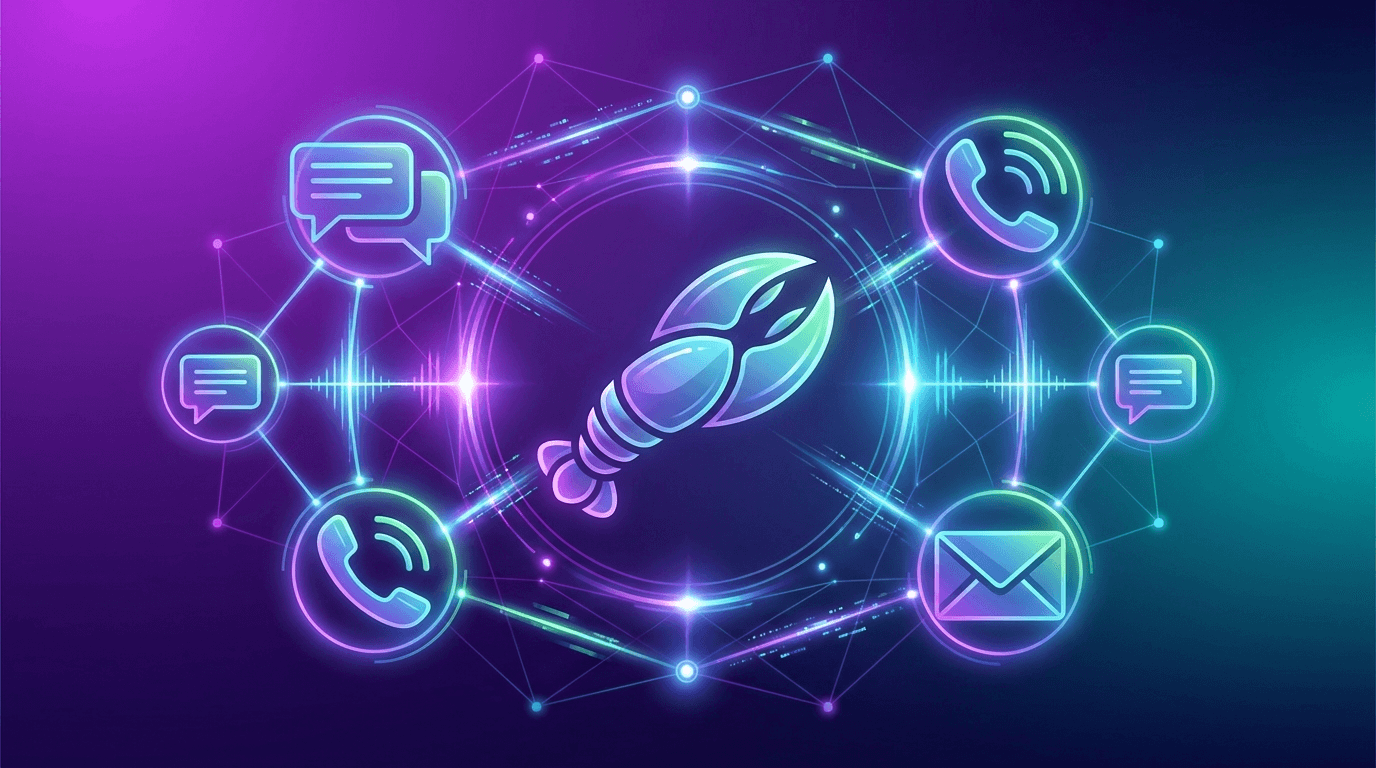
OpenClaw
Open-source personal AI assistant connecting to 13+ messaging platforms with local gateway architecture, voice support, and multi-agent routing.