
Open Source
Explore the latest AI open-source projects from GitHub and HuggingFace.
Explore the latest AI open-source projects from GitHub and HuggingFace.
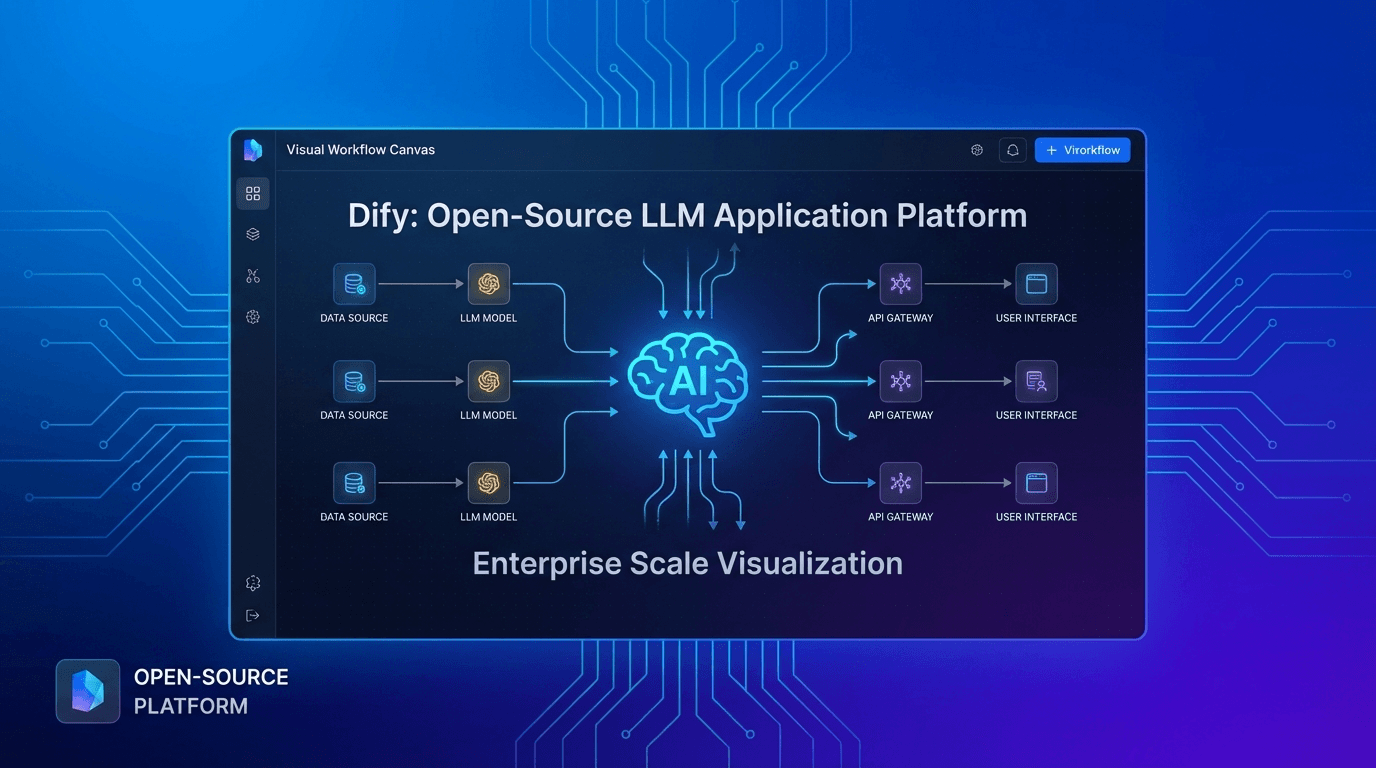
Dify is an open-source platform for building production-ready LLM applications, combining a visual workflow builder, RAG pipeline, agent capabilities, and comprehensive model management into a single unified interface. With over 130,000 GitHub stars, it has become one of the most popular open-source AI development platforms globally.
Dify takes a different approach from code-first AI frameworks by offering a visual canvas for constructing and testing AI workflows. This low-code approach dramatically reduces the time from prototype to production, making AI application development accessible to teams without deep machine learning expertise while still providing the flexibility that experienced developers need.
The platform supports hundreds of proprietary and open-source LLMs from dozens of inference providers, covering models from OpenAI, Anthropic, Google, Meta, Mistral, and any OpenAI API-compatible endpoint. This broad model support means teams can experiment with different models and switch providers without rebuilding their applications.
The workflow engine is Dify's centerpiece feature. Users drag and drop nodes on a visual canvas to create complex AI workflows that can include conditional branching, parallel execution, iterative loops, and human approval steps. Each node in the workflow can be independently tested and debugged, making it straightforward to identify and fix issues in complex pipelines.
Workflows can combine multiple AI models, external API calls, database queries, and custom code blocks. This composability enables sophisticated applications like multi-step document analysis, automated customer support systems, and content generation pipelines.
Dify includes a dedicated Prompt IDE that provides an intuitive interface for crafting and optimizing prompts. Developers can compare model performance side-by-side, test prompts against datasets, and add features like text-to-speech to chat-based applications. The IDE supports version control for prompts, enabling teams to track changes and roll back to previous versions.
The built-in RAG pipeline handles the complete document processing lifecycle from ingestion to retrieval. It supports text extraction from PDFs, PowerPoint presentations, Word documents, and other common formats. The chunking engine offers multiple strategies including semantic chunking, fixed-size chunking, and custom delimiters, allowing developers to optimize retrieval quality for their specific use cases.
Dify supports both function-calling and ReAct-based agent architectures with over 50 built-in tools including Google Search, DALL-E, Stable Diffusion, WolframAlpha, and web scraping utilities. Custom tools can be added through OpenAPI specifications, making it straightforward to integrate with existing enterprise APIs and services.
For production deployments, Dify provides comprehensive LLMOps features including monitoring dashboards, detailed logging, annotation tools, and continuous improvement workflows. Teams can track token usage, response latency, user satisfaction, and error rates across all their applications from a single interface.
Dify supports multiple deployment options including Docker Compose for quick setup, Kubernetes for enterprise scale, and a cloud-hosted version for teams that prefer managed infrastructure. The self-hosted option gives organizations full control over their data and model configurations.
Every Dify application automatically exposes a complete REST API, enabling frontend teams to integrate AI capabilities without building custom backend logic. This backend-as-a-service approach accelerates development and ensures consistent API patterns across applications.
With 130,000 GitHub stars, 20,200 forks, and nearly 9,000 commits, Dify represents one of the largest open-source AI projects by community engagement. The platform has helped build over 100,000 applications since its launch, demonstrating significant real-world adoption across startups and enterprises alike.
OpenClaw is an open-source, local-first AI gateway with 366K GitHub stars that routes AI responses through WhatsApp, Telegram, Slack, Discord, iMessage, Teams, and 15+ other platforms — zero cloud dependency.

OpenClaw
Open-source personal AI assistant connecting to 13+ messaging platforms with local gateway architecture, voice support, and multi-agent routing.