
Open Source
Explore the latest AI open-source projects from GitHub and HuggingFace.
Explore the latest AI open-source projects from GitHub and HuggingFace.
CAMEL — short for Communicative Agents for "Mind" Exploration of Large Language model society — is one of the earliest and most widely adopted open-source multi-agent frameworks. Maintained by a large community organized around camel-ai.org, the project frames multi-agent systems as a research instrument: by studying agents at scale, it aims to uncover the "scaling laws of agents." That research-first ambition, paired with a practical Python library, has earned it more than 17,000 GitHub stars.
CAMEL is organized around four principles. Evolvability lets multi-agent systems improve continuously by generating data and interacting with environments, driven by reinforcement learning with verifiable rewards or supervised learning. Scalability targets systems with up to millions of agents, with efficient coordination and communication. Statefulness gives agents persistent memory so they can carry out long, multi-step tasks. And "Code-as-Prompt" treats every line of code and comment as a prompt, pushing for clarity that both humans and agents can interpret.
The framework is general-purpose, but three use cases stand out. Data generation is a first-class citizen: CAMEL's role-playing agents can autonomously produce large synthetic conversation and instruction datasets, which is how the project ties back to its scaling-law research. Task automation lets developers compose agents, tools, and memory into pipelines that complete real work. And world simulation uses many interacting agents to model societies and emergent behavior. The same primitives — a ChatAgent at the core, plus tasks, prompts, and simulated environments — serve all three.
CAMEL is deliberately backend-agnostic. It supports a wide range of model providers and open-weight LLMs, a large catalog of tools and toolkits, retrieval and memory modules, and structured prompts, so teams are not locked into a single vendor. Getting started can be as small as instantiating a ChatAgent and giving it a tool, then scaling up to multi-agent role-playing societies. The repository is backed by extensive documentation, cookbooks covering basic concepts through advanced multi-agent applications, and active Discord, Reddit, and WeChat communities.
CAMEL's original role-playing paper predates much of the current agent ecosystem, and the framework has since been used as the foundation for a range of research projects and products. Because it was built by researchers, it tends to expose the underlying mechanics — message passing, memory, environment interaction — rather than hiding them behind a high-level wizard, which makes it a strong choice for teams who want to study or customize agent behavior rather than just ship a chatbot.
That research orientation is also the main trade-off. CAMEL gives you primitives and flexibility rather than an opinionated, batteries-included app, so simple single-agent use cases can feel heavier here than in more product-focused libraries, and there is a learning curve to its abstractions. Running large multi-agent or world-simulation experiments can consume significant LLM tokens and compute, and as a fast-moving community project the APIs evolve between releases. For researchers, dataset builders, and engineers who want a scalable, stateful, model-agnostic foundation for serious multi-agent work — and who value being close to the mechanics — CAMEL is a mature and well-supported choice. It is released under the Apache-2.0 license.
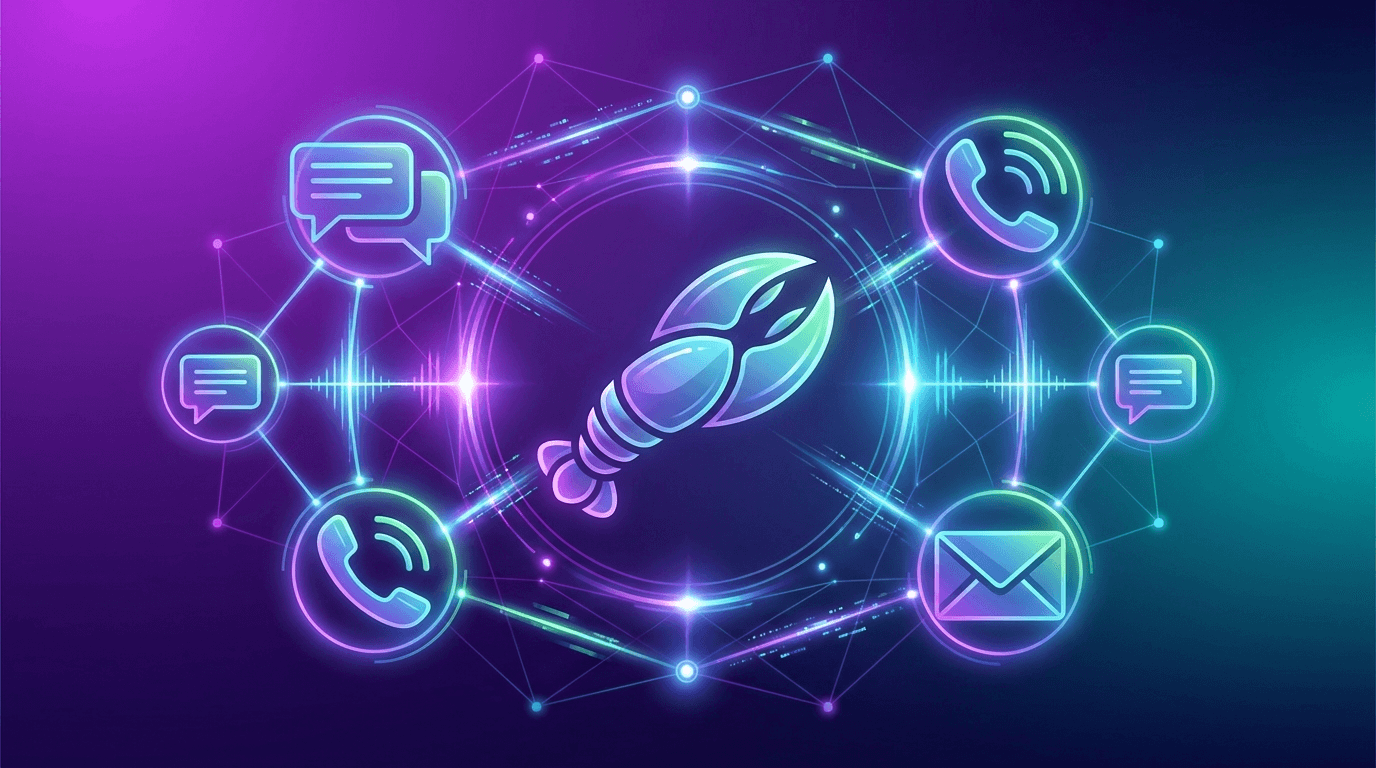
OpenClaw is an open-source, local-first AI gateway with 366K GitHub stars that routes AI responses through WhatsApp, Telegram, Slack, Discord, iMessage, Teams, and 15+ other platforms — zero cloud dependency.
OpenClaw
Open-source personal AI assistant connecting to 13+ messaging platforms with local gateway architecture, voice support, and multi-agent routing.