
Open Source
Explore the latest AI open-source projects from GitHub and HuggingFace.
Explore the latest AI open-source projects from GitHub and HuggingFace.
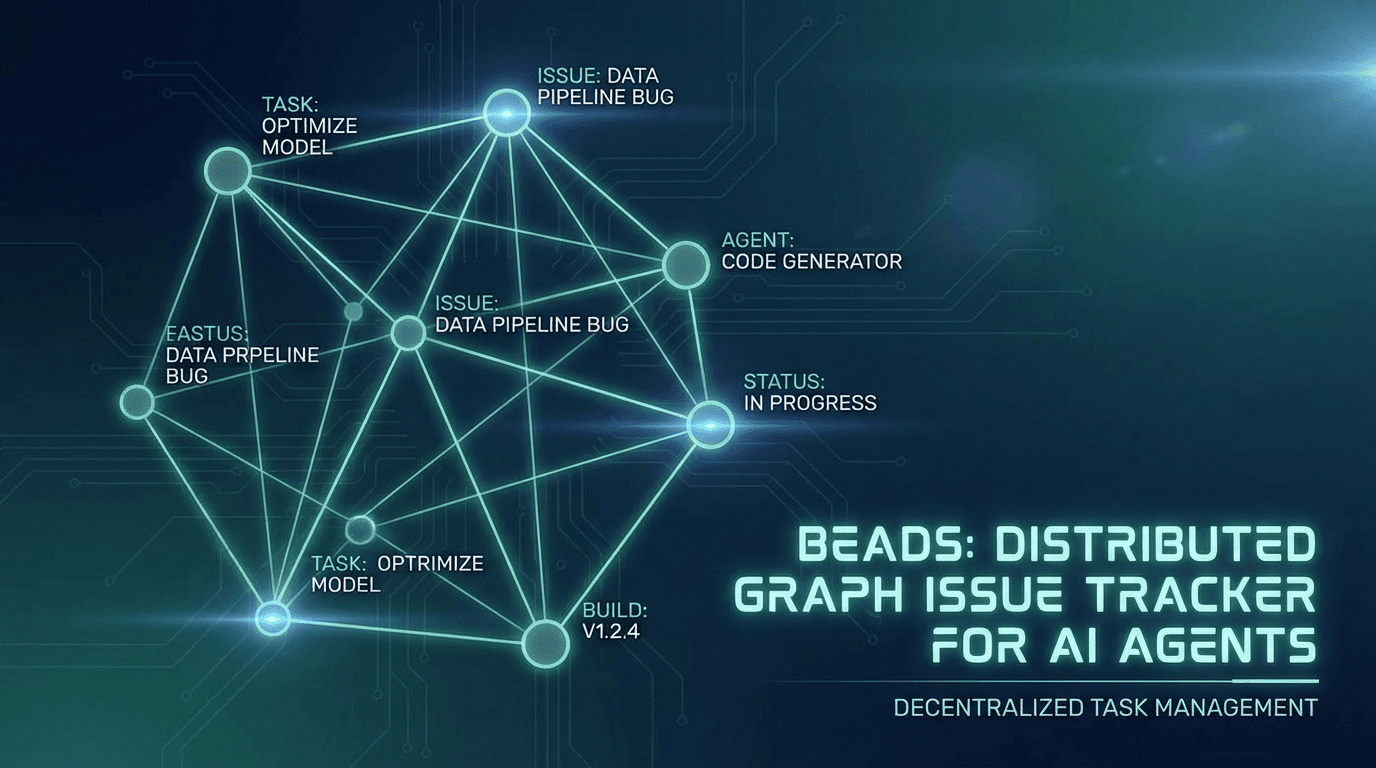
Steve Yegge's Beads has rapidly emerged as one of the most impactful open-source tools for AI-assisted software development in 2026, accumulating over 18,500 GitHub stars since its October 2025 launch. Beads replaces traditional markdown-based task lists with a distributed, git-backed graph issue tracker specifically designed for AI coding agents. The latest release, v0.59.0, shipped on March 6, 2026, with continued refinements to its dependency-aware task management system.
AI coding agents like Claude Code, Cursor, and Codex excel at individual tasks but struggle with long-horizon projects that span multiple files, dependencies, and sequential steps. The core problem is context window limitations: agents lose track of what has been done, what remains, and how tasks relate to each other. Beads solves this by providing a persistent, structured memory layer specifically for task tracking and project planning.
Beads uses Dolt, a version-controlled SQL database, as its backend. This provides cell-level merging, native branching, and built-in synchronization via Dolt remotes. Unlike flat markdown files, the database approach enables precise conflict resolution when multiple agents or developers work on the same project simultaneously.
The system outputs JSON natively, making it trivial for AI agents to parse and act on task data. Key commands include:
| Command | Purpose |
|---|---|
bd ready | List all unblocked tasks ready for execution |
bd show <id> | Display full audit trail for a task |
bd create | Create new tasks with dependencies |
bd close | Mark tasks complete with summary |
Beads uses hash-based identifiers in a bd-a1b2 format that prevent merge collisions entirely. Tasks are tracked hierarchically (bd-a3f8 -> bd-a3f8.1 -> bd-a3f8.1.1), enabling natural decomposition of complex projects into manageable subtasks.
One of Beads' most innovative features is semantic compaction: completed tasks are automatically summarized to preserve context window space. Instead of accumulating an ever-growing list of closed issues, the system condenses historical work into concise summaries that agents can reference without consuming excessive tokens.
Tasks support rich relationship types including relates_to, duplicates, supersedes, and replies_to. This graph structure enables agents to understand not just what needs to be done, but how tasks interconnect and influence each other.
Beads includes an ephemeral communication system with delegation capabilities. Agents can leave messages for other agents or human developers, creating a lightweight coordination layer that persists across sessions.
Beads supports multiple installation methods:
# npm (recommended)
npm install -g @beads/bd

# Homebrew
brew install beads

# Go install
go install github.com/steveyegge/beads@latest
After installation, initialize a project with bd init and add a single line to your AGENTS.md or CLAUDE.md file. Agents will automatically discover and use Beads for task management.
Beads addresses several critical pain points in agentic development:
bd ready command eliminates the need for agents to re-analyze project stateWith 283 contributors and 1,200 forks, Beads has attracted a substantial open-source community. The project is released under the MIT license and supports macOS, Linux, Windows, and FreeBSD. The primary codebase is written in Go (92.9%) with Python and Shell components.
Beads represents a fundamental shift in how AI coding agents manage complex, multi-step projects. By providing a persistent, version-controlled, graph-aware task tracking system, it eliminates one of the biggest barriers to effective autonomous software development. For teams using AI coding assistants on projects larger than single-file edits, Beads is quickly becoming an essential tool in the workflow.
OpenClaw is an open-source, local-first AI gateway with 366K GitHub stars that routes AI responses through WhatsApp, Telegram, Slack, Discord, iMessage, Teams, and 15+ other platforms — zero cloud dependency.
OpenClaw
Open-source personal AI assistant connecting to 13+ messaging platforms with local gateway architecture, voice support, and multi-agent routing.