
Sunday Robotics Hits $1.15B Unicorn Valuation With $165M Series B for Household Humanoid Robot Memo
Stanford-born Sunday raises $165M at $1.15B valuation to build Memo, a household humanoid robot trained via Skill Capture Glove technology. First units shipping by Thanksgiving 2026.
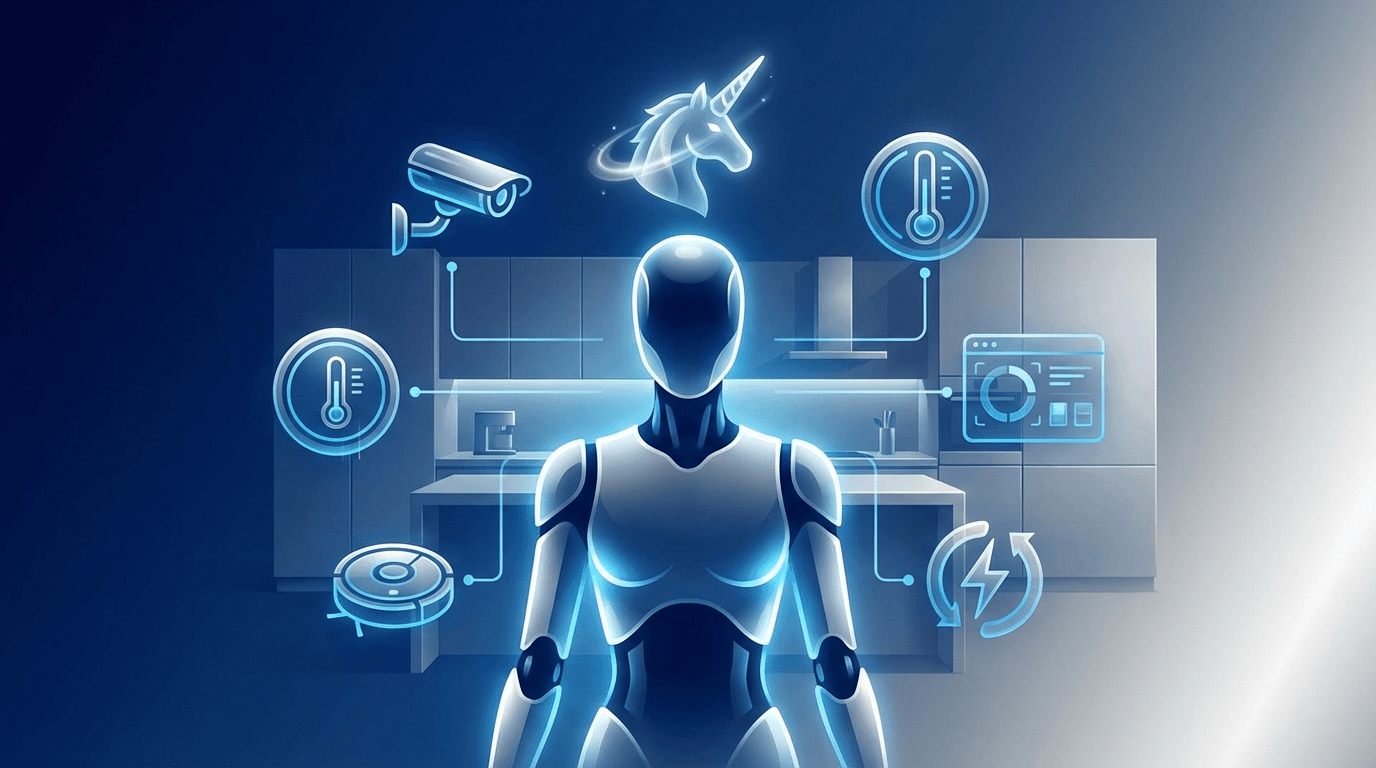
Stanford-born Sunday raises $165M at $1.15B valuation to build Memo, a household humanoid robot trained via Skill Capture Glove technology. First units shipping by Thanksgiving 2026.
Key Takeaways
On March 12, 2026, Sunday, a humanoid robotics startup founded by Stanford researchers Tony Zhao and Cheng Chi, announced a $165 million Series B round led by Coatue Management, reaching a $1.15 billion valuation and achieving unicorn status. The company plans to ship its first autonomous household robots, called Memo, to select households by Thanksgiving 2026. Sunday's approach centers on a proprietary Skill Capture Glove that lets humans teach robots household tasks by demonstration, bypassing the limitations of simulation-based training.
This funding round places Sunday at the forefront of the household robotics race, one of the most anticipated applications of AI in consumer technology.
Feature Overview
1. Skill Capture Glove: Learning by Demonstration
Sunday's core technological innovation is the Skill Capture Glove, a proprietary device that enables rapid data collection by recording human hand movements and task execution in real-world environments. The glove generates tens of millions of movement episodes, creating what the company describes as a competitive data advantage for model training.
This approach is fundamentally different from simulation-based robotics training, which the founders identified as too slow and inaccurate during their Stanford research. Instead of programming robots in virtual environments, Sunday captures the nuances of human movement directly, including the adaptive micro-adjustments that make tasks like folding laundry or clearing a table deceptively complex.
2. Memo: The Household Humanoid
Memo is Sunday's flagship autonomous home robot designed for everyday household tasks. Demonstrated capabilities include handling laundry, clearing tables, and general household organization. The humanoid form factor is designed to navigate human living spaces without requiring environmental modifications.
The company plans a phased rollout: beta deployments begin within months of the March announcement, with full-scale production targeted for Thanksgiving 2026. The waitlist has already attracted thousands of applications from potential early adopters.
3. Research Foundation: ALOHA and Diffusion Policy
Sunday's technology builds on the founders' academic research at Stanford. Tony Zhao and Cheng Chi conducted pioneering work on ALOHA (A Low-cost Open-source Hardware System for Bimanual Teleoperation), transformer adaptation for robotics, and diffusion policy, a technique that applies the mathematical framework behind image generation models to robot movement planning.
This research lineage gives Sunday a strong technical foundation that has attracted talent from Tesla, DeepMind, Waymo, Meta, OpenAI, and Apple. The team has grown to over 70 engineers and researchers.
4. Vertical Integration Strategy
Sunday controls the entire stack: hardware design, manufacturing, data collection, model training, and evaluation. This vertical integration reportedly enabled the company to achieve industry-leading capabilities within three months of its stealth launch. By owning every layer, Sunday can iterate rapidly across hardware and software simultaneously, an advantage that horizontally organized competitors cannot easily replicate.
5. Scaling Plans
The $165 million funding will be used to scale the engineering team by 3x, expand research by 4x, and increase data collection capacity by 5x before year-end 2026. This aggressive scaling plan reflects the company's belief that data volume is the primary bottleneck in household robotics, and that the Skill Capture Glove provides a scalable solution.
Investor Lineup
The breadth and quality of investors signals strong confidence in the household robotics market:
| Investor | Role |
|---|---|
| Coatue Management | Lead investor, Thomas Laffont joining board |
| Tiger Global | Existing investor |
| Benchmark | Existing investor |
| Bain Capital Ventures | New investor |
| Fidelity Management & Research | New investor |
| Conviction | Participating investor |
| Xtal Ventures | Participating investor |
Usability Analysis
The household robotics market has been a perennial promise that has consistently underdelivered. Previous attempts at consumer robots, from Jibo to Amazon Astro, have struggled with the gap between demonstrated capabilities and real-world household complexity. Sunday's approach addresses this gap directly by using human-demonstrated data rather than simulated environments, which should produce more natural and adaptive robot behavior.
However, the true test will be Memo's performance in uncontrolled home environments. Household tasks involve infinite variability in object placement, room layouts, material types, and interruptions. A robot that works flawlessly in a demo setting may struggle with the chaos of real family life.
The Thanksgiving 2026 shipping target is ambitious. Manufacturing humanoid robots at consumer-acceptable price points and quality levels is an enormous engineering and supply chain challenge that no company has yet solved at scale.
Competitive Context
Sunday enters a crowded field. Tesla's Optimus program, Figure AI, and 1X Technologies are all pursuing humanoid robotics, though most competitors focus on industrial and commercial applications first. Sunday's direct consumer focus is differentiated but higher-risk, as consumer expectations for reliability and safety are exceptionally demanding.
The Stanford pedigree and the specific focus on household tasks, combined with the Skill Capture Glove data advantage, give Sunday a technical angle that differs meaningfully from competitors relying on simulation and reinforcement learning.
Pros
- Skill Capture Glove provides a unique data collection advantage over simulation-based competitors, generating millions of real-world movement episodes
- Stanford research foundation (ALOHA, diffusion policy) gives the team deep technical credibility in robot learning
- Vertical integration across hardware, software, data, and manufacturing enables rapid iteration
- Strong investor lineup including Coatue, Tiger Global, Fidelity, and Benchmark at $1.15B valuation
- Team quality with 70+ engineers from Tesla, DeepMind, Waymo, Meta, OpenAI, and Apple
Limitations
- Thanksgiving 2026 shipping target is extremely ambitious for a humanoid robot startup that emerged from stealth in late 2025
- Consumer household environments are infinitely variable, and demo-quality performance may not translate to real-world reliability
- No disclosed pricing, making it unclear whether Memo will be affordable for mainstream consumers
- Manufacturing humanoid robots at scale remains an unsolved engineering and supply chain challenge industry-wide
Outlook
Sunday's rapid ascent to unicorn status reflects both the quality of the team's technical approach and the enormous market potential of household robotics. If the Skill Capture Glove's data advantage translates into meaningfully more capable household task execution, Sunday could define the category.
The next 12 months will be decisive. The company must transition from impressive demos to reliable, shippable products in diverse home environments. If Memo delivers on even a subset of household tasks with high reliability, it could establish Sunday as the leader in consumer humanoid robotics.
The broader trend of AI moving from digital-only applications into physical-world automation is one of the most significant technology transitions currently underway. Sunday's success or failure will be an important signal for the entire industry.
Conclusion
Sunday's $165 million Series B and $1.15 billion valuation mark one of the most significant funding events in consumer robotics. The Skill Capture Glove technology, Stanford research foundation, and vertical integration strategy distinguish Sunday from competitors. The Thanksgiving 2026 shipping target is ambitious, but if achieved, it would represent a genuine breakthrough in household automation. Robotics enthusiasts, early adopters, and investors watching the physical AI space should follow Sunday's progress closely.
Editor's Verdict
Sunday Robotics Hits $1.15B Unicorn Valuation With $165M Series B for Household Humanoid Robot Memo earns a solid recommendation within the it news space.
The strongest case for paying attention is skill Capture Glove provides a unique real-world data advantage over simulation-based competitors, which raises the bar for what readers should now expect from peers in this space. Reinforcing that, stanford research foundation (ALOHA, diffusion policy) gives deep technical credibility adds practical value rather than just headline appeal. The broader signal worth registering is straightforward: sunday's Skill Capture Glove bypasses simulation limitations by collecting real-world human movement data at massive scale. On the other side of the ledger, thanksgiving 2026 shipping target is extremely ambitious for a company that emerged from stealth only months ago is a real constraint, not a marketing footnote, and it should factor into any serious decision. Layered on top of that, consumer household variability may prevent demo-quality performance from translating to real-world reliability narrows the set of teams for whom this is an obvious yes.
For AI industry watchers, strategy teams, and decision-makers tracking platform shifts, this is a serious evaluation candidate, not just a curiosity to bookmark. For everyone else, the safer posture is to monitor coverage and revisit once the use cases that matter to your team are demonstrated in the wild.
Pros
- Skill Capture Glove provides a unique real-world data advantage over simulation-based competitors
- Stanford research foundation (ALOHA, diffusion policy) gives deep technical credibility
- Vertical integration enables rapid iteration across hardware and software simultaneously
- Top-tier investor lineup at $1.15B valuation demonstrates strong institutional confidence
- Elite engineering team from Tesla, DeepMind, Waymo, Meta, OpenAI, and Apple
Cons
- Thanksgiving 2026 shipping target is extremely ambitious for a company that emerged from stealth only months ago
- Consumer household variability may prevent demo-quality performance from translating to real-world reliability
- No disclosed pricing makes mainstream affordability uncertain
- Manufacturing humanoid robots at consumer scale remains an unsolved industry-wide challenge
References
Comments0
Key Features
1. Skill Capture Glove: proprietary device that records human hand movements to generate tens of millions of movement episodes for robot training 2. Memo humanoid robot designed for household tasks including laundry, table clearing, and home organization 3. Founded on Stanford ALOHA and diffusion policy research by Tony Zhao and Cheng Chi 4. Full vertical integration: hardware design, manufacturing, data collection, model training, and evaluation 5. Aggressive scaling plan: 3x engineering, 4x research, 5x data collection capacity by end of 2026
Key Insights
- Sunday's Skill Capture Glove bypasses simulation limitations by collecting real-world human movement data at massive scale
- The $1.15B unicorn valuation after emerging from stealth in late 2025 is one of the fastest in robotics history
- Vertical integration across the full stack gives Sunday iteration speed advantages over horizontally organized competitors
- The Stanford research foundation (ALOHA, diffusion policy) represents some of the most cited work in modern robot learning
- Consumer household focus differentiates Sunday from competitors primarily targeting industrial applications
- The team of 70+ from Tesla, DeepMind, Waymo, Meta, OpenAI, and Apple represents extraordinary talent density
- Thanksgiving 2026 shipping target would make Memo one of the first consumer humanoid robots to reach real households
- The broader trend of AI transitioning from digital to physical-world automation makes household robotics a category-defining opportunity
Was this review helpful?
Share
Related AI Reviews

Meta Pulls Commercial Terms Clause on Scraping, AI Training
Meta removed a Commercial Terms sentence experts read as letting it scrape publisher sites for AI training. Meta says crawlers are unchanged.
Microsoft Maia 300: 96-Accelerator Rack, 2027 Rollout
Microsoft's Maia 300 inference chip claims up to 7x Maia 200's rack throughput on TSMC N2P chiplets, with production rollout starting in 2027.

Nadella: Treat Frontier AI Models as Insider Risks
Nadella's X essay urges treating frontier models as insider risks: controls outside the model, audit evidence and an emergency brake.

Google Pauses OSS VRP Product-Bug Rewards Over AI Slop
Google stopped taking product-vulnerability reports in its OSS bug bounty on Oct 1 over invalid AI submissions; supply-chain rewards continue.