
Steerling-8B: The First LLM That Can Explain Every Word It Generates
Guide Labs releases Steerling-8B, an 8B-parameter open-source LLM where every generated token traces back to its training data, input context, and human-understandable concepts.
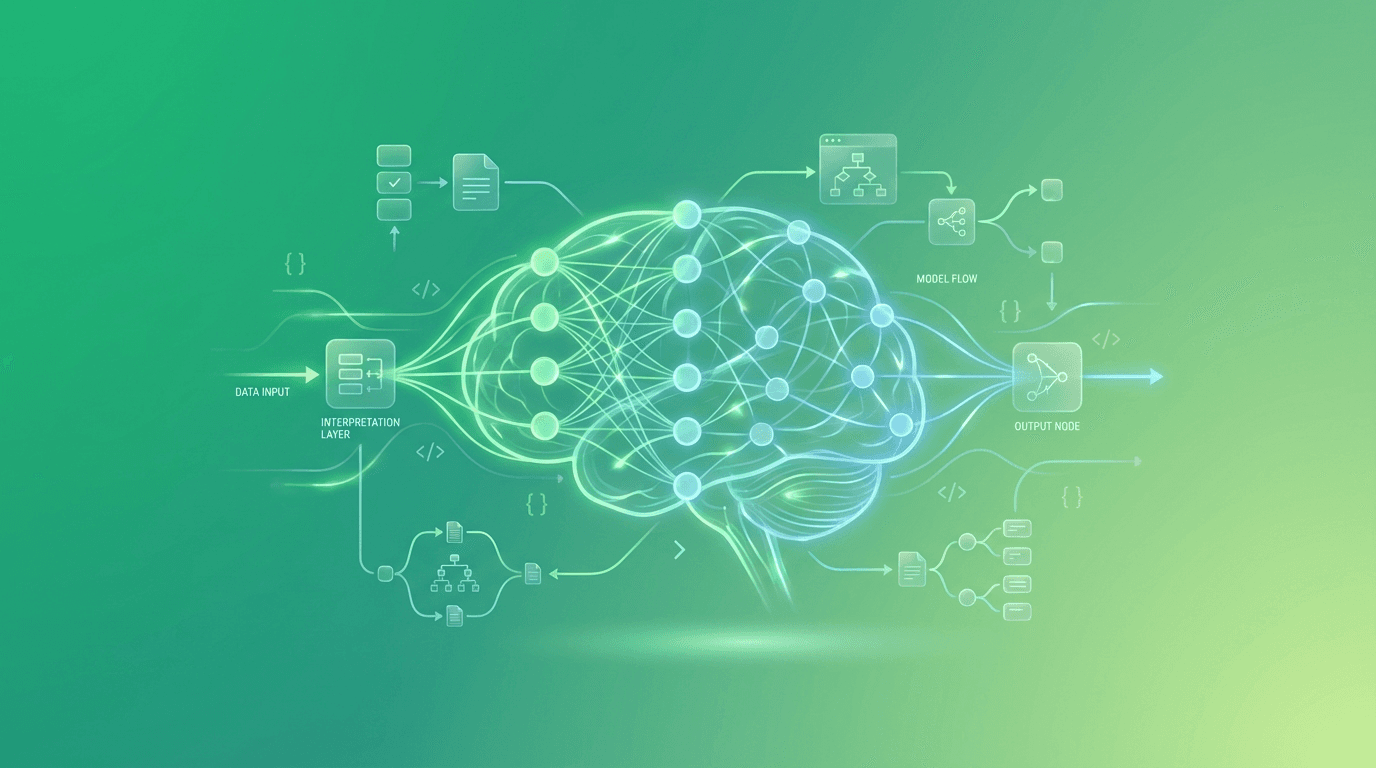
Guide Labs releases Steerling-8B, an 8B-parameter open-source LLM where every generated token traces back to its training data, input context, and human-understandable concepts.
The Black Box Problem Gets a Solution
Every major language model on the market today operates as what researchers call a black box: inputs go in, outputs come out, and the internal reasoning process remains effectively invisible. This opacity is not merely an academic concern. It creates liability in regulated industries, undermines trust in high-stakes applications, and makes it nearly impossible to audit AI decisions in contexts from loan approvals to medical recommendations.
On February 23, 2026, Guide Labs—a San Francisco startup backed by Y Combinator—released Steerling-8B, an 8-billion-parameter open-source language model built around a fundamentally different design philosophy. Unlike any production-scale LLM before it, Steerling-8B can trace any token it generates to three explicit sources: the input context, a library of human-understandable concepts, and the specific training data that shaped the output. The model weights are available on Hugging Face, the code is published on GitHub, and a PyPI package is available for developers to integrate the model.
How Steerling-8B Works
Three-Pathway Embedding Decomposition
The key architectural innovation in Steerling-8B is how it handles embeddings. Where standard transformer models compress all learned knowledge into opaque weight matrices, Steerling-8B decomposes each embedding into three distinct pathways:
Supervised known concepts: Approximately 33,000 concepts that are explicitly labeled and defined during training, covering identifiable topics, entities, and semantic categories.
Discovered concepts: Roughly 100,000 additional concepts that the model learns autonomously during training, without explicit human labeling. These represent patterns and associations the model identifies on its own.
Residual pathway: A small component that captures information that does not fit cleanly into either concept category.
Critically, every prediction made by Steerling-8B decomposes exactly into per-concept contributions. Developers can inspect which concepts drove a particular output, how much weight each concept contributed, and where in the training data those concepts originated.
Verification Through Numbers
Guide Labs reports that over 84% of token-level logit contributions flow through the concept module rather than the residual pathway. This figure matters because it demonstrates that the interpretability is genuine rather than cosmetic: the model is actually making predictions through its concept representations, not routing around them while providing post-hoc explanations.
The model can detect the presence of its supervised known concepts with 96.2% AUC accuracy on a held-out validation set, indicating that the concept representations are stable and meaningful.
Causal Diffusion Backbone
Steerling-8B is built on a causal discrete diffusion backbone rather than the standard next-token prediction architecture used by most contemporary LLMs. This architectural choice enables multi-token steering: developers can modify concept contributions at inference time to redirect or constrain the model's output without retraining. Blocking concepts related to copyrighted material, adjusting sentiment, or suppressing specific topics become runtime operations rather than fine-tuning projects.
Performance: Competitive Despite Fewer Resources
A natural concern with any novel architecture is whether interpretability comes at a performance cost. Guide Labs trained Steerling-8B on 1.35 trillion tokens, substantially fewer than the training budgets for comparable models in the 7-8 billion parameter range.
Despite this, the official benchmarks show Steerling-8B outperforming both LLaMA2-7B and DeepSeek-7B on overall average scores, and performing competitively with models trained on 2 to 10 times more compute. The company claims the architecture reaches approximately 90% of the capability of existing models in its parameter class.
These numbers come from Guide Labs and have not yet been independently verified by third-party evaluators. External benchmarking will be an important next step in establishing the model's standing against the broader field.
Practical Applications
Regulated Industries
The most compelling use case for Steerling-8B is in contexts where AI decisions must be explainable to regulators, auditors, or courts. Financial institutions making lending decisions, healthcare providers generating clinical recommendations, and legal technology platforms producing contract analysis all face regulatory requirements around explainability that black-box LLMs currently cannot satisfy.
With Steerling-8B, developers can demonstrate not just what the model output, but which training-data-derived concepts drove that output and how each concept contributed to the final result. In the specific example of loan evaluation, the model can be configured to explicitly ignore concepts related to race while weighing concepts related to financial history—and that configuration is verifiable at the level of individual predictions.
Content Moderation and Safety
For developers building consumer-facing applications, Steerling-8B's concept-level control offers a more precise alternative to system prompt-based guardrails. Suppressing a concept is a structural intervention that affects all outputs, whereas system prompt instructions can be circumvented through adversarial prompting. The model's concept blocking operates at the level of the computation itself.
Training Data Provenance
As copyright litigation around AI training data continues to escalate globally, the ability to trace model outputs to specific training data sources represents significant legal value. Steerling-8B provides a technical foundation for answering the question of whether a given output derives from copyrighted material.
Pros and Cons
Strengths
Steerling-8B is the first production-scale LLM with genuine, verifiable interpretability built into its architecture rather than layered on as an afterthought. The inference-time steering capability removes the need for costly fine-tuning when adjusting model behavior. Open weights and open code lower the barrier to adoption for research groups and organizations that cannot build interpretability tooling from scratch. Performance competitive with larger-resource models suggests the architecture does not impose severe capability costs.
Limitations
At 8 billion parameters, Steerling-8B sits in the mid-size range and will not match frontier-scale models on demanding benchmarks. The 90% capability figure, while encouraging, still represents a gap versus models like LLaMA 3 70B or Claude-class systems. Performance claims require independent verification. The model is currently inference-only, meaning developers cannot yet fine-tune the concept representations. Guide Labs is an early-stage startup with limited resources, raising questions about long-term support and roadmap execution.
Outlook
Steerling-8B is not a frontier model in the conventional sense—it will not set records on MMLU or outperform GPT-5.2-Codex on SWE-bench. What it represents is a proof of concept that interpretability and performance are not fundamentally at odds, and a usable tool for the specific set of applications where explainability is a hard requirement rather than a nice-to-have.
The open-source release is strategically significant. It invites the research community to study, verify, critique, and build on the architecture. If independent evaluators confirm Guide Labs' performance claims and the steering mechanisms prove robust to adversarial inputs, Steerling-8B could shift the conversation around what interpretability in production AI systems actually looks like.
For the broader LLM ecosystem, the model is also a useful reminder that architectural diversity matters. Nearly all competitive LLMs today converge on transformer-based next-token prediction. Steerling-8B's causal diffusion backbone with explicit concept routing represents a genuine departure from that consensus—one with practical advantages for a meaningful category of real-world applications.
Conclusion
Steerling-8B is best suited for developers and organizations working in regulated industries, high-stakes applications requiring auditability, or any context where being able to explain an AI's reasoning is as important as the quality of the output itself. For general-purpose users seeking maximum raw capability, larger frontier models remain the better choice. For those who need AI that can genuinely account for what it says, Steerling-8B is currently the most complete answer available.
Editor's Verdict
Steerling-8B: The First LLM That Can Explain Every Word It Generates earns a solid recommendation within the open source space.
The strongest case for paying attention is first production-scale LLM with genuine architectural interpretability—every token traces to training data, concepts, and input context, which raises the bar for what readers should now expect from peers in this space. Reinforcing that, inference-time concept blocking and amplification requires no fine-tuning, reducing operational costs for behavior adjustment adds practical value rather than just headline appeal. The broader signal worth registering is straightforward: three-pathway embedding decomposition is the core architectural innovation: 33K supervised concepts, 100K discovered concepts, and a residual component make every prediction traceable. On the other side of the ledger, at 8B parameters, cannot match frontier-scale models on demanding reasoning or coding benchmarks is a real constraint, not a marketing footnote, and it should factor into any serious decision. Layered on top of that, 90% capability estimate means a real performance gap remains versus the strongest models in the 7-8B class narrows the set of teams for whom this is an obvious yes.
For developers building locally, infrastructure engineers, and anyone preferring transparent, modifiable software, this is a serious evaluation candidate, not just a curiosity to bookmark. For everyone else, the safer posture is to monitor coverage and revisit once the use cases that matter to your team are demonstrated in the wild.
Pros
- First production-scale LLM with genuine architectural interpretability—every token traces to training data, concepts, and input context
- Inference-time concept blocking and amplification requires no fine-tuning, reducing operational costs for behavior adjustment
- Outperforms LLaMA2-7B and DeepSeek-7B despite using fewer training FLOPs, suggesting the architecture does not impose severe capability costs
- Open weights and MIT-licensed code make adoption accessible for research groups and regulated-industry developers
- 96.2% AUC concept detection provides quantitative evidence that interpretability claims are measurable and verifiable
Cons
- At 8B parameters, cannot match frontier-scale models on demanding reasoning or coding benchmarks
- 90% capability estimate means a real performance gap remains versus the strongest models in the 7-8B class
- Performance benchmarks come from Guide Labs and have not yet been independently verified by third-party evaluators
- Currently inference-only; developers cannot fine-tune the concept representations to adapt the model to domain-specific knowledge
References
Comments0
Key Features
Steerling-8B is an 8B-parameter open-source LLM released February 23, 2026, by Guide Labs. It uses a causal discrete diffusion backbone with three-pathway embedding decomposition: 33K supervised concepts, 100K discovered concepts, and a residual component. Over 84% of token-level predictions flow through the interpretable concept module. Developers can trace any generated token to its training data origin, block or amplify concepts at inference time without retraining, and achieve 96.2% AUC concept detection. The model outperforms LLaMA2-7B and DeepSeek-7B despite training on fewer resources.
Key Insights
- Three-pathway embedding decomposition is the core architectural innovation: 33K supervised concepts, 100K discovered concepts, and a residual component make every prediction traceable
- 84% of token-level logit contributions flow through the concept module, confirming interpretability is structural rather than cosmetic
- 96.2% AUC accuracy in detecting supervised known concepts validates the stability of the concept representations
- Inference-time concept steering eliminates the need for fine-tuning to modify model behavior, a significant operational advantage
- Training on 1.35 trillion tokens—less than comparable models—while matching or exceeding LLaMA2-7B and DeepSeek-7B performance suggests architectural efficiency
- Legal and regulatory applications are the primary value driver: loan decisions, medical recommendations, and content moderation benefit from provable concept-level auditability
- Training data provenance tracking provides a technical foundation for copyright compliance in regulated deployments
- Open weights on Hugging Face and code on GitHub lower adoption barriers for research institutions and regulated-industry developers
Was this review helpful?
Share
Related AI Reviews
Nemotron 3 Diarization: NVIDIA's Open 100M Speaker Model
NVIDIA's open-weight 100M-param diarization model tracks up to 8 speakers live or offline, ranking #1 on VoiceArena's initial benchmark at 14.72% DER.
Nvidia PAIR Routes Local AI Across Your Idle Home PCs
Nvidia's free open-source PAIR sends local AI requests to idle home PCs, but it does not pool GPU memory or shard a model across machines.

MCP's New Roadmap Sets Five Priorities for Late 2026
MCP maintainers published a new roadmap on August 22, prioritizing agentic messaging, HTTP-native transport, and enterprise identity.

Qwen3.8-27B Review: Alibaba's Dense Vision-LLM
Alibaba released Qwen3.8-27B, a 27B open-weight dense vision-language model with 262K context under Apache 2.0.