
Starcloud Raises $170M at $1.1B Valuation to Build AI Data Centers in Orbit
Starcloud became the fastest Y Combinator startup to reach unicorn status, raising $170M to build orbital data centers powered by space-based solar energy.
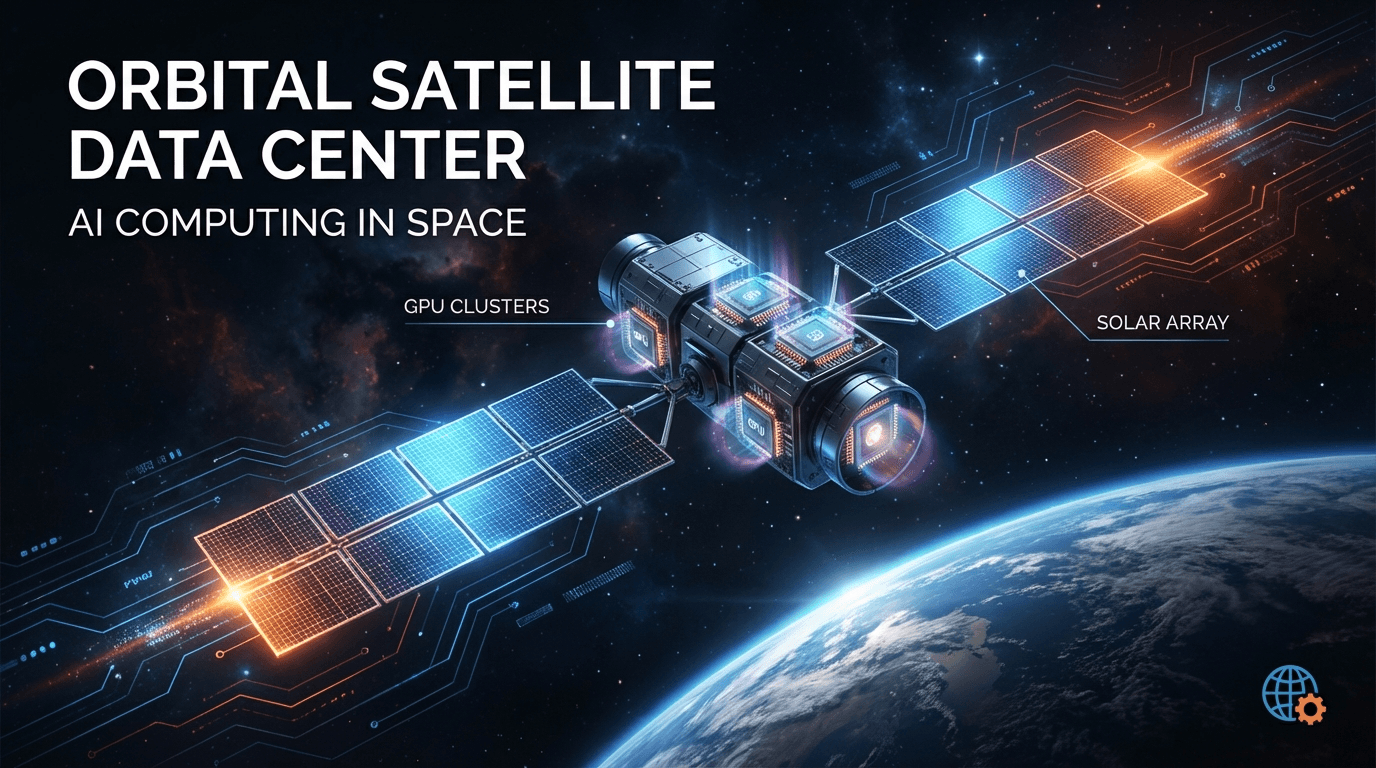
Starcloud became the fastest Y Combinator startup to reach unicorn status, raising $170M to build orbital data centers powered by space-based solar energy.
From Y Combinator to Unicorn in 17 Months
On March 30, 2026, Starcloud announced it had raised $170 million in a Series A round at a $1.1 billion valuation, becoming the fastest company in Y Combinator's history to reach unicorn status. Just 17 months after completing the accelerator program, the Redmond, Washington-based startup is building a case that the AI industry's insatiable demand for compute will eventually push data center economics beyond Earth.
The round was led by Benchmark and EQT Ventures, with participation from Macquarie Capital, NFX, Nebular, Y Combinator, Adjacent, 776 Ventures, Fuse Ventures, Manhattan West, and Monolith Power Systems. Former Boeing CEO Dennis Muilenburg participated as an angel investor. Benchmark's Chetan Puttagunta joined the board, noting that the firm believes it is "in the early innings of a decades-long buildout" of AI infrastructure.
The Thesis: Solar Power in Orbit Solves AI's Energy Problem
Starcloud's core premise is straightforward. AI training and inference workloads require enormous amounts of electricity. Terrestrial data centers are increasingly constrained by power grid limitations, permitting delays, cooling costs, and competition from other industries for the same energy resources. In orbit, near-continuous solar radiation provides effectively unlimited power without the grid bottlenecks that slow construction of new data centers on Earth.
The company is not proposing to replace terrestrial data centers entirely. Its pitch targets the marginal compute capacity that AI companies need but cannot get fast enough on Earth. With data center construction timelines stretching to 18-24 months and power purchase agreements becoming harder to secure, Starcloud positions orbital compute as a supplement that can scale independently of terrestrial infrastructure constraints.
Starcloud-1: Proof of Concept in Orbit
The company's credibility rests on a concrete achievement. In November 2025, Starcloud launched its first satellite, Starcloud-1, into orbit aboard a SpaceX Falcon 9 rocket's second stage. The satellite carried an Nvidia H100 GPU and was designed, built, and launched in 21 months using just $3 million in pre-seed funding.
Starcloud-1 accomplished several industry firsts. The company claims it was the first to train an AI model entirely in orbit and the first to run inference on Google's Gemini model from space. These demonstrations proved that GPU-class compute workloads can execute reliably in the orbital environment, addressing a fundamental question about the viability of space-based AI infrastructure.
The satellite also validated Starcloud's approach to the two hardest engineering challenges for space computing: power generation and thermal management. In orbit, solar panels receive roughly 40% more energy than ground-based panels due to the absence of atmospheric interference, and they operate nearly continuously on a sun-synchronous orbit with minimal eclipse periods.
Starcloud-2 and Beyond
The next satellite, Starcloud-2, is scheduled for launch later in 2026. It represents a significant step up from the proof-of-concept first satellite.
Starcloud-2 will feature the largest commercial radiator ever deployed in space, designed to dissipate the heat generated by multiple GPUs operating at full power. The satellite will deliver a 100x increase in power capacity compared to Starcloud-1, moving from single-GPU demonstrations to a multi-GPU platform capable of serving commercial workloads.
The satellite is expected to carry multiple GPUs including an Nvidia Blackwell chip and an AWS server blade. Planned commercial clients include Crusoe, AWS, Google Cloud, and Nvidia, suggesting that the major cloud providers are taking orbital compute seriously enough to allocate workloads for testing.
The $170 million in Series A funding will support development of Starcloud-3 satellites, establish manufacturing capacity for satellite production, and increase the company's headcount.
Technical and Economic Challenges
Starcloud's ambitions come with substantial technical hurdles that remain partially unresolved.
Latency is the most fundamental constraint. Data must travel from Earth to orbit and back, adding approximately 5-20 milliseconds of round-trip latency depending on orbital altitude. For real-time inference applications like chatbots or autonomous driving, this latency may be prohibitive. For batch training workloads, long-running simulations, and non-time-sensitive inference, the latency penalty is manageable.
Bandwidth is another challenge. Transmitting large datasets to orbit for training and returning results to Earth requires high-throughput communication links. Starcloud has not publicly detailed its communication architecture, though the partnership with Nvidia and cloud providers suggests access to existing satellite communication infrastructure.
Reliability in space remains a concern. GPU hardware in orbit faces radiation exposure, thermal cycling, and the impossibility of physical maintenance. If a chip fails in a terrestrial data center, a technician replaces it within hours. In orbit, a failed GPU is lost permanently. The economic model must account for hardware failure rates significantly higher than terrestrial baselines.
The economics also need to close. A single satellite with a handful of GPUs generates revenue measured in thousands of dollars per month at current inference pricing. Achieving the revenue scale that justifies a $1.1 billion valuation requires deploying hundreds or thousands of satellites, each carrying substantial GPU payloads. The path from one proof-of-concept satellite to a revenue-generating constellation involves manufacturing, launch, and operational challenges that Starcloud has not yet demonstrated at scale.
The Broader Space Computing Landscape
Starcloud is not alone in pursuing space-based compute. The concept has attracted increasing attention as terrestrial data center constraints become more acute.
Amazon's Project Kuiper, while primarily focused on internet connectivity, has explored compute capabilities. SpaceX's Starlink constellation provides the communication backbone that could support orbital data centers. And several defense-focused startups are developing space-based processing for satellite imagery and signals intelligence.
What distinguishes Starcloud is its exclusive focus on general-purpose AI compute rather than communications or defense applications. The company's Y Combinator pedigree, Benchmark-led financing, and commercial partnerships with major cloud providers give it credibility that previous space computing proposals have lacked.
Conclusion
Starcloud's $170 million raise and unicorn valuation represent a bet that the AI industry's compute demands will outgrow what Earth's power grids can supply. The company has demonstrated that GPU compute works in orbit and has attracted backing from top-tier investors and potential customers including AWS, Google Cloud, and Nvidia. Whether orbital data centers become a meaningful part of the AI infrastructure stack depends on solving the engineering challenges of scale: manufacturing satellites at volume, achieving competitive unit economics, and building a communication layer that minimizes latency penalties. Starcloud's next 18 months, from the launch of Starcloud-2 through the development of Starcloud-3, will determine whether space-based AI compute transitions from a compelling proof of concept to a viable commercial proposition.
Editor's Verdict
Starcloud Raises $170M at $1.1B Valuation to Build AI Data Centers in Orbit earns a solid recommendation within the it news space.
The strongest case for paying attention is first company to demonstrate AI training and inference in orbit, establishing technical credibility with a $3M proof of concept, which raises the bar for what readers should now expect from peers in this space. Reinforcing that, space-based solar power bypasses terrestrial energy grid bottlenecks that slow traditional data center construction adds practical value rather than just headline appeal. The broader signal worth registering is straightforward: starcloud's unicorn valuation in 17 months reflects investor conviction that AI compute demand will outpace terrestrial power grid capacity. On the other side of the ledger, 5-20ms orbital latency makes the platform unsuitable for real-time inference applications like chatbots or autonomous driving is a real constraint, not a marketing footnote, and it should factor into any serious decision. Layered on top of that, hardware failures in orbit are permanent, with no possibility of physical maintenance, increasing effective chip costs narrows the set of teams for whom this is an obvious yes.
For AI industry watchers, strategy teams, and decision-makers tracking platform shifts, this is a serious evaluation candidate, not just a curiosity to bookmark. For everyone else, the safer posture is to monitor coverage and revisit once the use cases that matter to your team are demonstrated in the wild.
Pros
- First company to demonstrate AI training and inference in orbit, establishing technical credibility with a $3M proof of concept
- Space-based solar power bypasses terrestrial energy grid bottlenecks that slow traditional data center construction
- Top-tier investor syndicate including Benchmark, EQT, and Macquarie Capital validates the business model
- Commercial partnerships with major cloud providers indicate real market demand for supplementary orbital compute
- Fastest Y Combinator company to unicorn status demonstrates exceptional execution speed
Cons
- 5-20ms orbital latency makes the platform unsuitable for real-time inference applications like chatbots or autonomous driving
- Hardware failures in orbit are permanent, with no possibility of physical maintenance, increasing effective chip costs
- Scaling from one satellite to a commercial constellation requires solving manufacturing, launch logistics, and bandwidth challenges simultaneously
- Revenue from current single-satellite operations is negligible relative to the $1.1 billion valuation, creating significant execution pressure
References
Comments0
Key Features
1. $170 million Series A at $1.1 billion valuation, led by Benchmark and EQT Ventures, making Starcloud the fastest Y Combinator startup to reach unicorn status in 17 months 2. Starcloud-1 launched in November 2025 with an Nvidia H100 GPU, achieving the first AI model training and Gemini inference in orbit 3. Starcloud-2 planned for 2026 with 100x power increase, largest commercial space radiator, and multiple GPUs including Nvidia Blackwell 4. Space-based solar power eliminates terrestrial grid constraints, providing near-continuous energy for AI compute workloads 5. Commercial partnerships with Crusoe, AWS, Google Cloud, and Nvidia for testing orbital compute workloads
Key Insights
- Starcloud's unicorn valuation in 17 months reflects investor conviction that AI compute demand will outpace terrestrial power grid capacity
- Successful GPU operation in orbit with Starcloud-1 proves space-based AI compute is technically feasible, shifting the question from 'if' to 'when'
- Orbital solar power delivers approximately 40% more energy than ground-based panels with near-continuous availability on sun-synchronous orbits
- Partnerships with AWS, Google Cloud, and Nvidia suggest major cloud providers are hedging by exploring orbital compute as a supplementary capacity source
- The 5-20ms latency overhead limits orbital compute to batch training and non-real-time inference, creating a specific rather than universal market
- Benchmark's Chetan Puttagunta characterizes this as the 'early innings of a decades-long buildout,' framing space compute as generational infrastructure
- The gap between one proof-of-concept satellite and a revenue-generating constellation represents the company's primary execution risk
Was this review helpful?
Share
Related AI Reviews

Judge Dismisses Chegg, Penske Suits Over Google AI Overviews
Judge Mehta granted Google's motions to dismiss both suits over AI Overviews on Sept 30; the court declined to rule on the state-law claim.

Reddit Ends RSS Feeds Nov 13 and Closes Public API by March
Reddit will stop RSS on Nov 13, 2026 and close public API access by March 2027, citing scraping and abuse. Registered apps can migrate to Devvit.
AMD to Acquire Fei-Fei Li's World Labs for $8.2B in Stock
AMD agreed to acquire World Labs for about $8.2 billion in stock; Fei-Fei Li would become AMD's chief scientist. Closing is expected by end of 2026.

Apple Reference Image: How iPhone 18 Pro Proves Photos Real
Apple's new iPhone 18 Pro camera signs sensor data at capture, letting users compare an unalterable reference image to verify a photo wasn't edited.