
Space Data Centers for AI: Musk's Orbital Computing Vision Meets Engineering Reality
Elon Musk proposes merging xAI with SpaceX to build orbital data centers, but experts say the technical challenges of cooling, power, and latency push feasibility beyond 2030.
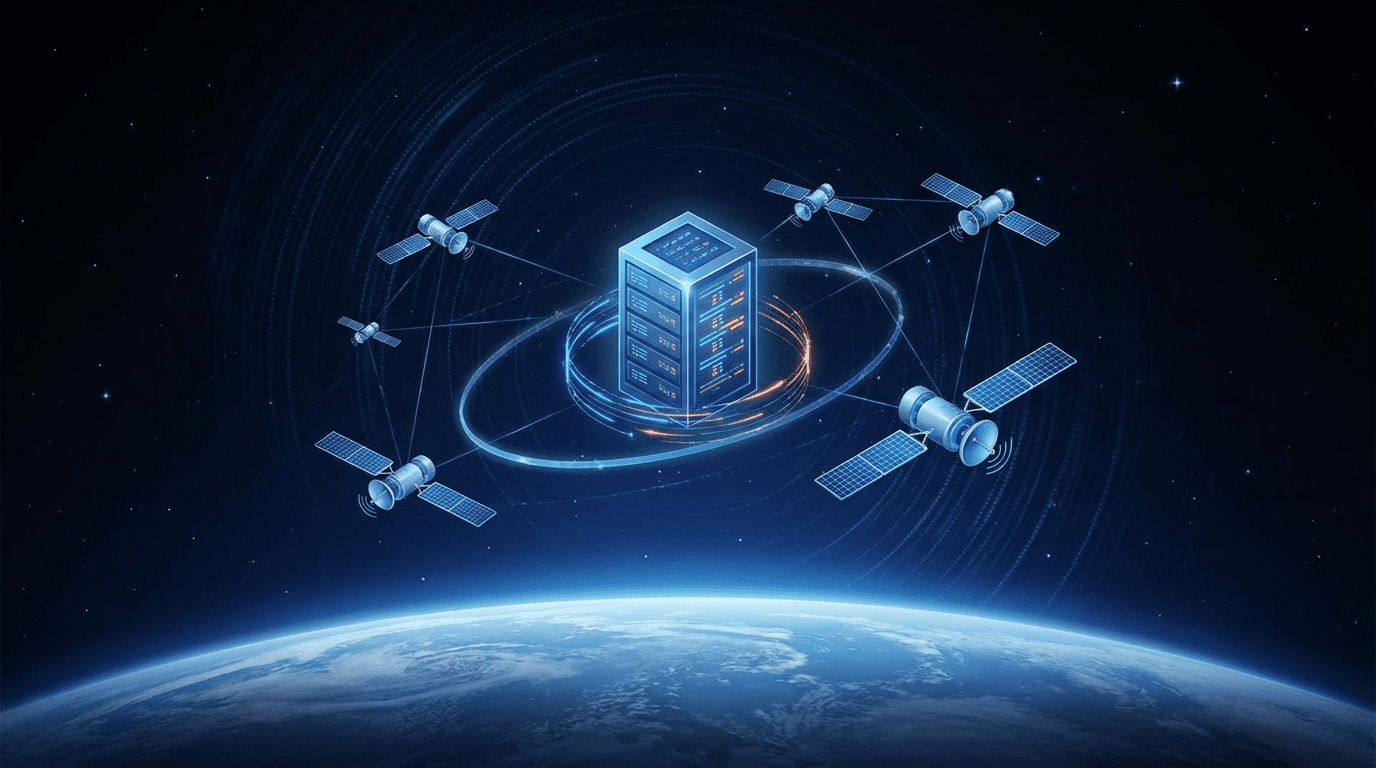
Elon Musk proposes merging xAI with SpaceX to build orbital data centers, but experts say the technical challenges of cooling, power, and latency push feasibility beyond 2030.
From Earth's Power Grid to Orbit
As AI data centers consume an ever-growing share of the world's electricity, Elon Musk has proposed a radical solution: move computing to space. Over the past three weeks of February 2026, SpaceX has filed plans with the Federal Communications Commission for what amounts to a million-satellite data-center network. Musk has announced plans to merge his AI company xAI with SpaceX specifically to pursue orbital data centers, arguing that "the lowest-cost place to put AI will be in space" within "two years, maybe three at the latest."
The proposal addresses a real and urgent problem. By 2028, AI servers alone may consume as much energy as 22 percent of U.S. households. A single large data center using evaporative cooling consumes millions of gallons of water daily. The terrestrial infrastructure required to power the next generation of AI training runs is straining electrical grids, water supplies, and real estate markets simultaneously.
The Case for Orbital Computing
The theoretical advantages of space-based data centers are compelling. Solar energy in orbit is available nearly 24 hours per day without atmospheric interference, cloud cover, or nighttime interruptions. There is effectively unlimited space for expansion without competing for land, water rights, or grid connections. The vacuum of space provides natural thermal isolation, and the absence of weather eliminates the risk of storms, floods, or fires disrupting operations.
Musk's vision extends even further. He has spoken about eventually building "a factory on the moon to build AI satellites" with "massive launch catapults" to deploy them. The scale of ambition is consistent with Musk's track record of proposing transformative infrastructure projects, though the timeline is characteristically aggressive.
The xAI-SpaceX merger would create a vertically integrated company that controls both the AI workload and the launch infrastructure needed to deploy it in orbit. This vertical integration is strategically significant: no other company currently possesses both the AI research capability and the launch capacity to attempt orbital computing at scale.
The Engineering Reality
Experts across multiple disciplines have challenged Musk's timeline and, in some cases, the fundamental feasibility of the concept at the scale he proposes.
Power generation is the first major obstacle. One gigawatt of orbital solar power, roughly the capacity of a single large terrestrial data center, would require approximately one square kilometer of solar panels. Boon Ooi, a professor at Rensselaer Polytechnic Institute, describes this as "extremely heavy and very expensive to launch." At current launch costs, even with SpaceX's Starship, deploying that much solar panel mass would cost billions of dollars before a single computation runs.
Energy consistency presents an additional challenge. Satellites in low Earth orbit pass through Earth's shadow regularly, creating periodic blackouts. AI training workloads require continuous, uninterrupted power; even brief interruptions can corrupt training runs that take weeks or months. Higher orbits reduce shadow time but increase communication latency and launch costs.
Heat dissipation may be the most fundamental unsolved problem. While space is cold, the vacuum eliminates all convective cooling methods that terrestrial data centers rely on. Airflow, liquid cooling, and evaporative systems all require a medium to transfer heat away from processors. In a vacuum, the only cooling mechanism is thermal radiation, which is far less efficient than convection. Josep Miquel Jornet of Northeastern University notes that researchers are "still exploring ways to dissipate that heat" at the densities required for modern AI accelerators.
Communication latency undermines the use case for interactive AI workloads. Fiber-connected terrestrial data centers deliver sub-millisecond latencies. Satellite communication, even with SpaceX's existing Starlink constellation, introduces latencies of 20 to 40 milliseconds at best. For AI inference serving real-time applications like conversational AI or autonomous driving, this latency is unacceptable. Batch training workloads are more tolerant of latency but require the massive power and cooling capabilities that remain unsolved.
Current State of Space Computing
The gap between vision and reality is illustrated by the current state of the art. Only one startup, Lumen, has successfully flown an Nvidia H100 GPU on a satellite. This represents a single chip in orbit, compared to the tens of thousands of GPUs in a modern terrestrial training cluster. The difference in scale is roughly five orders of magnitude.
Jeff Thornburg of Portal Space Systems, a company working on space-based computing, estimates "a minimum of three to five years" before functional systems exist, with mass production "beyond 2030." Kathleen Curlee of Georgetown University states that the promised 2030 to 2035 timeline for meaningful orbital data centers "really isn't possible."
The expert consensus points toward small pilot projects by 2030, perhaps "three or four or five satellites that together look like a tiny data center," orders of magnitude smaller than the terrestrial facilities they would need to complement, let alone replace.
The Terrestrial Alternative
While space data centers capture imagination, the AI industry is simultaneously pursuing more conventional solutions to its energy problem. Google has signed a 150-megawatt geothermal power agreement to provide steady baseload generation for its data centers. Microsoft's Maia 200 inference chip, announced in January 2026, achieves 30 percent better performance per dollar than previous hardware, reducing the energy needed per inference operation.
Nuclear power is attracting increased attention from AI companies. Microsoft, Google, and Amazon have all signed agreements with nuclear power providers. Small modular reactors, while still years from deployment, offer the prospect of dedicated, carbon-free power sources co-located with data centers.
These terrestrial solutions are less dramatic than orbital computing but face far fewer unsolved engineering problems. They can be deployed incrementally, financed with conventional capital structures, and maintained with existing expertise. The trade-off is clear: terrestrial solutions address AI's energy challenge within existing technological paradigms, while space-based computing requires breakthroughs in multiple engineering disciplines simultaneously.
What This Means for AI Infrastructure
Musk's orbital data center proposal should be understood as a long-horizon infrastructure vision rather than a near-term solution. The challenges of power generation, heat dissipation, and communication latency are real engineering problems, not merely cost barriers that scale can overcome. Solving them will require fundamental advances in thermal management, power systems, and space-based networking.
However, dismissing the concept entirely would ignore the pattern of Musk's infrastructure projects. SpaceX itself was widely considered technically infeasible when founded. Starlink was dismissed as impractical before becoming the world's largest satellite constellation. The difference is that both SpaceX and Starlink solved well-understood engineering problems at unprecedented scale, while orbital data centers require solutions to problems that do not yet have proven approaches.
For AI companies planning infrastructure over the next five years, terrestrial solutions remain the practical path. For those planning over a 10- to 20-year horizon, space-based computing represents a possibility worth monitoring, particularly if SpaceX demonstrates heat dissipation solutions in the Starship platform.
Conclusion
Musk's vision of orbital AI data centers addresses a genuine crisis in AI infrastructure energy consumption. The theoretical advantages of space-based computing are real: abundant solar power, unlimited expansion space, and no competition with terrestrial resources. But the engineering challenges, particularly heat dissipation in vacuum, power generation at scale, and communication latency, remain unsolved at the densities required for modern AI workloads. The expert consensus places meaningful orbital computing capability beyond 2030, with small pilot projects possible by the end of the decade. For now, the AI industry's energy challenge will be addressed through more efficient chips, alternative energy sources, and better cooling technology on the ground.
Editor's Verdict
Space Data Centers for AI: Musk's Orbital Computing Vision Meets Engineering Reality earns a solid recommendation within the it news space.
The strongest case for paying attention is addresses a genuine and urgent AI infrastructure energy crisis with a fundamentally different approach, which raises the bar for what readers should now expect from peers in this space. Reinforcing that, space-based solar provides nearly continuous power without competing for terrestrial grid capacity adds practical value rather than just headline appeal. The broader signal worth registering is straightforward: spaceX filed FCC plans for a million-satellite data center network in February 2026. On the other side of the ledger, heat dissipation in vacuum has no proven solution at AI accelerator densities is a real constraint, not a marketing footnote, and it should factor into any serious decision. Layered on top of that, communication latency (20-40ms minimum) makes real-time AI inference impractical narrows the set of teams for whom this is an obvious yes.
For AI industry watchers, strategy teams, and decision-makers tracking platform shifts, this is a serious evaluation candidate, not just a curiosity to bookmark. For everyone else, the safer posture is to monitor coverage and revisit once the use cases that matter to your team are demonstrated in the wild.
Pros
- Addresses a genuine and urgent AI infrastructure energy crisis with a fundamentally different approach
- Space-based solar provides nearly continuous power without competing for terrestrial grid capacity
- Vertical integration of xAI and SpaceX creates unique capability no other company possesses
- Long-term vision could unlock effectively unlimited computing expansion
Cons
- Heat dissipation in vacuum has no proven solution at AI accelerator densities
- Communication latency (20-40ms minimum) makes real-time AI inference impractical
- Launch costs for gigawatt-scale solar arrays remain prohibitively expensive
- Expert consensus places meaningful capability beyond 2030, contradicting Musk's 2-3 year timeline
References
Comments0
Key Features
Elon Musk has filed FCC plans through SpaceX for a million-satellite data center network and proposed merging xAI with SpaceX to pursue orbital AI computing. The vision leverages unlimited space-based solar power to address AI's energy crisis, which by 2028 may consume energy equivalent to 22% of U.S. households. However, experts identify unsolved challenges: heat dissipation in vacuum, one-gigawatt-scale solar panel deployment, communication latency, and shadow-period power interruptions. Only one GPU (Nvidia H100 by Lumen) has successfully operated in orbit.
Key Insights
- SpaceX filed FCC plans for a million-satellite data center network in February 2026
- Musk claims space will be the lowest-cost location for AI within two to three years, but experts push feasibility beyond 2030
- One gigawatt of orbital solar power requires approximately one square kilometer of solar panels
- Only one startup (Lumen) has successfully flown a single GPU in space, five orders of magnitude below terrestrial clusters
- Heat dissipation in vacuum remains the most fundamental unsolved engineering challenge
- By 2028, AI servers alone may consume energy equivalent to 22% of U.S. households
- Terrestrial alternatives including geothermal, nuclear, and more efficient chips address the energy crisis within existing paradigms
Was this review helpful?
Share
Related AI Reviews
Microsoft Maia 300: 96-Accelerator Rack, 2027 Rollout
Microsoft's Maia 300 inference chip claims up to 7x Maia 200's rack throughput on TSMC N2P chiplets, with production rollout starting in 2027.

Nadella: Treat Frontier AI Models as Insider Risks
Nadella's X essay urges treating frontier models as insider risks: controls outside the model, audit evidence and an emergency brake.

Google Pauses OSS VRP Product-Bug Rewards Over AI Slop
Google stopped taking product-vulnerability reports in its OSS bug bounty on Oct 1 over invalid AI submissions; supply-chain rewards continue.

Apple Rethinks macOS Full Disk Access as AI Agents Grow
Apple says it will add controls so granting macOS Full Disk Access takes very explicit user action, citing risks from capable AI agents.