
The SaaSpocalypse: How AI Agents Erased $1 Trillion From Software Stocks
AI agents from Anthropic and OpenAI triggered the worst software stock selloff in history, with the S&P 500 Software Index dropping 13% in a single day and nearly $1 trillion in market value evaporating in six weeks.
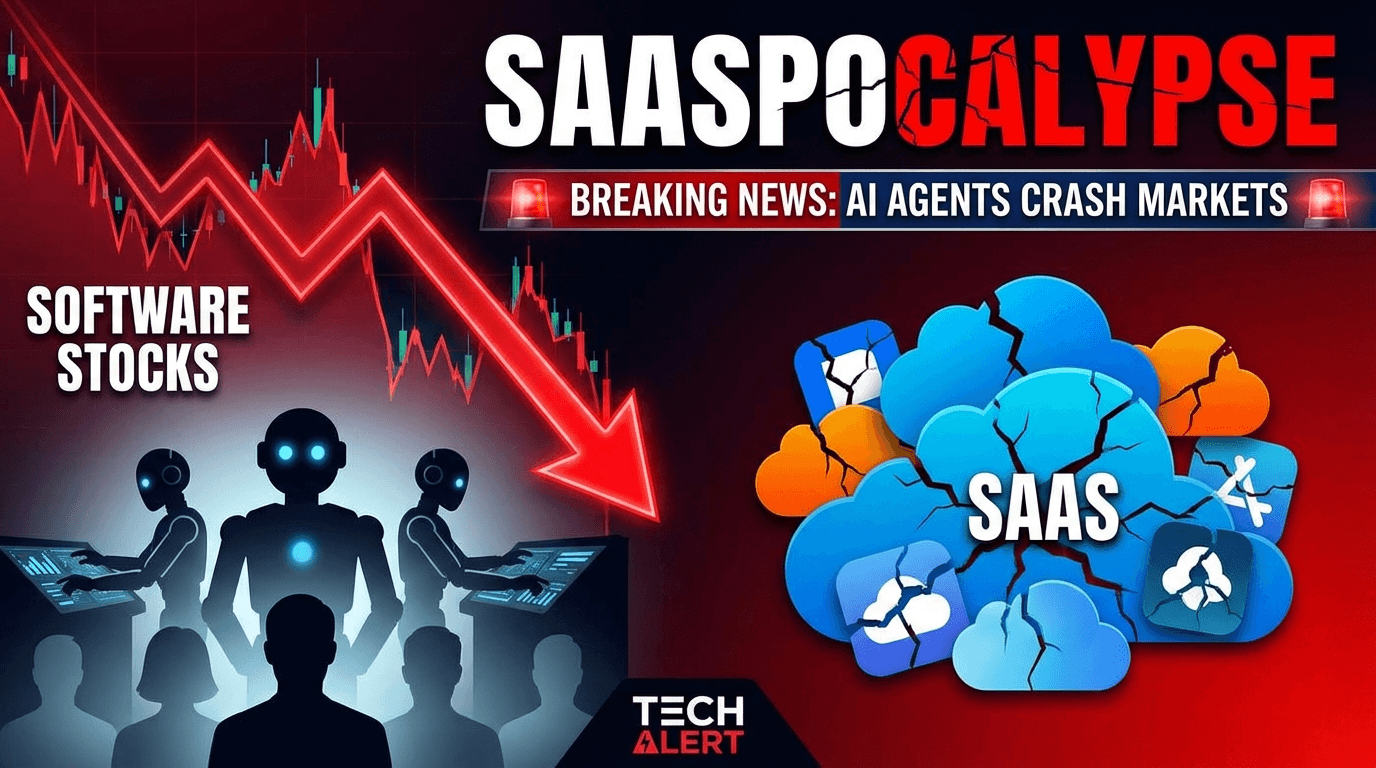
AI agents from Anthropic and OpenAI triggered the worst software stock selloff in history, with the S&P 500 Software Index dropping 13% in a single day and nearly $1 trillion in market value evaporating in six weeks.
Black Tuesday for Software
On February 3, 2026, the S&P 500 Software and Services Index fell 13 percent in a single trading session, its worst daily performance in history. Traders at Jefferies quickly coined the term "SaaSpocalypse" to describe what followed: a sustained selloff that has erased nearly $1 trillion in market capitalization from enterprise software companies in just six weeks.
The trigger was precise. Anthropic's public launch of Claude Cowork and Claude Code, combined with OpenAI's rollout of ChatGPT Agent Mode, demonstrated that AI agents could autonomously navigate desktop environments, execute multi-step business workflows, and manage software development tasks. Wall Street interpreted these capabilities as an existential threat to the traditional software-as-a-service business model.
The Mechanics of the Selloff
The selloff has been remarkably broad. Industry bellwethers Salesforce and Adobe have seen their share prices plummet by more than 25 percent since the start of 2026. Forward earnings multiples for the software industry, which averaged 39 times just a year ago, have collapsed to 21 times as investors reprice the sector's growth expectations.
Goldman Sachs and Oppenheimer issued rare simultaneous double-downgrades of multiple software companies, citing what they described as the democratization of capabilities that previously required specialized SaaS tools. The downgrades targeted companies across the horizontal SaaS category, including Salesforce, Adobe, ServiceNow, Workday, and Monday.com.
The speed and severity of the selloff caught many by surprise. Software stocks had been considered relatively defensive technology investments, with predictable recurring revenue streams and high customer switching costs. The SaaSpocalypse challenged both assumptions simultaneously.
Seat Compression: The Core Thesis
The investment thesis driving the selloff centers on a concept called seat compression. Traditional SaaS companies charge per user or per seat, meaning their revenue scales with the number of employees who use their software. AI agents threaten this model by enabling companies to accomplish the same work with fewer human employees.
The arithmetic is straightforward. If a sales team of ten people uses Salesforce at $150 per seat per month, that generates $1,500 monthly for Salesforce. If AI agents can perform the routine work of four of those salespeople, reducing the team to six, Salesforce's revenue from that customer drops by 40 percent even if the remaining users become more productive.
This dynamic is not theoretical. Companies are already experimenting with AI agents that can update CRM records, generate sales reports, draft follow-up emails, and schedule meetings, tasks that previously required dedicated human operators using SaaS tools. Claude Cowork's industry-specific plugins for sales, legal, finance, and marketing directly target these workflows.
Which Companies Are Most Exposed
The selloff has not been uniform. Companies whose products perform tasks that AI agents can replicate have been hit hardest, while those providing infrastructure or data services that AI agents depend on have been relatively resilient.
Most Affected
Salesforce has faced the most intense selling pressure. Its CRM platform is the textbook example of seat-based pricing in a category where AI agents can perform many routine tasks. Despite beating Q4 earnings with an EPS of $3.25, the stock continued to decline as analysts focused on the long-term structural threat rather than short-term financial performance.
Adobe is exposed on two fronts. Its creative tools face disruption from AI-powered image and video generation, while its document and marketing automation products compete directly with AI agent capabilities. The stock's 23.5 percent year-to-date decline reflects concern about both revenue streams.
ServiceNow faces pressure because its IT service management workflows, including ticket routing, incident classification, and knowledge base management, are natural targets for AI agent automation.
Monday.com is threatened by what analysts have called "vibe coding," the ability of AI agents to build simple workflow automations that previously required dedicated project management tools.
Relatively Resilient
Cloud infrastructure providers like AWS, Azure, and Google Cloud have held up better because AI agents consume more compute resources, not fewer. Data platform companies such as Snowflake and Databricks have also shown resilience because AI agents need data access regardless of how they interact with it.
Cybersecurity companies have been less affected because AI agents create new security challenges that require dedicated solutions, potentially expanding rather than contracting the security software market.
The Counter-Arguments
Not everyone agrees that the SaaSpocalypse reflects rational repricing. Several counter-arguments have emerged from software industry executives and bullish analysts.
First, AI agents still require underlying SaaS platforms to function. Claude Cowork's CRM plugin, for example, connects to existing CRM systems rather than replacing them. The AI agent layer may sit on top of SaaS infrastructure rather than displacing it.
Second, enterprise software purchasing decisions are driven by compliance, security, and data governance requirements that AI agents alone cannot satisfy. Large organizations need audit trails, role-based access controls, and regulatory compliance features that purpose-built SaaS platforms provide.
Third, the most optimistic view suggests that AI agents could increase total software spending by enabling new workflows and use cases that were previously impractical. Rather than replacing SaaS tools, AI agents could make organizations more productive in ways that generate demand for additional software.
Historical Parallels and Differences
The SaaSpocalypse has drawn comparisons to previous technology disruption moments. The shift from on-premises software to cloud-based SaaS in the early 2010s similarly disrupted incumbent software companies, but ultimately created a larger market. Mobile computing disrupted desktop software but generated entirely new categories of applications.
However, the current disruption may be qualitatively different. Previous technology transitions changed how people used software. AI agents threaten to eliminate the need for some human users entirely. This is a labor displacement argument as much as a technology transition argument, and it carries implications that extend beyond software industry valuations.
Impact on Hiring and Operations
Industry analysts have noted that agentic AI tools like Claude Cowork are already reducing junior-level hiring in affected domains. The combination of task automation and cross-application integration eliminates many routine tasks that traditionally defined entry-level positions in sales operations, legal support, data analysis, and marketing coordination.
Some companies have publicly discussed reducing headcount in areas where AI agents can handle routine work. While executives typically frame these decisions as redeployment rather than elimination, the practical effect on SaaS seat counts is the same: fewer human users means fewer software licenses.
What Happens Next
The SaaSpocalypse is still unfolding, and its ultimate impact on software industry valuations depends on several factors that will play out over the coming quarters.
If AI agents prove capable of replacing substantial numbers of SaaS seats in production environments, the selloff will be justified and may have further to run. If AI agents remain supplementary tools that enhance rather than replace human SaaS users, the current valuations may represent a buying opportunity.
The most likely outcome falls somewhere between these extremes. AI agents will probably reduce seat counts in some categories while expanding usage in others. The net effect will vary by company, category, and customer segment. What is already clear is that the software industry's pricing models, growth assumptions, and competitive dynamics have been permanently altered by the emergence of capable AI agents.
Conclusion
The SaaSpocalypse represents the market's rapid repricing of the enterprise software sector in response to AI agent capabilities demonstrated by Anthropic and OpenAI. With nearly $1 trillion in market value erased and forward multiples compressed by almost half, the selloff reflects genuine uncertainty about the long-term viability of seat-based SaaS business models. Whether this proves to be an overreaction or an accurate assessment of structural disruption will depend on how quickly AI agents move from impressive demos to production deployments that measurably reduce enterprise software spending. For now, the SaaSpocalypse serves as a stark reminder that even the most established business models are not immune to AI-driven disruption.
Editor's Verdict
The SaaSpocalypse: How AI Agents Erased $1 Trillion From Software Stocks earns a solid recommendation within the it news space.
The strongest case for paying attention is forces SaaS companies to innovate and integrate AI capabilities into their platforms to remain competitive, which raises the bar for what readers should now expect from peers in this space. Reinforcing that, compressed valuations may create investment opportunities if the selloff proves to be an overreaction adds practical value rather than just headline appeal. The broader signal worth registering is straightforward: the S&P 500 Software Index's 13% single-day drop on February 3 was the largest in the index's history. On the other side of the ledger, nearly $1 trillion in market value destruction affects pension funds, index investors, and employee stock compensation is a real constraint, not a marketing footnote, and it should factor into any serious decision. Layered on top of that, junior-level hiring reductions in affected domains have immediate workforce implications narrows the set of teams for whom this is an obvious yes.
For AI industry watchers, strategy teams, and decision-makers tracking platform shifts, this is a serious evaluation candidate, not just a curiosity to bookmark. For everyone else, the safer posture is to monitor coverage and revisit once the use cases that matter to your team are demonstrated in the wild.
Pros
- Forces SaaS companies to innovate and integrate AI capabilities into their platforms to remain competitive
- Compressed valuations may create investment opportunities if the selloff proves to be an overreaction
- AI agents could ultimately expand total software spending by enabling new workflows previously impractical
- Enterprise compliance, security, and governance requirements provide structural protection for many SaaS platforms
Cons
- Nearly $1 trillion in market value destruction affects pension funds, index investors, and employee stock compensation
- Junior-level hiring reductions in affected domains have immediate workforce implications
- The selloff may become self-reinforcing as declining stock prices reduce SaaS companies' ability to invest in AI capabilities
- Uncertainty about the magnitude of seat compression creates planning challenges for enterprise software budgets
References
Comments0
Key Features
The SaaSpocalypse refers to the historic selloff in enterprise software stocks triggered on February 3, 2026, when Anthropic's Claude Cowork/Code and OpenAI's ChatGPT Agent Mode launched. The S&P 500 Software Index fell 13% in one day, its worst ever. Nearly $1 trillion in market cap evaporated in six weeks. Salesforce dropped 25%+ and Adobe 23.5% YTD. Forward multiples compressed from 39x to 21x. The core mechanism is seat compression: AI agents reducing the number of human users who need SaaS licenses.
Key Insights
- The S&P 500 Software Index's 13% single-day drop on February 3 was the largest in the index's history
- Nearly $1 trillion in SaaS market capitalization evaporated within six weeks of the AI agent launches
- Forward earnings multiples collapsed from 39x to 21x as investors repriced the sector's growth trajectory
- Goldman Sachs and Oppenheimer issued rare simultaneous double-downgrades of multiple software companies
- Seat compression threatens the fundamental SaaS revenue model: fewer human users means fewer software licenses
- Cloud infrastructure and cybersecurity companies have been relatively resilient because AI agents consume more compute and create new security challenges
- Junior-level hiring in sales operations, legal support, and data analysis is already being affected as AI agents handle routine tasks
- The debate centers on whether AI agents will replace SaaS seats or add a supplementary layer on top of existing platforms
Was this review helpful?
Share
Related AI Reviews

Microsoft Maia 300: 96-Accelerator Rack, 2027 Rollout
Microsoft's Maia 300 inference chip claims up to 7x Maia 200's rack throughput on TSMC N2P chiplets, with production rollout starting in 2027.

Nadella: Treat Frontier AI Models as Insider Risks
Nadella's X essay urges treating frontier models as insider risks: controls outside the model, audit evidence and an emergency brake.

Google Pauses OSS VRP Product-Bug Rewards Over AI Slop
Google stopped taking product-vulnerability reports in its OSS bug bounty on Oct 1 over invalid AI submissions; supply-chain rewards continue.

Apple Rethinks macOS Full Disk Access as AI Agents Grow
Apple says it will add controls so granting macOS Full Disk Access takes very explicit user action, citing risks from capable AI agents.