
Nvidia PAIR Routes Local AI Across Your Idle Home PCs
Nvidia's free open-source PAIR sends local AI requests to idle home PCs, but it does not pool GPU memory or shard a model across machines.
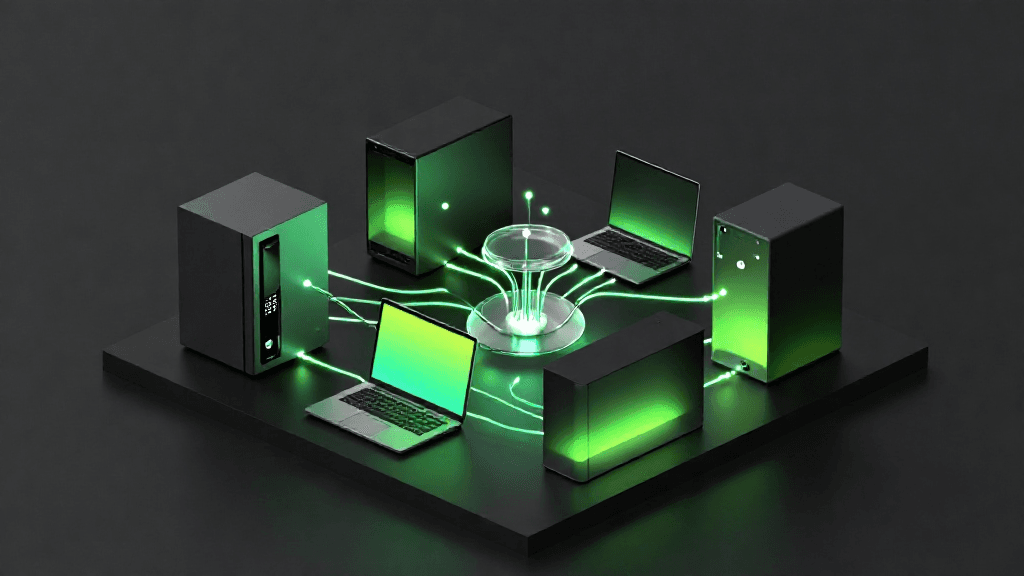
Nvidia's free open-source PAIR sends local AI requests to idle home PCs, but it does not pool GPU memory or shard a model across machines.
Introduction
NVIDIA announced Personal AI Router — PAIR — on September 3, 2026, as part of its IFA 2026 announcements. Despite the name, PAIR is not a piece of network hardware: as The Verge points out, it is free, open-source software, published on GitHub under the Apache-2.0 license. The premise is easy to grasp. A household with an RTX gaming desktop usually also has a laptop, and perhaps a Mac, sitting unused for most of the day. PAIR discovers those machines on the local network and hands local AI requests to whichever one is currently free.
What makes PAIR worth reading closely is the distance between how it is being described and what its own documentation says it does. Press coverage has reached for the phrase "personal AI data center." The project's README is considerably more precise, and that difference decides whether PAIR is useful to you.
Feature Overview
The project describes itself plainly: PAIR is "a local inference router for a group of compatible computers on the same network. It discovers participating nodes, manages supported inference engines, and presents Ollama-compatible and OpenAI-compatible proxy endpoints to applications and agents."
Those two proxy endpoints are the practical hook. Anything already pointed at a local Ollama instance, or at an OpenAI-compatible base URL, can be pointed at PAIR instead without application changes. From there PAIR decides where each request lands: "Independent requests can be routed to eligible nodes according to engine availability, model availability, and current workload."
Engine management. PAIR does not perform inference itself — it drives Ollama or LM Studio on each node. It can download and install either engine for you from a node card's "Engine settings", or adopt an installation you already have.
Idle-aware routing. According to The Verge, PAIR draws on in-home systems when they are idle so that it does not interfere with other tasks, and NVIDIA says the router adapts as devices join or leave the network — including the moment someone starts playing a game on the desktop PC that was serving inference a minute earlier.
Mixed-platform clusters. Windows, Linux and macOS nodes can all be paired with each other.
| Item | Supported |
|---|---|
| Operating systems | Windows 11, Linux, macOS |
| Architectures | x64 and arm64 on all three (Windows on ARM is experimental) |
| Installers | Windows .exe, Linux .deb, macOS .dmg |
| Inference engines | Ollama, LM Studio |
| Proxy endpoints | Ollama-compatible, OpenAI-compatible |
Two interfaces. PAIR ships a desktop GUI and a terminal interface for machines with no desktop environment — a useful detail, since a headless Linux box with a spare GPU is exactly the kind of node this software is meant to absorb.
Stated use case. NVIDIA points at "concurrent local workloads such as multi-agent applications," which is a narrower and more honest description than the data-center framing.
What PAIR Does Not Do
The README draws its boundary in unusually direct language, and this is the part to understand before installing anything: "PAIR routes each independent request to one node. It does not pool GPU memory, combine GPUs into a larger logical GPU, shard one model across machines, or split an in-flight inference request between nodes."
Set that against the data-center framing and the picture changes. If a model does not fit on any single machine you own, PAIR will not make it run — adding a second and a third computer does not add up to a larger GPU. What PAIR delivers is throughput: many requests in flight simultaneously across many machines, rather than one large request served faster or one larger model made possible. For an agentic workflow that decomposes a complex task into smaller independent jobs, that is a real benefit, and it targets a real bottleneck, since those jobs otherwise queue behind each other on one GPU. For a reader hoping to finally run a model class their hardware cannot hold, it is the wrong tool.
Usability Analysis
The hardware floor is genuine. The Verge reports that compatibility centers on NVIDIA GeForce GPUs — RTX 20-series cards and newer — plus RTX Pro GPUs and DGX Spark systems, with Apple M4 chips or newer also supported. In a media briefing, NVIDIA product manager Seth Schneider described a household in which an RTX Spark laptop, a DGX Spark desktop, an RTX 5090 laptop, a gaming desktop and a MacBook Pro all contribute, which gives a fair sense of the intended user.
Reaching a working node takes more than installing PAIR. The README is blunt about it: "PAIR running on a machine does not mean an engine will." Each engine sets its own OS, GPU and driver requirements, and each model needs enough memory to load. A machine becomes a routing candidate once it is actually running a compatible engine, and PAIR prefers nodes it already knows hold the requested model — so getting model copies onto your machines is a prerequisite rather than a side effect. Idle silicon is not automatically usable capacity.
Installation is handled well on the released builds. The signed installers set up the background services and the desktop app together, add Windows firewall rules, and check an update feed under Settings → Service. A build you compile yourself — the path for Linux distributions outside the .deb target — is unsigned and checks no update feed, which matters if you intend to run PAIR long-term on a non-Debian machine. The documentation's quick start uses qwen4:12b as its example model.
On privacy, the README's wording is conditional and deserves to be quoted exactly: "Prompts and responses are intended to remain on the local network when every configured client, model source, engine, and node is local." That is a meaningful property and also a fragile one — configure a remote model source, or add a node that is not local, and the condition no longer holds.
Pros and Cons
Pros:
- Free and open source under Apache-2.0, so the routing layer can be inspected and modified
- Ollama-compatible and OpenAI-compatible proxy endpoints let existing local-AI apps and agents point at PAIR without code changes
- Windows 11, Linux and macOS nodes can be mixed in one cluster, with signed installers for each
- Idle-aware routing that adapts as devices join or leave, so a gaming session on one node does not stall the group
- PAIR can install Ollama or LM Studio for you, or adopt an engine you already run
Cons:
- No GPU memory pooling and no model sharding: a model too large for every individual node still cannot run, no matter how many machines you add
- Every node needs a compatible engine and its own copy of the model before it becomes a routing candidate, so idle hardware is not automatically usable capacity
- The hardware floor excludes a lot of existing machines — RTX 20-series or newer, RTX Pro, DGX Spark, or Apple M4 and later — and Windows on ARM support is experimental
- Self-built copies are unsigned and receive no update-feed notifications, and the local-only privacy wording holds only while every client, model source, engine and node is local
Outlook
PAIR is early. Its GitHub repository was created on July 2, 2026, was last pushed on August 28, 2026, and carried 85 stars as of September 4, 2026 — a small figure that reflects how recently the project surfaced rather than a judgment on the code. Apache-2.0 licensing at least means the routing logic is open to inspection, which is the right posture for software that sits between your applications and every machine on your home network.
The more interesting question is what those endpoints enable. Because PAIR speaks both the Ollama-compatible and OpenAI-compatible protocols, it slides underneath the local-AI tooling people already run without those tools needing to know a router exists. If multi-agent frameworks keep moving onto consumer hardware, distributing independent requests across household machines is a plausible way to stop them from stalling on a single GPU. Whether NVIDIA later extends PAIR toward the capabilities it currently rules out — memory pooling, model sharding — is unknown, and nothing in the present documentation points that way.
Conclusion
PAIR is a focused, free tool that does one thing: route independent local inference requests to whichever compatible machine on your network happens to be free. Judged on that scope it looks well built — cross-platform, engine-agnostic between Ollama and LM Studio, and easy to slot under existing tools. Judged against the "personal AI data center" headline, it will disappoint anyone who expects their machines to add up to a bigger GPU. It suits households that already own several RTX-class or M4-class systems and run multi-agent or batch local workloads. It is not the answer for running models larger than your biggest single node.
Editor's Verdict
Nvidia PAIR Routes Local AI Across Your Idle Home PCs earns a solid recommendation within the open source space.
The strongest case for paying attention: free and open source under Apache-2.0, so the routing layer can be inspected and modified. That alone raises the bar for what readers should expect in this space. Reinforcing that, Ollama-compatible and OpenAI-compatible proxy endpoints let existing local-AI apps and agents point at PAIR without code changes — practical value rather than just headline appeal. The broader signal worth registering is straightforward: PAIR parallelizes many independent requests rather than accelerating one request, so its benefit shows up in multi-agent and batch workloads, not in single-prompt latency. On the other side of the ledger, one constraint is real rather than a marketing footnote: no GPU memory pooling and no model sharding: a model too large for every individual node still cannot run, no matter how many machines you add. It should factor into any serious decision. Layered on top of that, every node needs a compatible engine running before it becomes a routing candidate, and PAIR prefers nodes that already hold the model, so idle hardware is not automatically usable capacity — which narrows the set of teams for whom this is an obvious yes.
For developers building locally, infrastructure engineers, and anyone preferring transparent, modifiable software, this is a serious evaluation candidate, not just a curiosity to bookmark. For everyone else, the safer posture is to monitor coverage and revisit once the use cases that matter to your team are demonstrated in the wild.
Pros
- Free and open source under Apache-2.0, so the routing layer can be inspected and modified
- Ollama-compatible and OpenAI-compatible proxy endpoints let existing local-AI apps and agents point at PAIR without code changes
- Windows 11, Linux and macOS nodes can be mixed in one cluster, with signed installers for each platform
- Idle-aware routing adapts as devices join or leave, so a gaming session on one node does not stall the group
- PAIR can install Ollama or LM Studio for you, or adopt an engine you already run
Cons
- No GPU memory pooling and no model sharding: a model too large for every individual node still cannot run, no matter how many machines you add
- Every node needs a compatible engine running before it becomes a routing candidate, and PAIR prefers nodes that already hold the model, so idle hardware is not automatically usable capacity
- The hardware floor excludes many existing machines — RTX 20-series or newer, RTX Pro, DGX Spark, or Apple M4 and later — and Windows on ARM support is experimental
- Self-built copies are unsigned and get no update-feed notifications, and the local-only privacy wording holds while every client, model source, engine and node is local
References
Comments0
Key Features
1. Announced September 3, 2026 as part of NVIDIA's IFA 2026 announcements; free and open source on GitHub under the Apache-2.0 license, and not a hardware router despite the name. 2. Acts as a local inference router that discovers nodes on the same network, manages supported engines, and exposes Ollama-compatible and OpenAI-compatible proxy endpoints to apps and agents. 3. Routes independent requests to eligible nodes by engine availability, model availability and current workload, drawing on systems while they are idle and adapting as devices join or leave. 4. Explicitly does not pool GPU memory, combine GPUs into one logical GPU, shard a model across machines, or split an in-flight request between nodes. 5. Runs on Windows 11, Linux and macOS with x64 and arm64 builds (Windows on ARM experimental), and Windows, Linux and macOS nodes can be mixed in one cluster. 6. Drives Ollama or LM Studio, installing either engine for you from a node card's Engine settings or adopting one already present. 7. Ships both a desktop GUI and a terminal interface; released installers are signed, register background services, add Windows firewall rules and check an update feed, while self-built copies are unsigned with no update feed.
Key Insights
- PAIR parallelizes many independent requests rather than accelerating one request, so its benefit shows up in multi-agent and batch workloads, not in single-prompt latency.
- The README rules out GPU memory pooling and model sharding outright, which means PAIR cannot run a model that no single node on the network can already hold.
- Ollama-compatible and OpenAI-compatible proxy endpoints let existing local-AI applications adopt PAIR without any code change, which lowers the switching cost considerably.
- A node only counts as a routing candidate once it is actually running a compatible engine, and PAIR prefers nodes it already knows hold the model, so idle hardware does not translate directly into available capacity.
- NVIDIA's privacy statement is conditional — prompts and responses are intended to stay on the local network when every configured client, model source, engine and node is local.
- Cross-platform pairing of Windows, Linux and macOS nodes, plus Apple M4-or-newer support, widens the pool of usable machines beyond an all-NVIDIA household.
- Building from source on unsupported Linux distributions produces an unsigned copy with no update feed, a maintenance cost worth weighing before deploying to a non-Debian node.
- The project is early — repository created July 2, 2026, last pushed August 28, 2026, with 85 stars as of September 4, 2026 — so its operational track record is still thin.
Was this review helpful?
Share
Related AI Reviews
NVIDIA Open-Sources Run:ai GPU Orchestration Platform
NVIDIA released the full Run:ai platform as open source under its DSX AI Factory org, with four modules that can be adopted independently.
Nemotron 3 Diarization: NVIDIA's Open 100M Speaker Model
NVIDIA's open-weight 100M-param diarization model tracks up to 8 speakers live or offline, ranking #1 on VoiceArena's initial benchmark at 14.72% DER.
MCP's New Roadmap Sets Five Priorities for Late 2026
MCP maintainers published a new roadmap on August 22, prioritizing agentic messaging, HTTP-native transport, and enterprise identity.

Qwen3.8-27B Review: Alibaba's Dense Vision-LLM
Alibaba released Qwen3.8-27B, a 27B open-weight dense vision-language model with 262K context under Apache 2.0.