
NVIDIA Nemotron 3 Nano: A 30B Open Model That Activates Only 3B Parameters Per Token
NVIDIA releases Nemotron 3 Nano, a 30B-parameter open-weight model using hybrid Mamba-Transformer MoE architecture that activates just 3B parameters per forward pass, delivering 4x throughput over its predecessor.
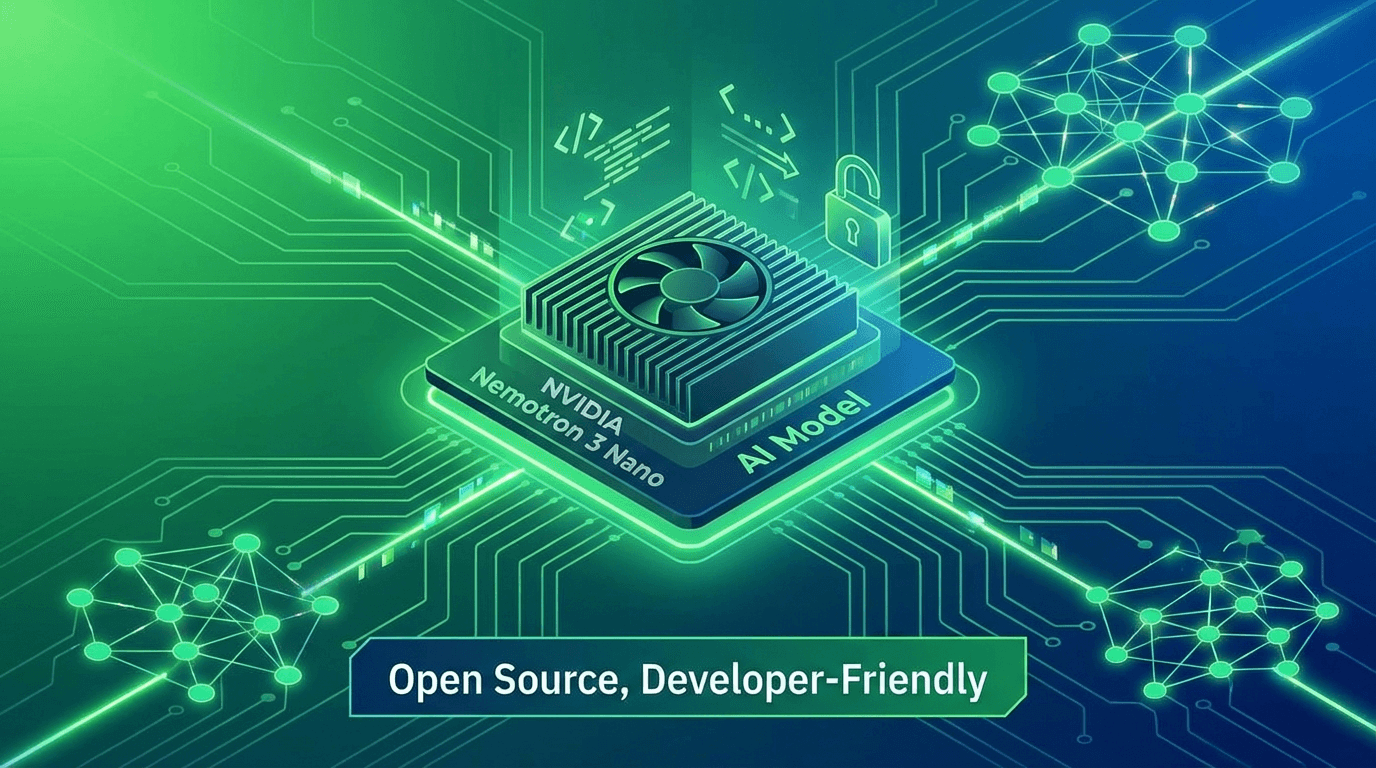
NVIDIA releases Nemotron 3 Nano, a 30B-parameter open-weight model using hybrid Mamba-Transformer MoE architecture that activates just 3B parameters per forward pass, delivering 4x throughput over its predecessor.
NVIDIA Enters the Open Model Race With an Efficiency Play
NVIDIA debuted the Nemotron 3 family of open models in December 2025, with Nemotron 3 Nano as the first available release. The model represents a departure from the brute-force scaling approach that has dominated the large language model landscape. Instead of maximizing total parameter count, Nemotron 3 Nano uses a hybrid mixture-of-experts architecture that activates only 3 billion parameters out of a total 30 billion on each forward pass. The result is a model that delivers 4x higher token throughput than its predecessor, Nemotron 2 Nano, while maintaining competitive accuracy.
The model weights are released under the NVIDIA Open Model License, and NVIDIA has also published nearly 10 trillion tokens of its synthetic pretraining corpus, along with detailed training and post-training recipes on GitHub and Hugging Face. This level of openness is notable for NVIDIA, a company historically focused on hardware rather than model distribution.
Architecture: Mamba, Transformers, and MoE in One Model
Nemotron 3 Nano's architecture is its most distinctive feature. It combines three computational paradigms in a single model: Mamba layers for efficient sequence modeling, Transformer layers for precision reasoning, and mixture-of-experts (MoE) routing for scalable compute efficiency.
The architecture alternates Mamba-2/MoE pairs with sparse self-attention layers in a carefully designed pattern. Mamba layers handle long-range sequence dependencies efficiently, avoiding the quadratic attention cost that constrains standard Transformers on long contexts. The sparse self-attention layers activate selectively for tasks that require precise cross-token reasoning. The MoE routing system directs each token to a subset of specialized experts, ensuring that only 3B of the model's 30B total parameters fire on any given inference step.
This hybrid approach yields a practical benefit: the model supports a native 1-million-token context window while maintaining throughput that makes it viable for multi-agent deployments where multiple model instances run concurrently. NVIDIA specifically designed the architecture for DGX Spark, H100, and B200 GPUs, optimizing memory access patterns for its own hardware ecosystem.
Training Methodology and Open Data
Nemotron 3 Nano was pretrained on nearly 10 trillion tokens of synthetic data generated through NVIDIA's augmentation pipelines. Post-training used a 13-million-sample corpus for supervised fine-tuning and reinforcement learning.
The reinforcement learning phase is particularly noteworthy. NVIDIA employed multi-environment RL through NeMo Gym, a framework that exposes the model to diverse agentic scenarios including tool use, multi-step reasoning, and code execution. The training emphasis on "real agentic behavior" through trajectory-based optimization distinguishes Nemotron 3 from models that rely primarily on instruction tuning for task completion.
NVIDIA has published the pretraining corpus, post-training data, and complete training recipes. Developers can inspect, modify, and reproduce the entire pipeline, enabling customization for domain-specific applications. This reproducibility commitment extends to NeMo RL and NeMo Evaluator, the reinforcement learning and evaluation toolkits released alongside the model.
Benchmark Performance and Efficiency Metrics
Nemotron 3 Nano achieves a score of 52 on the Artificial Analysis Intelligence Index v3.0, which Artificial Analysis ranks as leading accuracy among similarly sized models. The model's efficiency story is equally compelling: it delivers the highest throughput among small language reasoning models while reducing reasoning-token generation by up to 60% compared to models that use chain-of-thought approaches without MoE routing.
The throughput advantage is critical for agentic AI applications where multiple model calls happen in rapid succession. A coding agent that needs to analyze code, generate tests, and review results requires fast sequential inference. A customer service system running multiple concurrent conversations needs high throughput per GPU. Nemotron 3 Nano's 4x throughput improvement over Nemotron 2 Nano directly translates to lower per-query cost in these deployments.
NVIDIA has also released an NVFP4 quantized checkpoint that further reduces memory requirements for inference on Blackwell architecture GPUs, enabling deployment on smaller hardware configurations without significant accuracy loss.
The Nemotron 3 Family Roadmap
Nemotron 3 Nano is the smallest member of a three-model family. Nemotron 3 Super, with approximately 100 billion total parameters and 10 billion active per token, and Nemotron 3 Ultra, at approximately 500 billion total parameters with 50 billion active, are scheduled for release in the first half of 2026.
The Super and Ultra models will introduce two additional architectural innovations. Latent MoE enables 4x more experts at the same inference cost through latent space routing, improving semantic specialization. Multi-token prediction allows the model to predict multiple future tokens simultaneously, improving accuracy by approximately 2.4% during training while enabling speculative decoding speedups at inference time.
Both larger models will use NVIDIA's NVFP4 4-bit floating-point training format on the Blackwell architecture, reducing training memory requirements while maintaining accuracy. This positions the Nemotron 3 family as a showcase for NVIDIA's hardware-software co-optimization strategy.
Deployment and Ecosystem
Nemotron 3 Nano is available through multiple channels: Hugging Face for direct download, inference providers including Baseten, DeepInfra, Fireworks, Together AI, and OpenRouter for API access, and NVIDIA NIM microservices for enterprise deployment. The breadth of deployment options lowers the barrier to adoption for developers who may not have direct access to NVIDIA DGX hardware.
The model targets specific use cases: software debugging, content summarization, AI assistant workflows, information retrieval, multi-agent collaboration, and domain-specialized agent development. NVIDIA positions Nemotron 3 Nano not as a general-purpose chatbot competitor but as an inference engine for structured agentic workflows where throughput and efficiency matter more than raw benchmark scores.
Competitive Positioning
Nemotron 3 Nano competes with models like Meta's Llama 4 Scout, Alibaba's Qwen 3.5, and Mistral's smaller models. Its differentiation is architectural: the hybrid Mamba-Transformer-MoE design offers a fundamentally different efficiency profile than the dense Transformer models that dominate the open-weight landscape.
NVIDIA's unique position as both a hardware manufacturer and a model provider creates strategic alignment that other model builders cannot replicate. Nemotron 3 is optimized for NVIDIA GPUs at the silicon level, with memory access patterns and compute kernels designed for specific GPU architectures. This vertical integration means that Nemotron 3 running on NVIDIA hardware will likely outperform the same parameter count from competitors on the same hardware.
The open release of training data and recipes also serves a strategic purpose. By enabling the community to build on Nemotron 3, NVIDIA creates an ecosystem of fine-tuned models that run best on NVIDIA hardware, reinforcing GPU demand regardless of which specific model customers ultimately deploy.
Conclusion
Nemotron 3 Nano is a strategically significant release that demonstrates NVIDIA's ability to compete in the model layer while reinforcing its hardware advantage. The hybrid Mamba-Transformer-MoE architecture delivers genuine efficiency gains, the 1M-token context window and 4x throughput improvement address real deployment needs, and the open release of data and training recipes sets a high bar for reproducibility. For developers building agentic AI systems that require high throughput, low latency, and efficient GPU utilization, Nemotron 3 Nano is a compelling option. The upcoming Super and Ultra releases will determine whether NVIDIA's architectural approach scales to frontier-level performance.
Editor's Verdict
NVIDIA Nemotron 3 Nano: A 30B Open Model That Activates Only 3B Parameters Per Token brings real, demonstrable value, though with caveats that deserve weighing.
The strongest case for paying attention is 4x throughput improvement over predecessor makes it cost-effective for high-volume agentic deployments, which raises the bar for what readers should now expect from peers in this space. Reinforcing that, 1M-token context window supports long document analysis, codebase understanding, and extended conversations adds practical value rather than just headline appeal. The broader signal worth registering is straightforward: the hybrid Mamba-Transformer-MoE architecture activates only 10% of total parameters per token, delivering 4x throughput over the previous generation. On the other side of the ledger, intelligence Index score of 52 indicates accuracy tradeoffs compared to larger dense models is a real constraint, not a marketing footnote, and it should factor into any serious decision. Layered on top of that, architecture is optimized for NVIDIA GPUs, potentially limiting performance advantages on other hardware narrows the set of teams for whom this is an obvious yes.
For developers building locally, infrastructure engineers, and anyone preferring transparent, modifiable software, a measured trial makes sense, with clear criteria for when to expand or pull back. For everyone else, the safer posture is to monitor coverage and revisit once the use cases that matter to your team are demonstrated in the wild.
Pros
- 4x throughput improvement over predecessor makes it cost-effective for high-volume agentic deployments
- 1M-token context window supports long document analysis, codebase understanding, and extended conversations
- Fully open weights, training data, and recipes enable complete reproducibility and domain customization
- Hybrid Mamba-Transformer-MoE architecture offers a fundamentally different and more efficient approach to inference
- Available through multiple deployment channels including Hugging Face, major inference providers, and NVIDIA NIM
Cons
- Intelligence Index score of 52 indicates accuracy tradeoffs compared to larger dense models
- Architecture is optimized for NVIDIA GPUs, potentially limiting performance advantages on other hardware
- Super and Ultra models are not yet available, making the full family's performance claims unverifiable
- Synthetic pretraining data may introduce distributional biases different from web-crawled corpora
References
Comments0
Key Features
Nemotron 3 Nano is a 30B-parameter model that activates only 3B parameters per token through a hybrid Mamba-Transformer-MoE architecture. It delivers 4x higher throughput than Nemotron 2 Nano and supports a native 1M-token context window. The model reduces reasoning-token generation by up to 60%. Pretrained on nearly 10 trillion synthetic tokens with 13 million post-training samples. Released under NVIDIA Open Model License with full training data, recipes, and tools (NeMo Gym, NeMo RL, NeMo Evaluator) on GitHub and Hugging Face.
Key Insights
- The hybrid Mamba-Transformer-MoE architecture activates only 10% of total parameters per token, delivering 4x throughput over the previous generation
- NVIDIA released nearly 10 trillion tokens of synthetic pretraining data alongside the model weights, setting a new bar for open-model reproducibility
- Multi-environment reinforcement learning through NeMo Gym trains the model on real agentic behaviors rather than instruction-following alone
- The NVFP4 quantized checkpoint enables deployment on smaller hardware configurations without significant accuracy degradation
- Nemotron 3 Super (100B/10B active) and Ultra (500B/50B active) are scheduled for H1 2026, forming a complete family from edge to datacenter
- NVIDIA's vertical integration of model optimization with GPU hardware creates an efficiency advantage that pure model companies cannot match
- The open release strategy encourages community fine-tuning, building an ecosystem of models optimized for NVIDIA hardware
Was this review helpful?
Share
Related AI Reviews
Nemotron 3 Diarization: NVIDIA's Open 100M Speaker Model
NVIDIA's open-weight 100M-param diarization model tracks up to 8 speakers live or offline, ranking #1 on VoiceArena's initial benchmark at 14.72% DER.

Nvidia PAIR Routes Local AI Across Your Idle Home PCs
Nvidia's free open-source PAIR sends local AI requests to idle home PCs, but it does not pool GPU memory or shard a model across machines.

MCP's New Roadmap Sets Five Priorities for Late 2026
MCP maintainers published a new roadmap on August 22, prioritizing agentic messaging, HTTP-native transport, and enterprise identity.

Qwen3.8-27B Review: Alibaba's Dense Vision-LLM
Alibaba released Qwen3.8-27B, a 27B open-weight dense vision-language model with 262K context under Apache 2.0.