
Nvidia GTC 2026 Preview: Jensen Huang to Unveil Full-Stack AI Vision for 30,000 Attendees
Nvidia GTC 2026 runs March 16-19 in San Jose with 30,000 attendees from 190 countries, 700+ sessions, and a Jensen Huang keynote covering chips, software, models, and applications.
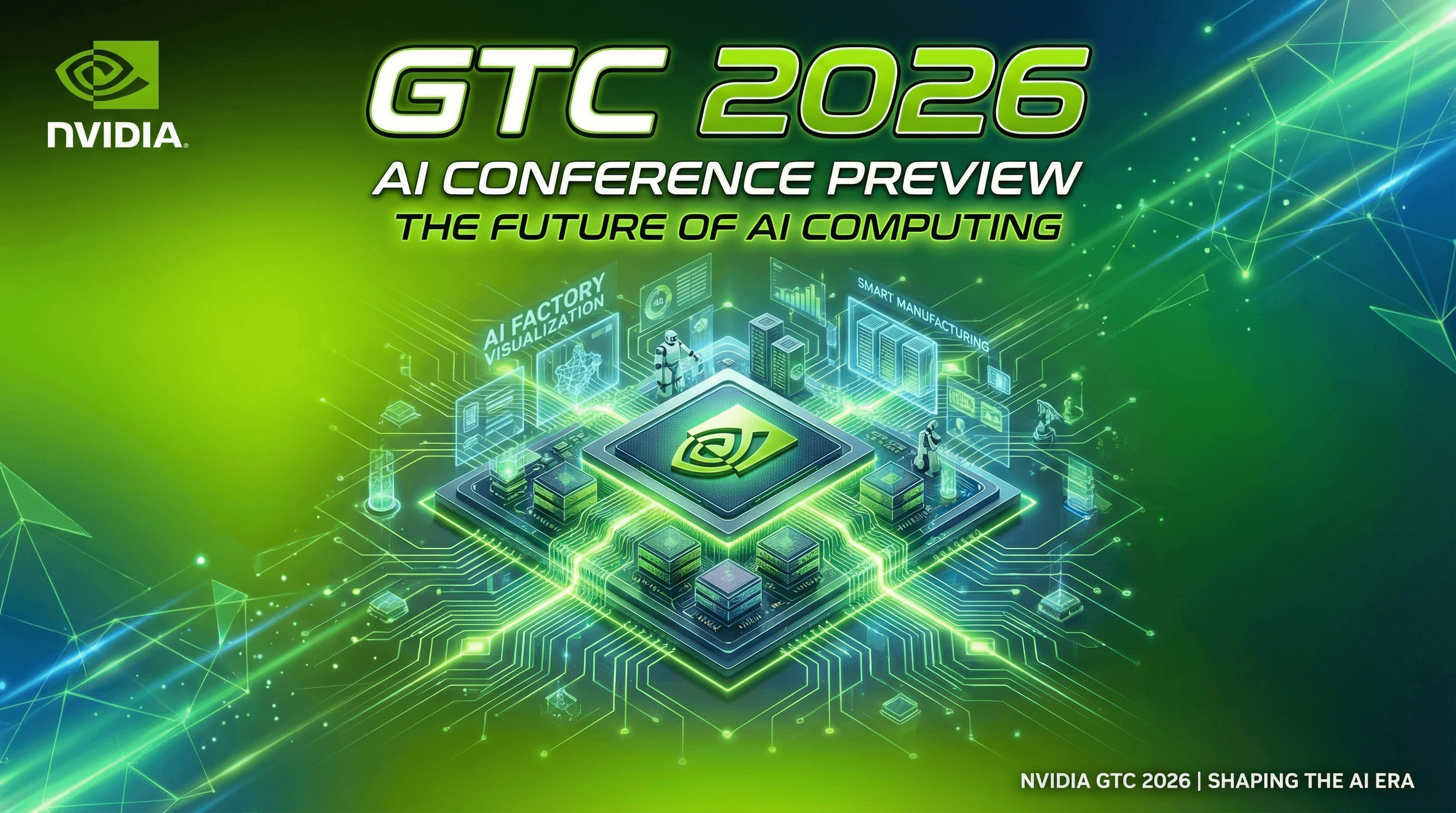
Nvidia GTC 2026 runs March 16-19 in San Jose with 30,000 attendees from 190 countries, 700+ sessions, and a Jensen Huang keynote covering chips, software, models, and applications.
The AI Industry's Biggest Stage Returns
Nvidia's GPU Technology Conference (GTC) 2026 is set to take place March 16-19 in San Jose, California, bringing together 30,000 attendees from 190 countries across 10 venues. The event, which has grown into the AI industry's most anticipated annual gathering, will feature more than 700 sessions spanning chips, software, models, robotics, and enterprise AI deployment.
The centerpiece is CEO Jensen Huang's keynote on March 16 at 11:00 AM PT at the SAP Center. Nvidia has confirmed the keynote will cover "the full stack: chips, software, models and applications," signaling potential announcements across the company's entire product portfolio. Given Nvidia's track record of using GTC keynotes for major hardware and platform reveals, this year's address carries significant expectations from investors, developers, and enterprise customers alike.
What to Expect: Key Sessions and Themes
Jensen Huang's Full-Stack Keynote
The keynote's "full stack" framing is notable. In previous GTC events, Huang has used the keynote to announce new GPU architectures, software frameworks, and partnerships. The explicit mention of chips, software, models, and applications suggests announcements that span Nvidia's hardware roadmap, its software ecosystem (CUDA, NIM microservices, Omniverse), and its growing role in AI model deployment.
A pregame show will feature CEOs from five companies: Aravind Srinivas (Perplexity), Harrison Chase (LangChain), Arthur Mensch (Mistral), Deepak Pathak (Skild AI), and Halim Abbas (OpenEvidence). This lineup spans AI search, agent frameworks, open-source LLMs, embodied AI, and medical AI, reflecting the breadth of the Nvidia ecosystem.
Physical AI and Robotics
Physical AI is a major theme for GTC 2026. Nvidia has been investing heavily in robotics through its Isaac and Omniverse platforms, and sessions on embodied AI and robot learning are prominently featured. Skild AI's presence in the pregame show reinforces this focus. The conference is expected to showcase advances in sim-to-real transfer, robot manipulation, and autonomous systems built on Nvidia hardware.
AI Factories and Inference Optimization
The concept of "AI factories," large-scale data centers purpose-built for AI training and inference, continues to be central to Nvidia's enterprise pitch. GTC 2026 sessions will cover inference optimization techniques, including quantization, speculative decoding, and model distillation, as enterprises seek to reduce the cost of deploying AI at scale.
Open Models and the Agentic AI Stack
A dedicated panel on open models will feature representatives from LangChain, Andreessen Horowitz (A16Z), AI2, Cursor, and Thinking Machines. This session reflects the growing importance of open-source models in the enterprise AI stack and the emergence of agentic AI workflows that combine multiple models, tools, and reasoning steps.
High-Profile Sessions Beyond the Keynote
Dario Gil, Senior Vice President at the U.S. Department of Energy, will speak on AI and energy. This session addresses one of the industry's most pressing challenges: the power consumption of large-scale AI infrastructure. As AI factories scale to gigawatt levels, the intersection of compute and energy policy becomes a first-order concern for the industry.
Universal Music Group's CEO will discuss AI's intersection with the music industry. This session highlights AI's expanding reach beyond traditional tech verticals into creative industries where intellectual property, licensing, and generative content raise complex questions.
Featured Products and Projects
OpenClaw
Nvidia is spotlighting OpenClaw, which it describes as the "fastest-growing open source project" in its ecosystem. The project is related to robotic manipulation and physical AI, consistent with the conference's emphasis on embodied intelligence. OpenClaw's open-source nature positions it as a community-driven platform for advancing robot dexterity and grasping capabilities.
DGX Spark Workstation
The DGX Spark represents Nvidia's push to bring AI development capabilities to individual researchers and small teams. Unlike the data-center-scale DGX systems, Spark is designed as a desktop workstation that can run substantial AI workloads locally. This product targets the gap between cloud-based AI development and the growing demand for on-premises AI compute.
Jetson Modules
Nvidia's Jetson platform for edge AI and robotics will feature prominently. Jetson modules power autonomous machines, drones, and IoT devices. Updated modules could expand the platform's capabilities for running larger models at the edge, aligning with the broader trend of moving AI inference closer to where data is generated.
| Featured Product | Category | Target Users |
|---|---|---|
| OpenClaw | Open Source / Robotics | Robotics researchers, physical AI developers |
| DGX Spark | Workstation | Individual researchers, small AI teams |
| Jetson Modules | Edge AI | IoT developers, autonomous systems engineers |
Who Should Pay Attention
GTC 2026 is most relevant for three groups. Enterprise AI teams evaluating infrastructure investments will find sessions on AI factories, inference optimization, and deployment architectures directly applicable to their planning. AI developers working with open models, agent frameworks, or robotics will benefit from technical deep dives and hands-on labs. Investors and analysts tracking the AI hardware market will look to the keynote for signals about Nvidia's product roadmap and competitive positioning.
The conference also serves as a barometer for the AI industry's direction. The themes Nvidia chooses to emphasize, and the companies it invites to its stage, indicate where the company sees the highest-value opportunities over the next 12-18 months.
Strengths
- Unmatched scale: 30,000 attendees from 190 countries with over 700 sessions across 10 venues provide breadth no other AI conference matches.
- Full-stack coverage: The keynote's explicit framing across chips, software, models, and applications demonstrates how Nvidia's components work together, which is more valuable than isolated product announcements.
- Ecosystem representation: CEOs from Perplexity, LangChain, Mistral, Skild AI, and OpenEvidence on stage demonstrate the breadth of Nvidia's platform across search, agents, open models, robotics, and healthcare.
- Cross-industry reach: Sessions from DOE, Universal Music Group, and other non-tech organizations show AI's expansion beyond traditional technology verticals.
Limitations
- Nvidia-centric perspective: While sessions cover broad AI topics, the conference naturally emphasizes Nvidia's products and ecosystem. Attendees should expect content filtered through Nvidia's commercial interests rather than a neutral industry overview.
- Session overload: The sheer volume of 700+ sessions across 10 venues can make it difficult to identify the most relevant content without careful planning.
- Physical logistics: Managing 30,000 people across 10 San Jose venues presents crowding, venue transitions, and networking friction that can diminish the experience.
Outlook: What GTC 2026 Could Signal
If past GTC events are any indication, Huang's keynote will contain at least one major hardware announcement. The most anticipated possibilities include updates on the Vera Rubin architecture timeline, new Blackwell Ultra configurations for inference workloads, and expanded DGX and HGX product lines.
On the software side, Nvidia may announce expanded NIM (Nvidia Inference Microservices) capabilities, new Omniverse features for digital twins and simulation, and deeper integrations with popular AI frameworks. The agentic AI theme suggests potential announcements around tool use, multi-step reasoning, and agent orchestration infrastructure.
The physical AI focus could yield announcements about new Isaac platform capabilities, expanded Jetson hardware, and partnerships with robotics companies. This area represents Nvidia's long-term bet that AI will move beyond software into the physical world.
The DOE session on AI and energy signals that power consumption constraints may shape Nvidia's hardware design decisions going forward. Energy efficiency per inference token could become as important a metric as raw throughput.
Conclusion
Nvidia GTC 2026 is the most significant AI industry event of the spring. The combination of Jensen Huang's full-stack keynote, 700+ technical sessions, and a speaker lineup spanning enterprise AI, open-source development, robotics, and policy makes it essential viewing for anyone working in or investing in AI. The conference runs March 16-19, with the keynote streaming live on March 16 at 11:00 AM PT from the SAP Center in San Jose. Enterprise AI teams, developers building on open models and agent frameworks, and industry analysts tracking hardware roadmaps should prioritize this event.
Editor's Verdict
Nvidia GTC 2026 Preview: Jensen Huang to Unveil Full-Stack AI Vision for 30,000 Attendees earns a solid recommendation within the it news space.
The strongest case for paying attention is unmatched scale with 30,000 attendees from 190 countries, 700+ sessions, and speakers from enterprise, government, and creative industries, which raises the bar for what readers should now expect from peers in this space. Reinforcing that, full-stack coverage from chips to applications provides a comprehensive view of the AI infrastructure landscape adds practical value rather than just headline appeal. The broader signal worth registering is straightforward: the full-stack keynote framing covering chips, software, models, and applications suggests Nvidia will demonstrate integrated solutions rather than isolated product announcements. On the other side of the ledger, inherently Nvidia-centric perspective filters all content through the company's commercial interests is a real constraint, not a marketing footnote, and it should factor into any serious decision. Layered on top of that, 700+ sessions across 10 venues create logistical challenges and risk of missing high-value content narrows the set of teams for whom this is an obvious yes.
For AI industry watchers, strategy teams, and decision-makers tracking platform shifts, this is a serious evaluation candidate, not just a curiosity to bookmark. For everyone else, the safer posture is to monitor coverage and revisit once the use cases that matter to your team are demonstrated in the wild.
Pros
- Unmatched scale with 30,000 attendees from 190 countries, 700+ sessions, and speakers from enterprise, government, and creative industries
- Full-stack coverage from chips to applications provides a comprehensive view of the AI infrastructure landscape
- Strong ecosystem representation with CEOs from five leading AI startups on stage alongside Nvidia leadership
- Diverse themes spanning physical AI, agentic systems, inference optimization, and energy address the industry's most pressing challenges
Cons
- Inherently Nvidia-centric perspective filters all content through the company's commercial interests
- 700+ sessions across 10 venues create logistical challenges and risk of missing high-value content
- Physical attendance logistics for 30,000 people in San Jose present crowding and venue transition friction
References
Comments0
Key Features
Nvidia GTC 2026 runs March 16-19 in San Jose, California with 30,000 attendees from 190 countries, 700+ sessions across 10 venues. Jensen Huang delivers a full-stack keynote on March 16 at 11:00 AM PT at the SAP Center covering chips, software, models, and applications. Key themes include Physical AI, AI factories, agentic AI, and inference optimization. Featured products include OpenClaw (fastest-growing open source project), DGX Spark workstation, and Jetson edge AI modules. A pregame show features CEOs from Perplexity, LangChain, Mistral, Skild AI, and OpenEvidence.
Key Insights
- The full-stack keynote framing covering chips, software, models, and applications suggests Nvidia will demonstrate integrated solutions rather than isolated product announcements
- Physical AI and robotics have been elevated to a central conference theme, signaling Nvidia's long-term bet on AI moving beyond software into embodied systems
- The pregame show lineup spanning Perplexity, LangChain, Mistral, Skild AI, and OpenEvidence reflects the breadth of Nvidia's ecosystem across search, agents, open models, robotics, and healthcare
- AI factories and inference optimization sessions indicate the industry is shifting focus from training cost to deployment cost as enterprises scale AI workloads
- The open models panel featuring LangChain, A16Z, AI2, Cursor, and Thinking Machines highlights growing enterprise adoption of open-source AI stacks
- DGX Spark targets individual researchers and small teams, addressing an underserved market between cloud AI development and data center infrastructure
- Dario Gil's DOE session on AI and energy signals that power consumption is becoming a first-order constraint on AI infrastructure scaling
- Universal Music Group CEO's participation demonstrates AI's expansion into creative industries where IP, licensing, and generative content raise complex questions
Was this review helpful?
Share
Related AI Reviews

Meta Pulls Commercial Terms Clause on Scraping, AI Training
Meta removed a Commercial Terms sentence experts read as letting it scrape publisher sites for AI training. Meta says crawlers are unchanged.
Microsoft Maia 300: 96-Accelerator Rack, 2027 Rollout
Microsoft's Maia 300 inference chip claims up to 7x Maia 200's rack throughput on TSMC N2P chiplets, with production rollout starting in 2027.

Nadella: Treat Frontier AI Models as Insider Risks
Nadella's X essay urges treating frontier models as insider risks: controls outside the model, audit evidence and an emergency brake.

Google Pauses OSS VRP Product-Bug Rewards Over AI Slop
Google stopped taking product-vulnerability reports in its OSS bug bounty on Oct 1 over invalid AI submissions; supply-chain rewards continue.