
Microsoft Copilot Now Uses Claude to Fact-Check GPT: Multi-Model Research Arrives
Microsoft 365 Copilot's new Critique feature pairs GPT and Claude in sequence, improving deep research accuracy by 13.8% on the DRACO benchmark.
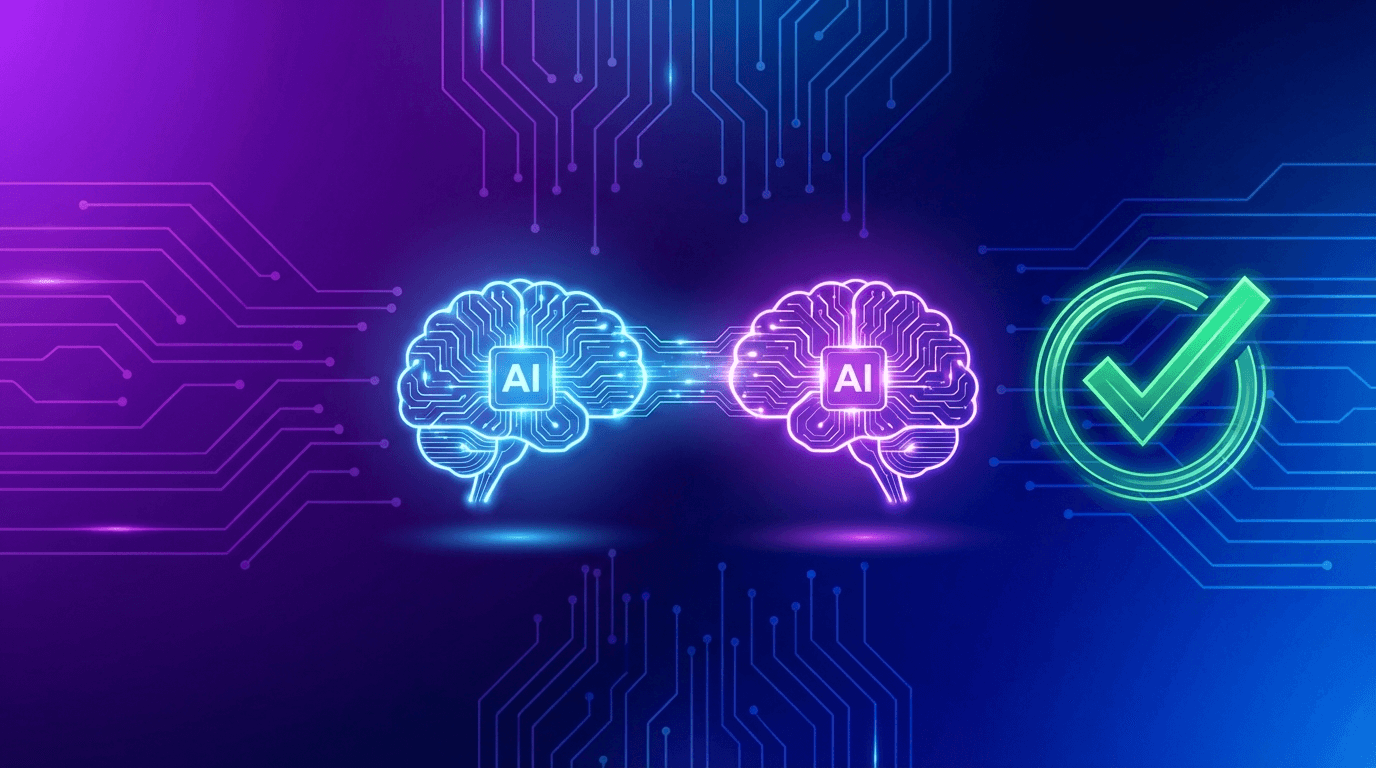
Microsoft 365 Copilot's new Critique feature pairs GPT and Claude in sequence, improving deep research accuracy by 13.8% on the DRACO benchmark.
GPT Drafts, Claude Reviews, Users Win
On March 30, 2026, Microsoft announced a fundamental change to how its Copilot Researcher agent processes queries. Instead of relying on a single AI model to handle every step, the new Critique feature puts two frontier models to work in sequence: OpenAI's GPT drafts a research response, and Anthropic's Claude reviews it for accuracy, completeness, and citation integrity before the answer reaches the user.
The feature launched as part of the Copilot Cowork initiative within the Frontier preview program. It represents the first time a major productivity platform has formally integrated rival AI models into a single cooperative workflow, and the results suggest the approach has measurable advantages over any single model working alone.
How Critique Works
The Critique workflow operates through a clearly defined division of labor. When a user submits a research query through Copilot Researcher, the system follows a three-stage process.
First, GPT generates a comprehensive draft response. The model draws on its training data and any connected enterprise context to produce an initial answer with citations, analysis, and supporting evidence.
Second, Claude receives the draft and evaluates it across three dimensions: factual accuracy, completeness of coverage, and citation quality. Claude flags errors, identifies gaps in the analysis, and verifies that sources actually support the claims being made. This is not a superficial review. Claude acts as an independent auditor with full authority to request corrections.
Third, the system incorporates Claude's feedback, revises the response, and delivers the final output to the user. The entire process runs automatically with no additional user input required beyond the original query.
Crucially, the roles can be reversed. Users can configure the system so that Claude drafts the initial response and GPT performs the fact-checking review. This flexibility allows organizations to optimize the workflow based on the specific strengths each model brings to different types of queries.
13.8% Improvement on DRACO
The multi-model approach produces measurable quality gains. Microsoft reports that the Critique workflow scores 13.8% higher on DRACO (Deep Research Accuracy, Completeness, and Objectivity), the industry-standard benchmark for evaluating deep research quality.
This improvement puts Copilot Researcher ahead of standalone deep-research tools from OpenAI, Google, Perplexity, and Anthropic on the same benchmark. The result is notable because it suggests that combining two models cooperatively outperforms either model working alone, even when those individual models are among the most capable in the world.
The DRACO benchmark evaluates three specific qualities. Accuracy measures whether factual claims are correct and properly sourced. Completeness assesses whether the response covers all relevant aspects of the query. Objectivity evaluates whether the analysis presents balanced perspectives without unwarranted bias. The 13.8% composite improvement indicates gains across all three dimensions.
Model Council: Beyond One-on-One Review
Beyond the Critique pairing, Microsoft also introduced a Model Council feature within Researcher. This tool distributes the same prompt across multiple AI models simultaneously and presents users with a comparative view showing where the models agree, where they diverge, and where each produces unique insights.
Model Council is designed for situations where the stakes of a research query are high enough to warrant multiple independent perspectives. A financial analyst researching a market trend, for example, could see how GPT, Claude, and other available models interpret the same data, identifying areas of consensus as strong signals and areas of disagreement as topics requiring further investigation.
The Council approach mirrors a pattern already emerging in enterprise AI deployment. Several organizations have begun routing critical queries through multiple models as a form of quality assurance. Microsoft is formalizing this practice into a native product feature.
Copilot Cowork: The Broader Context
Critique and Model Council are components of Copilot Cowork, Microsoft's framework for long-running, multi-step AI workflows within Microsoft 365. Cowork is designed to handle tasks that are too complex for a single prompt-response cycle, such as multi-day research projects, iterative document drafting, and cross-application workflows that span Word, Excel, PowerPoint, and Outlook.
Cowork entered the Frontier preview program on March 30, 2026. The Frontier program is Microsoft's early-access tier for experimental Copilot features, available to organizations with Microsoft 365 E3 or E5 licenses that opt into preview features. A broader general availability rollout has not been announced.
Why This Matters
Microsoft's decision to integrate Claude into its flagship productivity AI carries implications that extend beyond the Copilot product line.
First, it validates the multi-model architecture. The industry has debated whether using multiple AI models cooperatively produces better results than investing in a single, more capable model. Microsoft's 13.8% DRACO improvement provides concrete evidence that model diversity has measurable value, at least for research-intensive tasks.
Second, it challenges the assumption of AI provider exclusivity. Microsoft has invested $13 billion in OpenAI and built Copilot primarily on GPT models. The decision to bring in Anthropic's Claude as a fact-checker for GPT signals that Microsoft prioritizes output quality over vendor loyalty. This pragmatic approach could accelerate similar multi-model strategies across the enterprise software industry.
Third, it creates a new competitive dynamic. Anthropic's Claude is now embedded in both Apple's upcoming Siri Extensions and Microsoft's Copilot workflow. For a company that does not operate its own consumer platform, these integrations give Claude distribution reach that rivals ChatGPT's direct consumer install base.
Fourth, it reframes what "AI assistant" means in enterprise contexts. Rather than a single chatbot answering questions, Copilot Researcher now operates more like a research team with built-in peer review. This model may become the standard for enterprise AI deployments where accuracy and reliability matter more than response speed.
Conclusion
Microsoft's Critique feature is a practical acknowledgment that no single AI model excels at everything. By pairing GPT's generation capabilities with Claude's analytical rigor, Copilot Researcher achieves research quality that neither model delivers alone. The 13.8% DRACO improvement is significant not because of the number itself, but because of what it implies: the future of enterprise AI may be less about choosing the best model and more about orchestrating the right combination of models for each task. For the 400 million Microsoft 365 users who rely on Copilot, this multi-model approach promises more accurate, more complete, and more trustworthy AI-assisted research.
Editor's Verdict
Microsoft Copilot Now Uses Claude to Fact-Check GPT: Multi-Model Research Arrives earns a solid recommendation within the ai tools space.
The strongest case for paying attention is 13.8% measurable improvement in research quality through multi-model cooperation on DRACO benchmark, which raises the bar for what readers should now expect from peers in this space. Reinforcing that, flexible role assignment lets users choose which model drafts and which reviews based on task requirements adds practical value rather than just headline appeal. The broader signal worth registering is straightforward: microsoft's integration of Claude into Copilot validates the multi-model architecture as superior to single-model approaches for research tasks. On the other side of the ledger, only available through Frontier preview program, limiting access to E3/E5 enterprise customers who opt in is a real constraint, not a marketing footnote, and it should factor into any serious decision. Layered on top of that, multi-model workflow likely increases latency compared to single-model responses due to sequential processing narrows the set of teams for whom this is an obvious yes.
For product teams, content creators, and knowledge workers looking to upgrade a specific workflow, this is a serious evaluation candidate, not just a curiosity to bookmark. For everyone else, the safer posture is to monitor coverage and revisit once the use cases that matter to your team are demonstrated in the wild.
Pros
- 13.8% measurable improvement in research quality through multi-model cooperation on DRACO benchmark
- Flexible role assignment lets users choose which model drafts and which reviews based on task requirements
- Model Council provides multiple independent perspectives on high-stakes research queries
- Automated workflow requires no additional user input beyond the original query
- Demonstrates that combining rival AI models cooperatively outperforms either model working alone
Cons
- Only available through Frontier preview program, limiting access to E3/E5 enterprise customers who opt in
- Multi-model workflow likely increases latency compared to single-model responses due to sequential processing
- Running two frontier models per query increases computational cost and may affect pricing at general availability
- General availability timeline has not been announced, leaving the broader rollout schedule uncertain
References
Comments0
Key Features
1. Critique feature pairs GPT and Claude in a sequential workflow where GPT drafts responses and Claude reviews them for accuracy, completeness, and citation integrity 2. 13.8% improvement on the DRACO benchmark (Deep Research Accuracy, Completeness, and Objectivity) compared to single-model approaches 3. Model Council distributes prompts across multiple AI models simultaneously, showing where they agree, diverge, and produce unique insights 4. Roles are reversible, allowing Claude to draft and GPT to review, optimizing for different query types 5. Part of Copilot Cowork framework for long-running, multi-step AI workflows across Microsoft 365 applications
Key Insights
- Microsoft's integration of Claude into Copilot validates the multi-model architecture as superior to single-model approaches for research tasks
- The 13.8% DRACO improvement puts Copilot Researcher ahead of standalone deep-research tools from OpenAI, Google, Perplexity, and Anthropic
- Microsoft prioritizing output quality over vendor loyalty signals a pragmatic shift despite its $13 billion investment in OpenAI
- Claude is now embedded in both Apple Siri Extensions and Microsoft Copilot, giving Anthropic distribution reach rivaling ChatGPT
- Model Council formalizes the emerging enterprise practice of routing critical queries through multiple AI models for quality assurance
- The Critique workflow suggests the future of enterprise AI is about orchestrating model combinations rather than selecting a single best model
- Copilot Cowork's Frontier preview availability limits initial access to E3/E5 enterprise customers opting into experimental features
Was this review helpful?
Share
Related AI Reviews

Daydream Adds iOS 27 Photo Shopping and Siri Search
Fashion app Daydream uses Apple's iOS 27 tools to turn saved outfit photos into shoppable matches, plus Siri natural-language search.

Roland Melody Flip: Free AI Melody Plug-In With Sony CSL
Roland's free Melody Flip plug-in uses Sony CSL music analysis and 250+ Palettes to help musicians generate MIDI melody, chord, bass, and drum ideas.

Microsoft's MAI-Transcribe-2: Cheap, Fast Speech-to-Text
Microsoft's MAI-Transcribe-2 tops the FLEURS benchmark across 60 languages and costs $0.10 per audio hour, undercutting OpenAI, Google and ElevenLabs.

Testers Praise Instinct AI Agent but Flag Privacy Risks
TechCrunch: testers praise Instinct AI agent for autonomous task skill but flag its data-license terms, unapproved actions, and phishing exposure.