
Jensen Huang Declares AGI Has Been Achieved: NVIDIA CEO's Bold Claim on Lex Fridman Podcast
NVIDIA CEO Jensen Huang told Lex Fridman that AGI has been achieved, citing AI agents that can autonomously create billion-dollar businesses, though he hedged with significant caveats.
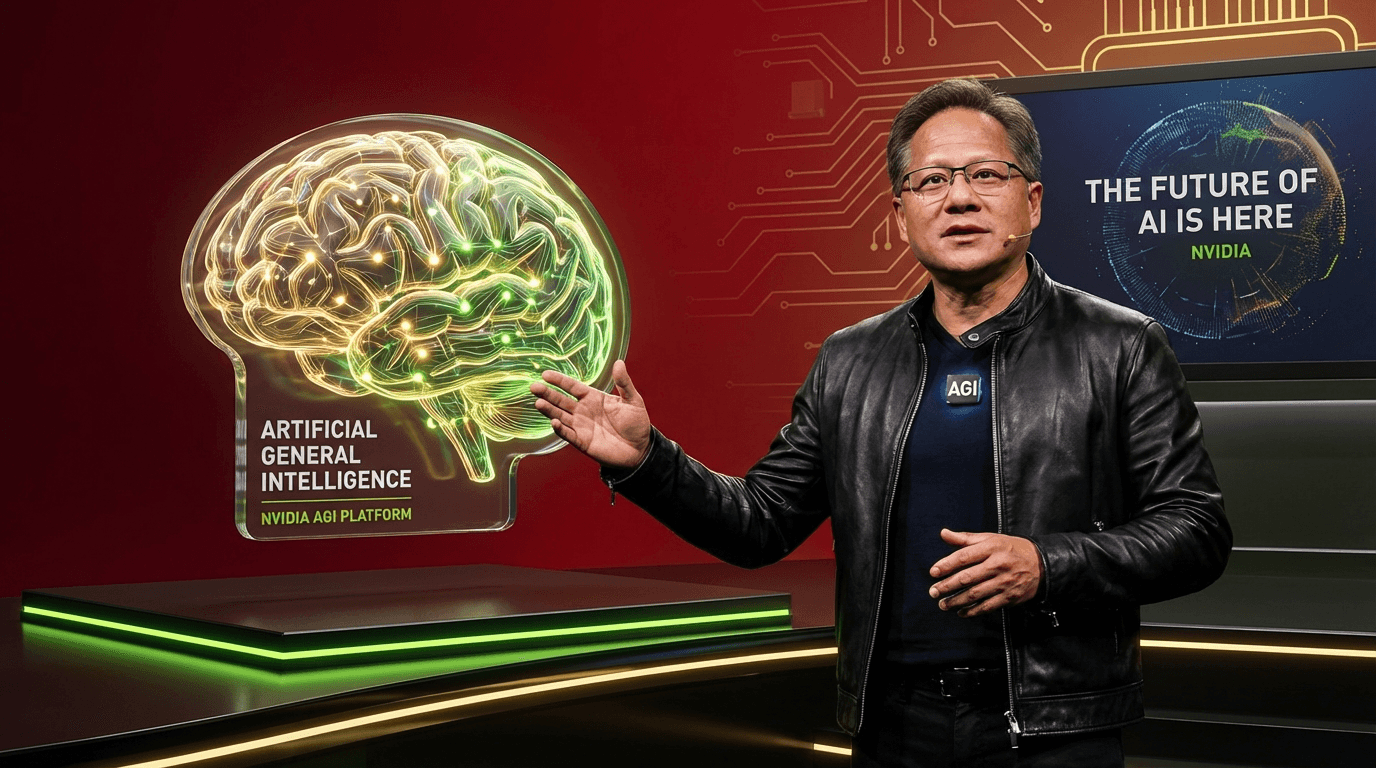
NVIDIA CEO Jensen Huang told Lex Fridman that AGI has been achieved, citing AI agents that can autonomously create billion-dollar businesses, though he hedged with significant caveats.
The Claim That Shook the AI World
On March 29, 2026, NVIDIA CEO Jensen Huang made one of the most provocative statements in AI history during an appearance on the Lex Fridman Podcast. When asked about the timeline for AI systems capable of building and running a billion-dollar technology company, Huang responded simply: "I think it's now. I think we've achieved AGI."
The comment immediately rippled through the AI community, tech media, and financial markets. Coming from the leader of the world's most valuable semiconductor company, a firm whose $4 trillion market capitalization is built almost entirely on AI infrastructure demand, the statement carries unusual weight. But as with most claims about artificial general intelligence, the details matter far more than the headline.
What Huang Actually Said
Huang's AGI claim was not a sweeping declaration that machines now match human cognition in all domains. His framing was notably specific and heavily qualified.
The context was Fridman's question about whether AI could autonomously start, grow, and operate a successful technology company. Huang argued that current AI models, particularly frontier-class agents, can already perform at "roughly high-human level" in language understanding, code generation, and knowledge work, while operating "thousands of times faster" than human workers.
He pointed to open-source agent platforms such as OpenClaw, where autonomous AI systems perform tasks that generate real revenue, build applications, and operate with limited human oversight. In Huang's framing, if an AI system can create something of genuine economic value, even temporarily, the threshold for AGI has been crossed.
But he added a crucial caveat: the hypothetical AI-created billion-dollar company "might go out of business again shortly after." Success, in his definition, does not need to be permanent. This is a significantly narrower interpretation of AGI than what most AI researchers use.
The Definition Problem
The reaction to Huang's claim exposed the fundamental lack of consensus on what AGI actually means.
The traditional academic definition, popularized by researchers like Shane Legg (co-founder of DeepMind) and Ben Goertzel, describes AGI as an artificial system that matches or exceeds human cognitive abilities across the full range of intellectual tasks. Under this definition, current AI models, which excel at language and pattern recognition but struggle with novel physical reasoning, common sense, and open-ended creativity, do not qualify.
Huang's working definition is far more pragmatic: can AI autonomously create significant economic value? By this measure, the answer is arguably yes. AI agents today write production code, manage customer service interactions, generate marketing content, and execute trades. Intercom's Fin Apex model, announced just days before Huang's interview, handles millions of customer conversations weekly without human intervention.
| Definition | Proponent | AGI Achieved? |
|---|---|---|
| Full human-level cognition across all domains | Shane Legg, DeepMind | No |
| Autonomous economic value creation | Jensen Huang, NVIDIA | Arguably yes |
| Pass a broad battery of human expert tests | OpenAI (internal) | Partially |
| Self-improving recursive intelligence | Eliezer Yudkowsky | No |
Why Huang's Position Matters
Regardless of whether one agrees with Huang's definition, his statement matters for several reasons.
First, NVIDIA's business model depends on continued AI infrastructure investment. If the CEO of the company selling the shovels in an AI gold rush declares the gold has been found, it signals confidence in sustained demand for GPU compute. NVIDIA's data center revenue hit $35.6 billion in Q4 FY2026 alone, and the company's Rubin architecture is already in production for next-generation AI training clusters.
Second, Huang's framing shifts the AGI conversation from theoretical capabilities to practical economics. Rather than debating whether AI can pass the Turing test or solve arbitrary mathematical proofs, he asks whether AI can generate real revenue. This reframing resonates with enterprise buyers who care less about philosophical milestones than about return on investment.
Third, the timing aligns with a broader wave of AGI-adjacent claims from industry leaders. OpenAI's Sam Altman has described GPT-5 as approaching human-level performance on many benchmarks. Anthropic's internal planning documents, leaked earlier in March, describe Claude Mythos as a "step change" in capabilities. The industry appears to be converging on the view that current models are, at minimum, approaching some meaningful threshold.
The Skeptic's Response
Not everyone was persuaded. Multiple AI researchers pushed back within hours of the podcast's release.
TechRadar published an analysis titled "Sorry Jensen Huang, we haven't achieved AGI," arguing that economic value creation is an insufficient benchmark. The piece noted that specialized tools have generated economic value for decades without anyone calling a spreadsheet program artificially intelligent.
The core counterargument is straightforward: current AI models are sophisticated pattern matchers, not general reasoners. They excel within trained domains but fail unpredictably on novel tasks. A system that can write excellent code but cannot reliably plan a multi-step physical task in an unfamiliar environment does not meet any reasonable definition of general intelligence.
Others pointed out the inherent conflict of interest. As the primary hardware supplier for AI training and inference, Huang has a direct financial incentive to declare the AI revolution a success. Every declaration of progress supports continued capital expenditure on NVIDIA GPUs.
What the Data Shows
The objective performance data tells a nuanced story.
Frontier models in early 2026 achieve expert-level performance on standardized tests across law, medicine, mathematics, and coding. GPT-5.4, Claude Opus 4.6, and Gemini 3.1 Pro all score above the 90th percentile on bar exams, medical licensing exams, and competitive programming benchmarks.
However, these same models still struggle with basic spatial reasoning, long-horizon planning, and tasks requiring genuine world knowledge that was not in their training data. The gap between benchmark performance and robust general capability remains significant.
Conclusion
Jensen Huang's AGI declaration is simultaneously meaningful and misleading. It is meaningful because it reflects the genuine and rapid expansion of AI capabilities into economically productive domains. AI agents are creating real value today, and their capabilities are improving rapidly. It is misleading because it conflates narrow economic productivity with the broader concept of general intelligence that the term AGI was coined to describe.
What Huang has effectively done is propose a new, commercially oriented definition of AGI: one where the benchmark is economic output rather than cognitive generality. Whether the AI community adopts this definition will depend less on philosophical debates and more on whether AI agents continue to deliver measurable business results. For enterprise decision-makers, Huang's practical framing may ultimately prove more useful than academic definitions, even if researchers find it imprecise.
Editor's Verdict
Jensen Huang Declares AGI Has Been Achieved: NVIDIA CEO's Bold Claim on Lex Fridman Podcast earns a solid recommendation within the it news space.
The strongest case for paying attention is reframes the AGI discussion around practical economic value rather than abstract cognitive benchmarks, which raises the bar for what readers should now expect from peers in this space. Reinforcing that, backed by concrete examples of AI agents generating real revenue in production environments adds practical value rather than just headline appeal. The broader signal worth registering is straightforward: huang's AGI claim uses a commercially oriented definition focused on economic value creation rather than the traditional cognitive benchmark. On the other side of the ledger, conflates narrow task performance with genuine general intelligence across all cognitive domains is a real constraint, not a marketing footnote, and it should factor into any serious decision. Layered on top of that, carries an inherent conflict of interest given NVIDIA's dependence on continued AI infrastructure spending narrows the set of teams for whom this is an obvious yes.
For AI industry watchers, strategy teams, and decision-makers tracking platform shifts, this is a serious evaluation candidate, not just a curiosity to bookmark. For everyone else, the safer posture is to monitor coverage and revisit once the use cases that matter to your team are demonstrated in the wild.
Pros
- Reframes the AGI discussion around practical economic value rather than abstract cognitive benchmarks
- Backed by concrete examples of AI agents generating real revenue in production environments
- Reflects genuine and measurable improvements in AI capabilities across coding, reasoning, and knowledge work
- Provides enterprise decision-makers with a commercially relevant framework for evaluating AI progress
Cons
- Conflates narrow task performance with genuine general intelligence across all cognitive domains
- Carries an inherent conflict of interest given NVIDIA's dependence on continued AI infrastructure spending
- Current models still fail unpredictably on novel tasks, spatial reasoning, and long-horizon planning
- Risk of inflating expectations and driving unsustainable investment based on premature AGI claims
References
Comments0
Key Features
1. NVIDIA CEO Jensen Huang declared on the Lex Fridman Podcast on March 29 that AGI has been achieved, citing AI agents that autonomously create economic value 2. Huang's AGI definition is pragmatic and commercially oriented: AI systems that can build billion-dollar businesses, even if temporarily 3. The claim is heavily qualified, with Huang acknowledging that AI-created ventures might be short-lived and that sustainability is not guaranteed 4. He cited open-source agent platforms like OpenClaw as evidence of autonomous AI systems generating real revenue 5. The statement comes amid a wave of AGI-adjacent claims from OpenAI, Anthropic, and other industry leaders in early 2026
Key Insights
- Huang's AGI claim uses a commercially oriented definition focused on economic value creation rather than the traditional cognitive benchmark
- The statement aligns with NVIDIA's business interests in sustaining demand for AI infrastructure and GPU compute
- AI researchers widely pushed back, arguing that narrow economic productivity does not constitute general intelligence
- Current frontier models achieve expert-level performance on standardized tests but still struggle with spatial reasoning and novel tasks
- The AGI definition debate has shifted from theoretical capability milestones to practical economic output measures
- Multiple industry leaders including Altman and leaked Anthropic documents suggest convergence on the view that models are approaching a meaningful threshold
- The conflict of interest in hardware vendors declaring AI success is a legitimate concern raised by multiple analysts
Was this review helpful?
Share
Related AI Reviews

Judge Dismisses Chegg, Penske Suits Over Google AI Overviews
Judge Mehta granted Google's motions to dismiss both suits over AI Overviews on Sept 30; the court declined to rule on the state-law claim.

Reddit Ends RSS Feeds Nov 13 and Closes Public API by March
Reddit will stop RSS on Nov 13, 2026 and close public API access by March 2027, citing scraping and abuse. Registered apps can migrate to Devvit.

AMD to Acquire Fei-Fei Li's World Labs for $8.2B in Stock
AMD agreed to acquire World Labs for about $8.2 billion in stock; Fei-Fei Li would become AMD's chief scientist. Closing is expected by end of 2026.

Apple Reference Image: How iPhone 18 Pro Proves Photos Real
Apple's new iPhone 18 Pro camera signs sensor data at capture, letting users compare an unalterable reference image to verify a photo wasn't edited.