
Intercom Fin Apex 1.0: The Vertical AI Model That Beats GPT-5.4 and Claude
Intercom shipped Fin Apex 1.0, a domain-specific model achieving 73.1% resolution rate on customer support, beating GPT-5.4 and Claude Opus 4.5 while running faster and cheaper.
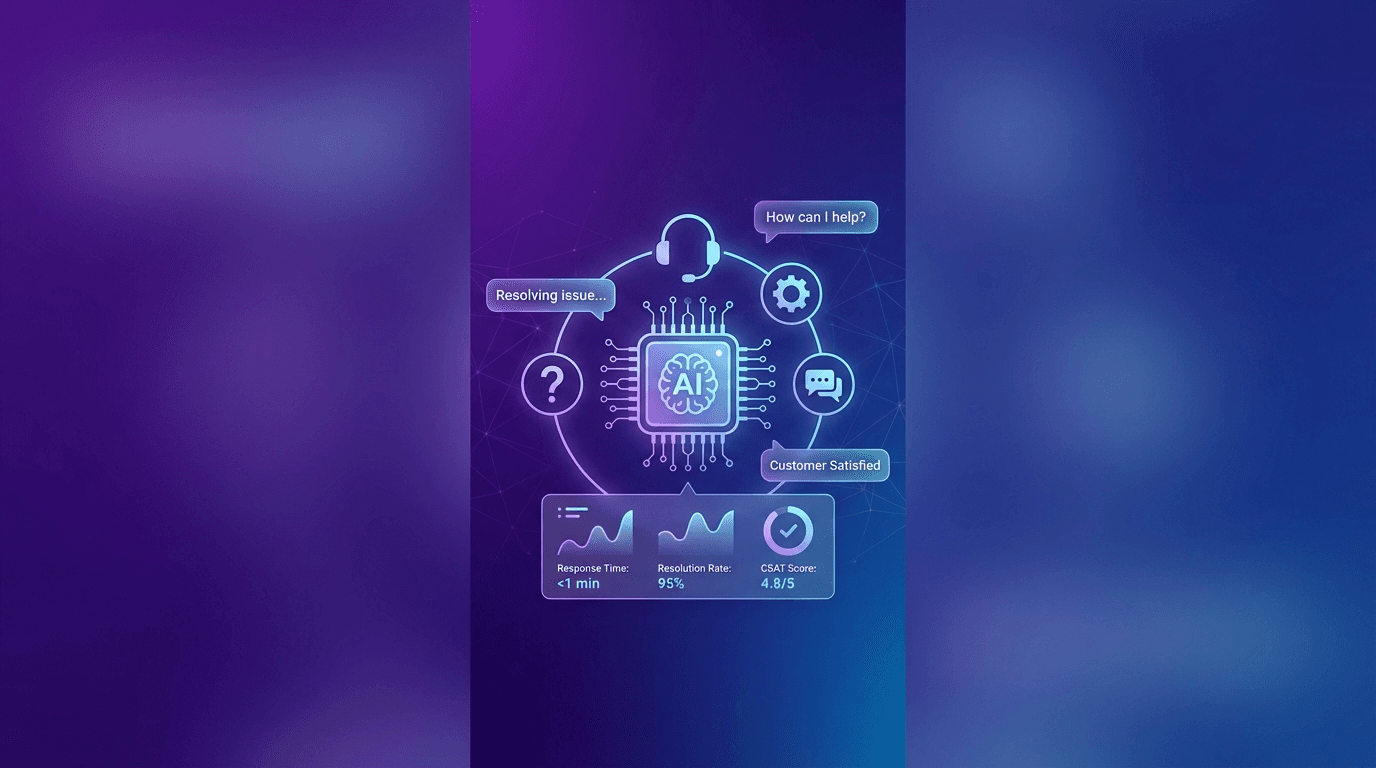
Intercom shipped Fin Apex 1.0, a domain-specific model achieving 73.1% resolution rate on customer support, beating GPT-5.4 and Claude Opus 4.5 while running faster and cheaper.
The Age of Vertical AI Models Has Arrived
On March 28, 2026, Intercom CEO Eoghan McCabe announced Fin Apex 1.0, a purpose-built AI model for customer service that outperforms every major frontier model on the metrics that matter most for support operations. The announcement marks a turning point in the AI industry: the first credible demonstration that a domain-specific, post-trained model can consistently beat general-purpose giants like GPT-5.4 and Claude Opus 4.5 in a specific vertical.
Fin Apex is not a fine-tuned wrapper around an existing foundation model. It is a new model developed by Intercom's internal AI group, trained on billions of customer service interactions accumulated through Fin's operational history. The model now powers approximately 100% of English-language chat and email conversations through Intercom's Fin AI agent, handling over two million customer conversations every week.
Performance: The Numbers That Matter
The headline metric for any AI customer service agent is resolution rate, the percentage of customer issues fully resolved without human intervention. Fin Apex 1.0 achieves a 73.1% resolution rate, compared to 71.1% for both GPT-5.4 and Claude Opus 4.5, and 69.6% for Claude Sonnet 4.6.
A two-percentage-point improvement may sound incremental, but at Intercom's scale, it translates to tens of thousands of additional automated resolutions per week. One major gaming sector customer reported an overnight jump from 68% to 75% resolution rate after switching to Apex, a reduction in unresolved conversations of 22%. Intercom described this as the largest single-improvement jump since Fin's inception.
| Model | Resolution Rate | Speed | Cost |
|---|---|---|---|
| Fin Apex 1.0 | 73.1% | Fastest | Lowest |
| GPT-5.4 | 71.1% | Moderate | Higher |
| Claude Opus 4.5 | 71.1% | Moderate | Higher |
| Claude Sonnet 4.6 | 69.6% | Fast | Moderate |
Beyond resolution rate, Apex also leads on speed (fastest response times among tested models), cost (lowest per-conversation expense), and hallucination rate (fewer factually incorrect responses). Intercom claims it is "objectively the highest performing, fastest, and cheapest model for customer service."
How Apex Was Built
Apex was not built from scratch in the traditional foundation model sense. Instead, Intercom's approach relies on domain-specific post-training, a technique where a base model is extensively fine-tuned and evaluated against real-world customer service data.
The critical advantage is data. Intercom processes over two million customer conversations weekly through Fin, generating a continuous stream of labeled training data. Every resolved conversation, every escalation to a human agent, and every customer satisfaction score becomes a training signal. This creates what Intercom calls a "flywheel" effect: the more Fin handles conversations, the more data Apex has to train on, which makes Fin better at handling conversations.
Intercom grew its AI team from roughly six researchers to 60 over the past three years, reflecting a strategic bet that domain expertise combined with proprietary data would eventually outperform general-purpose models in specific verticals.
Why This Matters for the AI Industry
Fin Apex represents a significant shift in the competitive dynamics of the AI market. Until now, the prevailing assumption was that frontier foundation models would dominate all applications, with companies like OpenAI, Anthropic, and Google competing on general capability. Apex challenges this by demonstrating that vertical specialization can beat horizontal scale.
The implications are far-reaching. If Intercom can build a model that outperforms GPT-5.4 in customer service, it is reasonable to expect similar outcomes in other verticals. Legal AI companies training on court filings, medical AI companies training on clinical records, and financial AI companies training on trading data could all potentially develop models that surpass frontier generalists in their specific domains.
This does not mean foundation models become irrelevant. They remain essential as the base layer for post-training and as general-purpose tools for tasks without sufficient domain-specific data. But the ceiling for specialized applications may increasingly be set by domain-specific models rather than general-purpose ones.
The Business Case
Fin is approaching $100 million in annual recurring revenue and growing at 3.5x, making it the fastest-growing segment of Intercom's $400 million ARR business. The revenue trajectory validates the product-market fit for AI-powered customer service, but Apex changes the economics further.
By running on a proprietary model rather than paying per-token costs to OpenAI or Anthropic, Intercom can reduce its cost of goods sold on AI inference. Lower costs per conversation mean higher margins, which in turn fund further model development. The flywheel extends beyond data to economics.
For Intercom's customers, the value proposition is straightforward: higher resolution rates mean fewer conversations escalated to human agents, which directly reduces headcount requirements in support organizations. A customer with 100,000 monthly support conversations moving from 69% to 73% resolution rate eliminates approximately 4,000 human-handled conversations per month.
Limitations and Open Questions
Apex 1.0 currently covers only English-language chat and email. Intercom has not disclosed plans for multilingual support, voice channels, or more complex multi-step resolution workflows. The 73.1% resolution rate, while best-in-class, still means that more than one in four customer issues requires human intervention.
The benchmark comparisons also deserve scrutiny. Intercom evaluated models on its own customer base and use cases, not on a standardized third-party benchmark. Performance on Intercom's data may not generalize to other customer service platforms with different conversation distributions.
Additionally, the long-term competitive dynamics are uncertain. OpenAI, Anthropic, and Google all have the resources to develop their own customer service-optimized models or to partner with enterprise software companies to do so. Intercom's data moat is real but not necessarily permanent.
Conclusion
Fin Apex 1.0 is the clearest evidence yet that the future of enterprise AI is not just about bigger foundation models but about smarter specialization. By combining domain expertise, proprietary data, and focused post-training, Intercom has produced a model that outperforms the world's most capable general-purpose AI systems in a specific, high-value vertical. For SaaS companies and enterprise software vendors sitting on large proprietary datasets, Apex is both a blueprint and a warning: the data you are collecting today may be your most valuable AI asset tomorrow.
Editor's Verdict
Intercom Fin Apex 1.0: The Vertical AI Model That Beats GPT-5.4 and Claude earns a solid recommendation within the ai tools space.
The strongest case for paying attention is highest resolution rate (73.1%) among all tested models including GPT-5.4 and Claude Opus 4.5, which raises the bar for what readers should now expect from peers in this space. Reinforcing that, fastest response times and lowest per-conversation cost reduce total cost of ownership for customers adds practical value rather than just headline appeal. The broader signal worth registering is straightforward: vertical AI models can outperform general-purpose frontier models when trained on sufficient domain-specific data. On the other side of the ledger, currently limited to English-language chat and email with no disclosed multilingual or voice support is a real constraint, not a marketing footnote, and it should factor into any serious decision. Layered on top of that, benchmarks are based on Intercom's own data rather than standardized third-party evaluation narrows the set of teams for whom this is an obvious yes.
For product teams, content creators, and knowledge workers looking to upgrade a specific workflow, this is a serious evaluation candidate, not just a curiosity to bookmark. For everyone else, the safer posture is to monitor coverage and revisit once the use cases that matter to your team are demonstrated in the wild.
Pros
- Highest resolution rate (73.1%) among all tested models including GPT-5.4 and Claude Opus 4.5
- Fastest response times and lowest per-conversation cost reduce total cost of ownership for customers
- Data flywheel from 2+ million weekly conversations creates a self-reinforcing competitive advantage
- Reduces customer support headcount requirements by automating a higher percentage of conversations
- Proprietary model eliminates dependency on third-party AI providers for core functionality
Cons
- Currently limited to English-language chat and email with no disclosed multilingual or voice support
- Benchmarks are based on Intercom's own data rather than standardized third-party evaluation
- 73.1% resolution rate still means over one in four issues require human intervention
- OpenAI, Anthropic, and Google have the resources to develop competing customer service-optimized models
References
Comments0
Key Features
1. Fin Apex 1.0 achieves a 73.1% customer service resolution rate, outperforming GPT-5.4 (71.1%) and Claude Opus 4.5 (71.1%) 2. Purpose-built through domain-specific post-training on billions of customer service interactions, not a fine-tuned wrapper 3. Powers 100% of English-language chat and email through Intercom's Fin agent, handling 2+ million conversations weekly 4. Delivers the fastest response times and lowest per-conversation cost among all tested models 5. Intercom's Fin product line approaching $100M ARR growing at 3.5x, within a $400M ARR business
Key Insights
- Vertical AI models can outperform general-purpose frontier models when trained on sufficient domain-specific data
- Intercom's data flywheel of 2+ million weekly conversations creates a compounding advantage that is difficult for competitors to replicate
- The 22% reduction in unresolved conversations for one gaming customer demonstrates the real-world business impact of even small resolution rate improvements
- Domain-specific post-training may become the standard approach for enterprise AI rather than relying solely on general-purpose models
- Fin's trajectory toward $100M ARR validates the product-market fit for AI customer service agents as a standalone revenue stream
- The shift from paying per-token costs to running proprietary models fundamentally changes SaaS economics for AI-powered features
- Foundation models remain essential as the base layer, but the performance ceiling in specific verticals is increasingly set by specialized models
Was this review helpful?
Share
Related AI Reviews

Daydream Adds iOS 27 Photo Shopping and Siri Search
Fashion app Daydream uses Apple's iOS 27 tools to turn saved outfit photos into shoppable matches, plus Siri natural-language search.

Roland Melody Flip: Free AI Melody Plug-In With Sony CSL
Roland's free Melody Flip plug-in uses Sony CSL music analysis and 250+ Palettes to help musicians generate MIDI melody, chord, bass, and drum ideas.

Microsoft's MAI-Transcribe-2: Cheap, Fast Speech-to-Text
Microsoft's MAI-Transcribe-2 tops the FLEURS benchmark across 60 languages and costs $0.10 per audio hour, undercutting OpenAI, Google and ElevenLabs.

Testers Praise Instinct AI Agent but Flag Privacy Risks
TechCrunch: testers praise Instinct AI agent for autonomous task skill but flag its data-license terms, unapproved actions, and phishing exposure.