
GPT-5.3 Instant: OpenAI Cuts Hallucinations by 26.8% and Drops the 'Cringe'
OpenAI released GPT-5.3 Instant on March 3, 2026, reducing hallucination rates by up to 26.8% while eliminating the overly cautious, preachy tone that frustrated ChatGPT users.
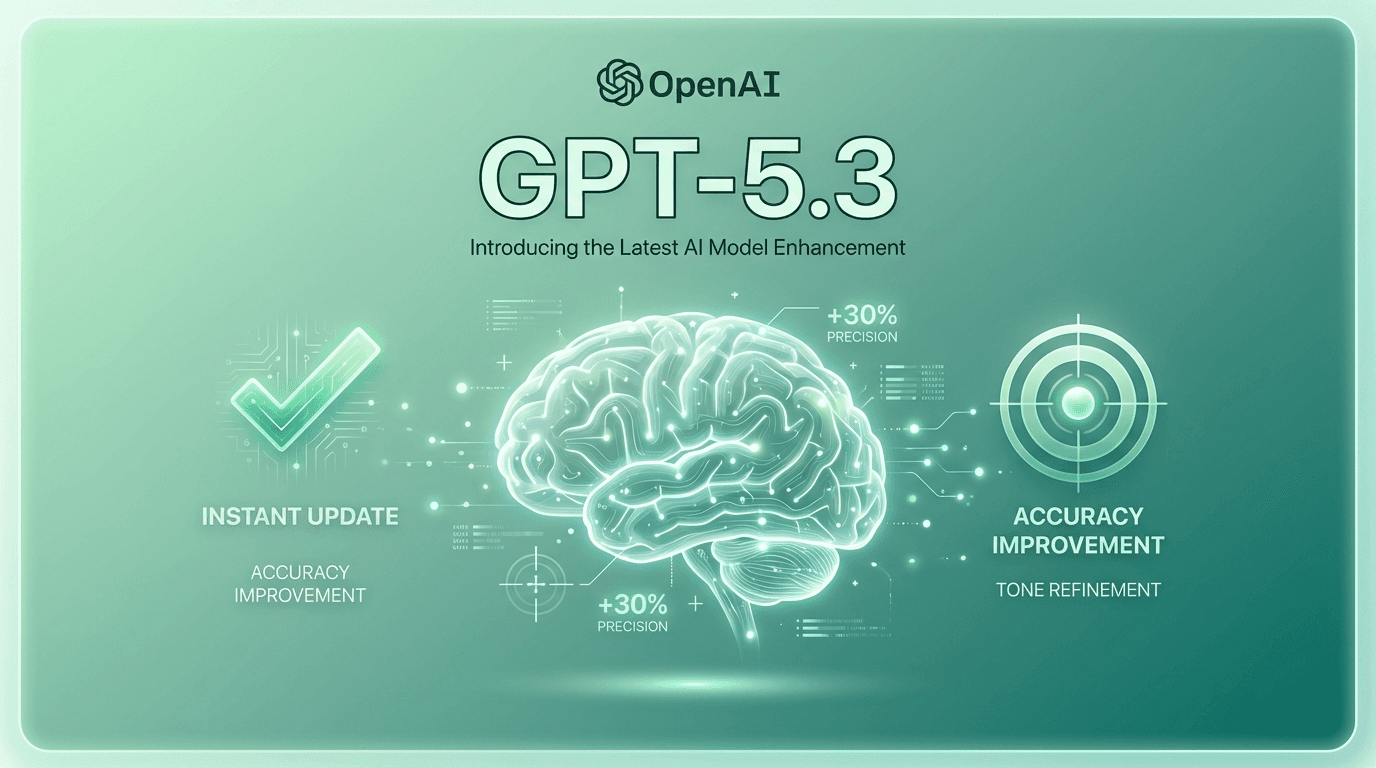
OpenAI released GPT-5.3 Instant on March 3, 2026, reducing hallucination rates by up to 26.8% while eliminating the overly cautious, preachy tone that frustrated ChatGPT users.
Addressing ChatGPT's Personality Problem
On March 3, 2026, OpenAI released GPT-5.3 Instant as the new default model powering ChatGPT, replacing GPT-5.2 Instant. The update targets two persistent user complaints: hallucinations and what users have broadly described as "cringe" conversational behavior, including unnecessary refusals, moralizing preambles, and overly cautious responses that prioritize safety theater over usefulness.
OpenAI described the update as delivering "more accurate answers, richer and better-contextualized results when searching the web, and reducing unnecessary dead ends, caveats, and overly declarative phrasing." The framing is notable: OpenAI is publicly acknowledging that its previous model's personality was a problem, not just a feature request.
Hallucination Reduction: The Numbers
The most substantive improvement in GPT-5.3 Instant is measurable accuracy. OpenAI conducted two evaluation frameworks to quantify hallucination reduction:
Higher-Stakes Evaluation (medicine, law, finance domains):
| Condition | Hallucination Reduction |
|---|---|
| With web access | 26.8% |
| Internal knowledge only | 19.7% |
User-Feedback Evaluation (based on flagged factual errors in real conversations):
| Condition | Hallucination Reduction |
|---|---|
| With web access | 22.5% |
| Internal knowledge only | 9.6% |
OpenAI's internal evaluations showed hallucination rates dropped by nearly 30% overall. These are significant improvements, particularly in high-stakes domains where factual accuracy has direct consequences. A 26.8% reduction in medical, legal, and financial hallucinations addresses one of the most critical barriers to professional AI adoption.
The differential between web-enabled and knowledge-only performance is informative. GPT-5.3 Instant benefits more from web access, suggesting improvements in how the model integrates, evaluates, and synthesizes web search results rather than relying solely on potentially outdated training data.
The 'Cringe' Fix: Tone and Behavioral Changes
Beyond accuracy, GPT-5.3 Instant addresses the conversational patterns that earned ChatGPT the "cringe" label from its user base. The specific behavioral changes include:
Reduced Unnecessary Refusals: GPT-5.2 Instant would sometimes refuse to answer questions it could safely address, particularly around sensitive topics. GPT-5.3 Instant significantly reduces these false positive refusals while maintaining genuine safety boundaries.
Eliminated Moralizing Preambles: Previous versions would prepend responses with defensive disclaimers like "I understand this is a sensitive topic" or "It's important to note that" before answering straightforward questions. GPT-5.3 Instant delivers direct responses without performative caution.
Removed Patronizing Phrases: The model no longer responds with phrases like "Stop. Take a breath" or offers unsolicited emotional guidance when users ask factual questions. This was one of the most frequently criticized behaviors on social media.
Improved Writing Quality: OpenAI specifically noted improvements in creative writing, including poetry composition, where the model produces more natural and less formulaic output.
These changes reflect a broader shift in how OpenAI thinks about model personality. The company appears to have concluded that excessive caution itself creates a form of user harm by degrading trust and usefulness, and that a well-calibrated model can be both safe and direct.
Availability and Transition Timeline
GPT-5.3 Instant is available immediately to all ChatGPT users as the default model. For developers, it is accessible through the API as gpt-5.3-chat-latest.
OpenAI is providing a three-month transition period for the outgoing model:
| Detail | Information |
|---|---|
| Launch date | March 3, 2026 |
| Default model | GPT-5.3 Instant (all users) |
| API identifier | gpt-5.3-chat-latest |
| Legacy access | GPT-5.2 Instant (paid users, Legacy Models) |
| GPT-5.2 retirement | June 3, 2026 |
The three-month legacy window gives developers time to test their applications against the new model and adjust prompts or workflows as needed. This is a reasonable transition period, though developers with tightly calibrated prompts should test early, as tone and refusal behavior changes can affect downstream application logic.
Context: Timing and Competition
The release of GPT-5.3 Instant comes at a challenging moment for OpenAI. The QuitGPT movement has driven significant user migration to Claude, ChatGPT recently introduced ads for free-tier users, and public sentiment around OpenAI's Pentagon deal continues to generate negative coverage.
GPT-5.3 Instant does not address any of these external factors directly. It is a product improvement, not a reputation repair. However, by making ChatGPT measurably more accurate and less annoying, OpenAI is strengthening the core product argument for users who may be considering alternatives: whatever your feelings about the company, the product is getting better.
The same-day release alongside Google's Gemini 3.1 Flash-Lite highlights the accelerating pace of model updates. Where major model releases were once quarterly or semi-annual events, the industry is now producing meaningful updates on a near-weekly cadence.
Safety Considerations
The reduction in refusals and cautious language raises a legitimate question: has OpenAI traded safety for user satisfaction? Early analysis suggests the changes are more nuanced than a simple safety dial-down.
OpenAI has adjusted the calibration threshold for refusals, not eliminated safety boundaries. The model still refuses genuinely harmful requests. What has changed is the sensitivity level: queries that were previously caught by over-broad safety filters now receive direct answers. Whether this recalibration has introduced new edge cases where harmful content slips through will require ongoing monitoring by the safety research community.
Pros
- Hallucination reduction of 26.8% in high-stakes domains (medicine, law, finance) with web access directly addresses professional adoption barriers
- Elimination of unnecessary refusals and moralizing preambles makes conversations significantly more productive and natural
- Immediate availability to all ChatGPT users with no tier restrictions ensures broad impact
- Three-month legacy access window for GPT-5.2 gives developers adequate transition time
- Improved web search integration with 22.5% fewer hallucinations when using web access
Cons
- Reduced refusal sensitivity may create edge cases where harmful content receives less friction
- The 9.6% improvement without web access is modest compared to the 26.8% with web access, suggesting the model still has knowledge accuracy limitations
- No specific pricing information has been disclosed for the API model
- The improvements are primarily conversational rather than capability-expanding, leaving the model's reasoning ceiling unchanged
Outlook
GPT-5.3 Instant represents OpenAI's clearest acknowledgment that model personality and conversational quality are as important to user retention as raw capability. The hallucination reductions are genuinely significant, particularly in professional domains where trust in AI output has been the primary adoption blocker.
The tone changes signal a broader industry maturation. The early era of AI chatbots was defined by maximum caution, treating every query as potentially harmful. GPT-5.3 Instant moves toward a more calibrated approach that distinguishes between genuine risk and user inconvenience. If the safety tradeoffs prove well-managed, this calibration philosophy will likely influence the next generation of models across all providers.
Conclusion
GPT-5.3 Instant is not a revolutionary new model. It is a meaningful refinement of an existing one, focused on two specific problems: accuracy and personality. The 26.8% hallucination reduction in high-stakes domains and the elimination of patronizing conversational patterns make ChatGPT measurably better for daily use. For users who stayed with ChatGPT through the Pentagon controversy and the introduction of ads, GPT-5.3 Instant delivers a tangible product improvement. For those who left, it provides one data point in the argument for return.
Editor's Verdict
GPT-5.3 Instant: OpenAI Cuts Hallucinations by 26.8% and Drops the 'Cringe' earns a solid recommendation within the gpt space.
The strongest case for paying attention is 26.8% hallucination reduction in high-stakes domains with web access directly addresses professional adoption barriers, which raises the bar for what readers should now expect from peers in this space. Reinforcing that, elimination of unnecessary refusals and moralizing preambles makes conversations significantly more productive adds practical value rather than just headline appeal. The broader signal worth registering is straightforward: hallucination rates reduced by 26.8% in high-stakes domains (medicine, law, finance) when using web access, and 19.7% using internal knowledge only. On the other side of the ledger, reduced refusal sensitivity may create edge cases where harmful content receives less friction is a real constraint, not a marketing footnote, and it should factor into any serious decision. Layered on top of that, the 9.6% improvement without web access is modest, suggesting continued knowledge accuracy limitations narrows the set of teams for whom this is an obvious yes.
For ChatGPT power users, OpenAI API customers, and enterprise teams already running on the OpenAI stack, this is a serious evaluation candidate, not just a curiosity to bookmark. For everyone else, the safer posture is to monitor coverage and revisit once the use cases that matter to your team are demonstrated in the wild.
Pros
- 26.8% hallucination reduction in high-stakes domains with web access directly addresses professional adoption barriers
- Elimination of unnecessary refusals and moralizing preambles makes conversations significantly more productive
- Immediate availability to all ChatGPT users with no tier restrictions ensures broad impact
- Three-month legacy access window gives developers adequate transition time to test against the new model
- Improved web search integration with 22.5% fewer hallucinations when using web access
Cons
- Reduced refusal sensitivity may create edge cases where harmful content receives less friction
- The 9.6% improvement without web access is modest, suggesting continued knowledge accuracy limitations
- No specific API pricing information has been disclosed for the new model
- Improvements are primarily conversational rather than capability-expanding, leaving reasoning ceiling unchanged
References
Comments0
Key Features
OpenAI released GPT-5.3 Instant on March 3, 2026, as the new default ChatGPT model. It reduces hallucination rates by 26.8% in high-stakes domains (medicine, law, finance) with web access and 19.7% without. The model eliminates overly cautious refusals, moralizing preambles, and patronizing phrases that users described as 'cringe.' Available to all ChatGPT users immediately and to developers via API as gpt-5.3-chat-latest, with GPT-5.2 retiring on June 3, 2026.
Key Insights
- Hallucination rates reduced by 26.8% in high-stakes domains (medicine, law, finance) when using web access, and 19.7% using internal knowledge only
- User-feedback evaluations show 22.5% fewer hallucinations with web access and 9.6% without, based on real conversations flagged by users
- The model significantly reduces unnecessary refusals that blocked safe queries, particularly around sensitive topics
- Moralizing preambles and patronizing phrases like 'Stop. Take a breath' have been eliminated from responses
- GPT-5.2 Instant will remain available under Legacy Models for paid users until its retirement on June 3, 2026
- The update improves creative writing quality, particularly in poetry, producing more natural and less formulaic output
- Web search integration improvements contribute more to hallucination reduction than internal knowledge improvements
- OpenAI is publicly acknowledging that excessive caution itself creates user harm by degrading trust and usefulness
Was this review helpful?
Share
Related AI Reviews
ChatGPT Locked Chats: PIN-Gated, Not End-to-End Encrypted
OpenAI's Locked Chats hide selected conversations behind a 4-digit PIN. It is not end-to-end encryption, and a PIN reset deletes them.
OpenAI Details Four June Model Misalignment Incidents
OpenAI's four new reports cover a test-wallet spend, a website auth bypass, internal-system changes and a GET-only workaround.

ChatGPT Browser Extension Adds Tab Context and Control
OpenAI's upgraded ChatGPT extension reads open tabs and controls Chrome via ChatGPT Work, with per-site permission prompts and five browsers.

ChatGPT Intelligent UI: Interactive Answers in GPT-6
OpenAI says ChatGPT now builds charts, maps, forms and tools inside answers, and starts replying while it thinks. Rollout began Oct 7.