
Google Expands Personal Intelligence to Free Gemini Users: AI That Knows Your Life
Google rolls out Personal Intelligence to free Gemini users in the U.S., connecting Gmail, Photos, and more for personalized AI responses across Search, Chrome, and the Gemini app.
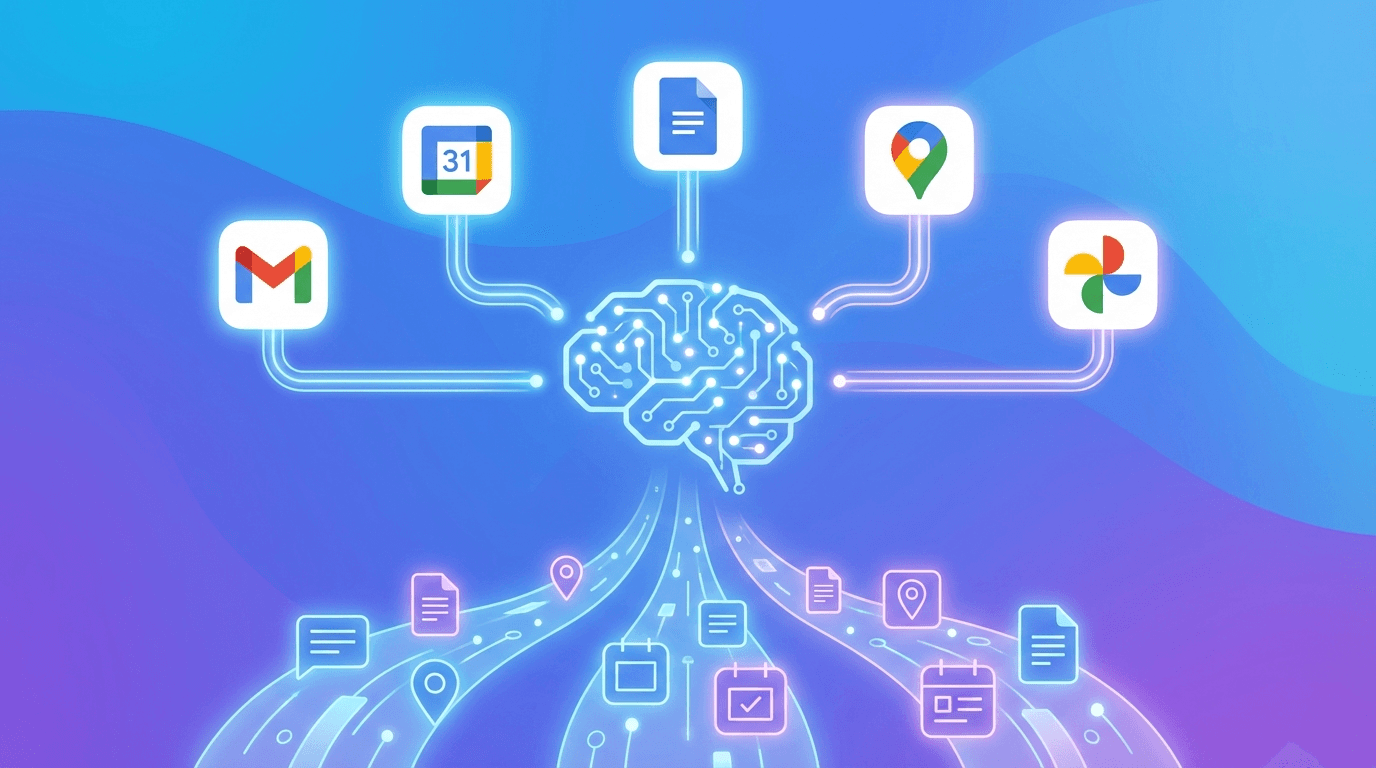
Google rolls out Personal Intelligence to free Gemini users in the U.S., connecting Gmail, Photos, and more for personalized AI responses across Search, Chrome, and the Gemini app.
Key Takeaways
On March 17, 2026, Google announced the expansion of Personal Intelligence, its AI personalization feature, to free Gemini users in the United States. Previously restricted to AI Pro ($19.99/month) and AI Ultra ($149.99/month) subscribers, Personal Intelligence allows Gemini to pull information from a user's connected Google apps to generate responses tailored to their specific context. The feature is rolling out across AI Mode in Search, the Gemini app, and Gemini in Chrome.
Critically, Personal Intelligence is disabled by default and requires explicit user opt-in, a deliberate privacy-first design choice that gives users full control over what data Gemini can access.
Feature Overview
1. How Personal Intelligence Works
Personal Intelligence connects Gemini to a user's Google ecosystem, including Gmail, Google Photos, Google Calendar, Google Drive, YouTube, Search history, and Maps data. When enabled, Gemini can reference this information to provide contextually relevant responses rather than generic answers.
For example, if a user asks Gemini to help plan a weekend trip, the system can reference their Calendar for availability, Gmail for hotel confirmation emails, Photos for images from past trips to similar destinations, and Maps data for frequently visited locations. The result is an AI assistant that understands the user's actual life context rather than operating in a vacuum.
This integration leverages Google's unique advantage: no other AI company has access to a comparable breadth of first-party user data across email, photos, documents, video history, and location services.
2. Availability Across Three Surfaces
Personal Intelligence is rolling out across three distinct surfaces, each serving different use cases:
| Surface | Status | Use Case |
|---|---|---|
| AI Mode in Search | Available now (U.S.) | Personalized search answers |
| Gemini App | Rolling out to free U.S. users | Conversational AI assistant |
| Gemini in Chrome | Phased U.S. rollout beginning | Browser-integrated AI help |
The multi-surface approach means personalization follows the user across their primary interaction points with Google, creating a consistent experience whether they are searching, chatting with Gemini, or browsing the web.
International expansion is planned but Google has not provided a specific timeline for availability outside the United States.
3. Privacy Controls and Opt-In Design
Google has implemented a privacy-first architecture for Personal Intelligence. The feature is disabled by default and requires users to manually enable it through their profile settings. Users navigate to their profile, select Search personalization, then choose Connected Content Apps to specify which Google services Gemini can access.
Users can granularly control which apps are connected. Someone comfortable sharing their Photos but not their Gmail can configure accordingly. The system can be fully disabled at any time, reverting Gemini to standard non-personalized responses.
An important restriction: Personal Intelligence is only available for personal Google accounts. Workspace business, enterprise, and education accounts are excluded, likely due to the different data governance requirements of organizational accounts.
4. Practical Use Cases
Google highlighted several specific scenarios where Personal Intelligence adds value:
Trip Planning: Gemini can create tailored itineraries based on the user's interests, past travel patterns from Photos and Maps, and relevant emails from Gmail containing booking confirmations or travel recommendations.
Device Troubleshooting: When a user needs help with a device, Personal Intelligence can identify the specific model from purchase emails in Gmail or photos in Google Photos, providing targeted troubleshooting steps rather than generic advice.
Shopping Recommendations: The system can offer product suggestions based on recent purchases visible in Gmail receipts, browsing history, and previously expressed preferences.
Usability Analysis
For free-tier users, Personal Intelligence transforms Gemini from a general-purpose chatbot into a personal assistant that understands context. The practical difference is significant: instead of providing the same answer to every user, Gemini can now account for individual preferences, history, and circumstances.
The opt-in design is a smart usability choice. Users who value personalization can enable it immediately, while privacy-conscious users lose nothing from the feature's existence. The granular app-level controls add another layer of comfort for users who want some personalization without full data access.
The primary usability concern is discovery. Free-tier users may not realize the feature exists or understand how to enable it, since the setup requires navigating through profile settings rather than being prompted during normal usage. Google's rollout strategy of phased expansion also means some users will have access before others, potentially creating confusion.
Pros
- Leverages Google's unmatched first-party data ecosystem across Gmail, Photos, Calendar, Drive, YouTube, Maps, and Search
- Disabled by default with granular app-level controls gives users full authority over their data sharing
- Multi-surface availability across Search, Gemini app, and Chrome creates a consistent personalized experience
- Free-tier access removes the paywall that previously restricted personalization to Pro and Ultra subscribers
- Practical use cases like trip planning and device troubleshooting demonstrate immediate, tangible value
Limitations
- U.S.-only availability with no announced timeline for international rollout excludes the majority of Google users
- Personal accounts only with Workspace business, enterprise, and education users excluded from the feature
- Privacy concerns are inherent in any system that connects AI to personal email, photos, and location data
- Feature discovery may be limited since opt-in requires manual navigation through profile settings
Outlook
Personal Intelligence represents Google's strongest competitive moat in the AI assistant race. While OpenAI, Anthropic, and other competitors build excellent general-purpose AI models, none of them have access to the depth of personal data that Google accumulates across its ecosystem. By making this personalization free, Google is betting that the value of a context-aware AI assistant will drive user engagement and loyalty in ways that raw model capability alone cannot.
The feature also sets the stage for deeper integration with Google's hardware ecosystem. As Pixel devices, Nest products, and Android become more AI-native, Personal Intelligence could evolve from a software feature into the connective tissue of an entire AI-powered personal computing experience.
The key risk is public perception. In an era of heightened data privacy awareness, an AI assistant that reads your email and looks at your photos will inevitably attract scrutiny, regardless of the opt-in controls. Google's ability to maintain user trust while delivering compelling personalization will determine whether Personal Intelligence becomes a beloved feature or a privacy controversy.
Conclusion
Google's decision to bring Personal Intelligence to free Gemini users is a calculated move to differentiate its AI assistant through personalization rather than pure model performance. By leveraging its unmatched data ecosystem while maintaining privacy-first opt-in controls, Google has created a compelling value proposition that competitors cannot easily replicate. For U.S. users willing to connect their Google apps, this is the most contextually aware AI assistant available at any price point.
Editor's Verdict
Google Expands Personal Intelligence to Free Gemini Users: AI That Knows Your Life earns a solid recommendation within the gemini space.
The strongest case for paying attention is leverages Google's unmatched first-party data ecosystem for personalization no competitor can replicate, which raises the bar for what readers should now expect from peers in this space. Reinforcing that, disabled by default with granular app-level privacy controls adds practical value rather than just headline appeal. The broader signal worth registering is straightforward: google's first-party data ecosystem across email, photos, and location services creates a personalization moat that no AI competitor can replicate. On the other side of the ledger, U.S.-only availability with no announced international rollout timeline is a real constraint, not a marketing footnote, and it should factor into any serious decision. Layered on top of that, personal accounts only, excluding Workspace business and education users narrows the set of teams for whom this is an obvious yes.
For Google Cloud and Workspace integrators, multimodal-first teams, and Gemini API adopters, this is a serious evaluation candidate, not just a curiosity to bookmark. For everyone else, the safer posture is to monitor coverage and revisit once the use cases that matter to your team are demonstrated in the wild.
Pros
- Leverages Google's unmatched first-party data ecosystem for personalization no competitor can replicate
- Disabled by default with granular app-level privacy controls
- Multi-surface availability creates consistent personalized experience across Search, Gemini, and Chrome
- Free-tier access removes previous paywall for AI personalization
- Practical use cases like trip planning and device troubleshooting deliver immediate value
Cons
- U.S.-only availability with no announced international rollout timeline
- Personal accounts only, excluding Workspace business and education users
- Privacy concerns are inherent in connecting AI to personal email, photos, and location data
- Feature discovery requires manual opt-in through profile settings, limiting adoption
References
Comments0
Key Features
1. Connects Gemini to Gmail, Photos, Calendar, Drive, YouTube, Maps, and Search for personalized AI responses 2. Rolling out across AI Mode in Search, the Gemini app, and Gemini in Chrome for free U.S. users 3. Disabled by default with granular app-level opt-in controls for user privacy 4. Previously limited to AI Pro ($19.99/month) and Ultra ($149.99/month) subscribers, now free 5. Only available for personal Google accounts, excluding Workspace business, enterprise, and education users
Key Insights
- Google's first-party data ecosystem across email, photos, and location services creates a personalization moat that no AI competitor can replicate
- Making Personal Intelligence free signals Google is prioritizing user engagement and ecosystem lock-in over subscription revenue
- The opt-in, disabled-by-default design is a strategic response to growing data privacy awareness among consumers
- Multi-surface availability across Search, Gemini app, and Chrome creates consistent personalization that follows users across their digital life
- Excluding Workspace accounts suggests Google is navigating enterprise data governance separately from consumer AI features
- Personal Intelligence could evolve into the connective tissue of Google's entire hardware and software AI ecosystem
- The feature transforms Gemini from a general chatbot into a context-aware personal assistant with genuine utility
- International rollout timing will determine whether Google can establish a global lead in personalized AI before competitors develop alternatives
Was this review helpful?
Share
Related AI Reviews

Gemini 3.8 Live and Extended Thinking Split Voice AI in Two
Google splits real-time voice AI into two tiers: Gemini 3.8 Live for scale, Extended Thinking for complex reasoning - both share one price table.

Gemini App Comes to Windows with Alt + Space Overlay
Google's Gemini app is now on Windows, summoned with Alt + Space over your active work - but macOS still holds native features Windows lacks.

Gemini 3.8 Flash and Cyber: Faster Reasoning, Gated Security
Google's Gemini 3.8 Flash boosts coding and reasoning at 3.7 Flash's price; Gemini 3.8 Flash Cyber hunts vulnerabilities via a gated program.

Gemini Adds Optional Toggle to Remove AI Visible Watermarks
Google now lets users toggle off visible watermarks on Gemini-made media, while invisible SynthID and C2PA metadata remain embedded regardless.