
DeepSeek V4 Multimodal Launch Imminent: Text, Image, and Video in One Open Model
DeepSeek V4 is expected in the first week of March 2026 as a unified multimodal system generating text, images, and video—far beyond the coding-focused V4 details disclosed in February.
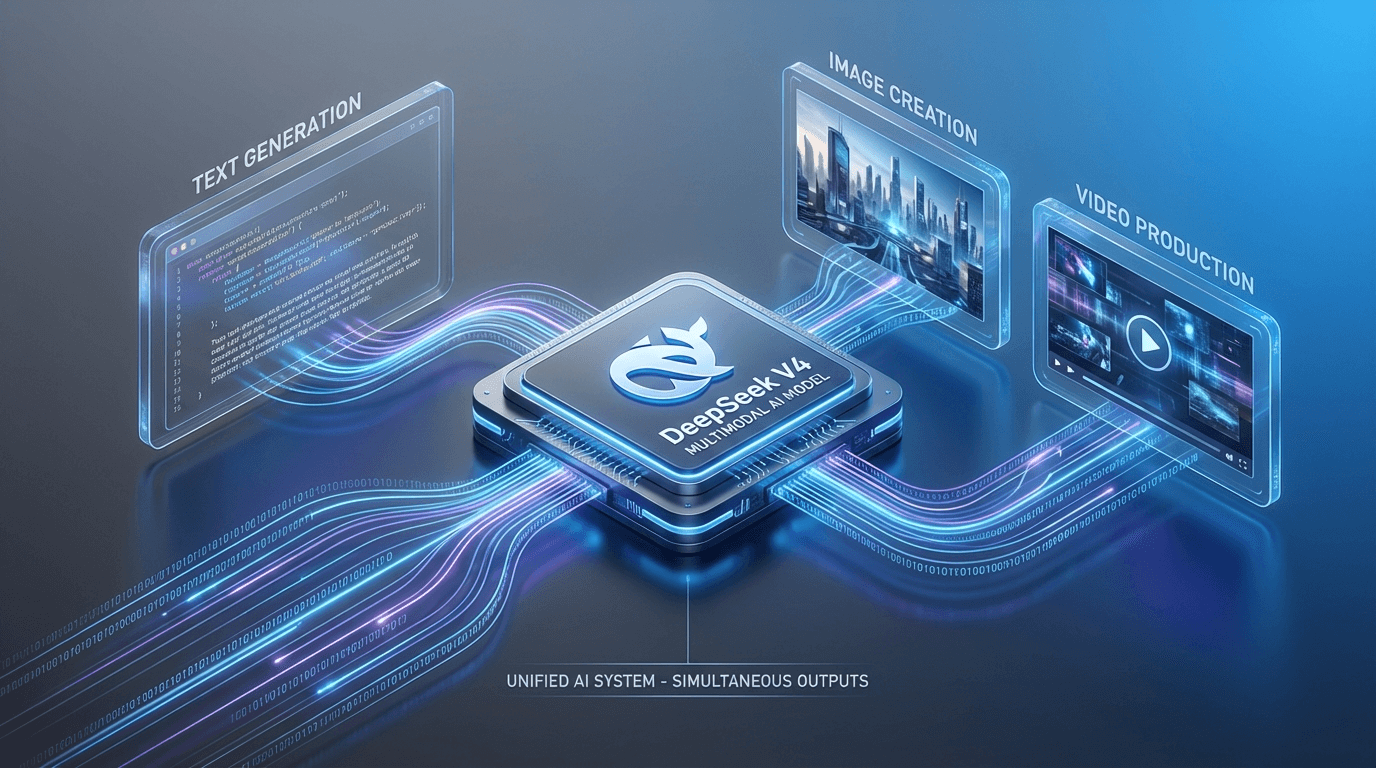
DeepSeek V4 is expected in the first week of March 2026 as a unified multimodal system generating text, images, and video—far beyond the coding-focused V4 details disclosed in February.
From Coding Powerhouse to Full Multimodal System
When early details about DeepSeek V4 emerged in February 2026, they pointed to a model laser-focused on coding: a 700-billion-parameter-plus architecture targeting SWE-bench records, a 1-million-token context window built on Engram memory, and a release window timed to coincide with the Lunar New Year. That window passed without a launch.
By March 1-2, 2026, the picture of V4 has changed substantially. Multiple credible sources—including a report from the Financial Times citing sources familiar with DeepSeek's plans—indicate that V4 is now expected in the first week of March, timed to coincide with China's annual Two Sessions parliamentary meetings starting March 4. More significantly, V4 is no longer being described as a coding-first model. The version now approaching release is a unified multimodal AI system capable of generating text, images, and video within a single architecture.
This positions DeepSeek V4 as a direct architectural competitor to OpenAI's GPT-4o multimodal system and Google's Gemini 3 series—and, if the open-weight release materializes as expected under MIT or Apache 2.0 licensing, as the most capable open-source multimodal foundation model ever released.
The Multimodal Architecture
Unified Generation Across Modalities
DeepSeek V4's multimodal design integrates text generation, image synthesis, and video creation into a single model framework rather than using separate specialized models for each modality. This unified approach differs from systems like Gemini 3 Pro, which maintains distinct pipelines for different output types under a shared interface.
The practical advantage of unified multimodal generation is coherence: when V4 generates an image to accompany text, or produces video narrated by generated commentary, the different modalities should share semantic understanding rather than operating independently. Whether DeepSeek has achieved this coherence at production quality is not yet verifiable until the model is publicly available.
Image and Video Generation for Competitive Positioning
The addition of image and video generation places V4 in direct competition with OpenAI's Sora, Google's Veo 3, and Runway's Gen-3. These are all proprietary systems with significant infrastructure requirements. A capable open-weight alternative would be a significant development for the open-source community, enabling researchers and developers to build multimodal applications without dependency on closed APIs.
DeepSeek has not disclosed benchmark specifics for the image and video generation components of V4. Community-circulated figures suggest HumanEval scores around 90% and SWE-bench Verified above 80% for the text and coding components, but these remain unverified leaked benchmarks rather than official disclosures.
Architectural Foundations Remain
The architectural innovations disclosed in January 2026—Engram Conditional Memory for efficient million-token context retrieval and Manifold-Constrained Hyper-Connections for trillion-parameter-scale training stability—are expected to underpin the V4 release regardless of the expanded multimodal scope. The Engram memory system, which offloads static knowledge to system DRAM and achieves sub-3% throughput penalty with 100-billion-parameter embedding tables, is particularly relevant for the long-context retrieval demands of multimodal workflows.
Strategic Context: The Two Sessions Timing
DeepSeek's decision to time the V4 release to China's Two Sessions parliamentary meetings is consistent with the pattern established by its R1 model, which launched around Lunar New Year 2025 and became an international technology story almost immediately. The Two Sessions represent one of China's highest-profile political events of the year, and a frontier AI announcement timed to the meetings carries symbolic weight about China's technology development trajectory.
Analysts have noted that V4's release—should it match or exceed frontier proprietary models while remaining open-weight—would further intensify the geopolitical dimension of the AI competition between Chinese and Western AI developers. DeepSeek previously disrupted markets with its R1 model's pricing and performance combination; V4 operating in the multimodal space extends that competitive pressure to Sora, Veo, and similar systems.
Open-Weight Release and Hardware Requirements
DeepSeek's stated intention is to release V4 as an open-weight model under MIT or Apache 2.0 licensing, continuing the tradition established with V3 and R1. For developers outside China's regulatory environment, this matters significantly: open weights enable local deployment, fine-tuning, and integration without API dependency.
V4's trillion-parameter-class total parameter count (with approximately 32 billion active parameters per token inference via its Mixture-of-Experts architecture) makes local deployment on consumer hardware challenging but potentially feasible for quantized versions. The coding-focused variant disclosed in February was projected to run on dual NVIDIA RTX 4090s or a single RTX 5090. Whether the full multimodal V4 can meet similar hardware targets at acceptable quality levels will be one of the first questions the developer community will test at release.
What Has Not Been Released Yet
As of March 2, 2026, DeepSeek has made no official announcement of V4's launch. All timeline information derives from sources cited by the Financial Times and community monitoring of DeepSeek's API behavior. No official benchmark disclosures for the multimodal components have been published. The licensing terms, pricing structure, and API availability windows remain unconfirmed.
The gap between reported capabilities and verified performance is important to hold clearly. DeepSeek has a track record of releasing models that perform substantially as described (R1 and V3 both met or exceeded pre-release claims in independent testing), but V4 represents a significantly more ambitious technical scope. Independent evaluation at launch will be essential.
Pros and Cons
Strengths
If V4 delivers on its reported capabilities, the combination of multimodal generation, a 1-million-token context window, and open-weight licensing would make it the most capable freely available foundation model ever released. DeepSeek's pricing history (V3 input at under $1 per million tokens) suggests V4 API costs will dramatically undercut Western multimodal API providers. The Engram memory architecture provides a technically credible basis for the claimed context window performance. DeepSeek's track record of delivering on pre-release descriptions adds confidence to the broad outline of V4's capabilities.
Limitations
No capabilities have been officially disclosed or independently verified as of March 2, 2026. Government restrictions in Australia, the Czech Republic, the Netherlands, and other jurisdictions may limit enterprise adoption even if the open weights are available. The MoE architecture can produce inconsistent outputs across different expert activations, a known limitation of this design class. Multimodal generation quality—particularly for video—is extremely difficult to assess without hands-on testing, and early releases in this category often reveal significant gaps between reported and actual capability.
Outlook
The next week will likely resolve the primary uncertainty: whether V4 launches as described, or whether the window shifts again. If the release occurs in the first week of March, independent benchmarking within the first 48-72 hours will establish whether the multimodal capabilities match the pre-release narrative.
For developers, the most actionable position is to monitor DeepSeek's official channels and prepare testing pipelines for rapid evaluation at release. For researchers studying AI capability progression, V4 represents the most significant open-source multimodal release since Meta's Llama 3 expanded the definition of what open models could achieve.
Conclusion
DeepSeek V4's expected March 2026 launch marks a significant escalation in the open-source AI competition. The expansion from a coding-first architecture to unified multimodal generation—text, image, and video in a single open-weight model—would represent a meaningful capability milestone for the open ecosystem. The model is best suited for developers and organizations seeking multimodal AI capabilities without proprietary API dependency, and for the research community evaluating the open-source frontier. Verified performance at launch will determine whether V4 fulfills its ambitious pre-release description.
Editor's Verdict
DeepSeek V4 Multimodal Launch Imminent: Text, Image, and Video in One Open Model earns a solid recommendation within the other llm space.
The strongest case for paying attention is unified text, image, and video generation in a single open-weight model would make V4 the most capable freely available multimodal foundation model if capabilities match description, which raises the bar for what readers should now expect from peers in this space. Reinforcing that, expected open-weight release under permissive licensing eliminates API dependency for developers and researchers adds practical value rather than just headline appeal. The broader signal worth registering is straightforward: V4's expansion to unified multimodal generation (text, image, video) significantly broadens its competitive scope beyond the coding-focused architecture described in February 2026 reporting. On the other side of the ledger, no capabilities have been officially disclosed or independently verified as of March 2, 2026—the entire picture derives from pre-release reports and community monitoring is a real constraint, not a marketing footnote, and it should factor into any serious decision. Layered on top of that, government restrictions in Australia, Czech Republic, Netherlands, and other jurisdictions limit enterprise adoption regardless of open-weight status narrows the set of teams for whom this is an obvious yes.
For multi-model deployment teams, cost-conscious operators, and developers willing to evaluate beyond the major labs, this is a serious evaluation candidate, not just a curiosity to bookmark. For everyone else, the safer posture is to monitor coverage and revisit once the use cases that matter to your team are demonstrated in the wild.
Pros
- Unified text, image, and video generation in a single open-weight model would make V4 the most capable freely available multimodal foundation model if capabilities match description
- Expected open-weight release under permissive licensing eliminates API dependency for developers and researchers
- Engram Conditional Memory provides a technically credible architecture for the 1M+ token context window, enabling long-context multimodal workflows
- DeepSeek's track record with R1 and V3 supports confidence that broad capability claims will be substantially validated at launch
Cons
- No capabilities have been officially disclosed or independently verified as of March 2, 2026—the entire picture derives from pre-release reports and community monitoring
- Government restrictions in Australia, Czech Republic, Netherlands, and other jurisdictions limit enterprise adoption regardless of open-weight status
- MoE architecture produces inherent output variability across different expert activations, a limitation of the design class
- Video generation quality in particular is difficult to assess without hands-on testing; early multimodal releases frequently reveal significant gaps between reported and actual capability
References
Comments0
Key Features
DeepSeek V4 is expected to launch in the first week of March 2026 (Financial Times reporting, March 1-2, 2026) as a unified multimodal AI system generating text, images, and video within a single architecture. Built on the previously disclosed Engram Conditional Memory (1M+ token context) and Manifold-Constrained Hyper-Connections architecture, V4 is expected as an open-weight release under MIT or Apache 2.0 licensing. Leaked benchmarks suggest HumanEval ~90% and SWE-bench Verified >80%. No official benchmarks or licensing terms have been disclosed as of March 2, 2026.
Key Insights
- V4's expansion to unified multimodal generation (text, image, video) significantly broadens its competitive scope beyond the coding-focused architecture described in February 2026 reporting
- Two Sessions timing (China's parliamentary meetings, March 4) follows DeepSeek's Lunar New Year R1 playbook: symbolic timing for maximum strategic impact
- Financial Times reporting citing sources familiar with DeepSeek's plans provides the most credible basis for the first-week-of-March launch window
- Open-weight release under MIT or Apache 2.0 would make V4 the first fully open multimodal system competitive with GPT-4o and Gemini 3 Pro
- Leaked HumanEval ~90% and SWE-bench Verified >80% benchmarks, if independently confirmed, would place V4 at or above current frontier models
- The MoE architecture (32B active of ~1T total parameters) enables inference efficiency that could allow quantized consumer-hardware deployment
- DeepSeek's pricing history (under $1/million input tokens for V3) strongly suggests V4 API costs will undercut Sora, Veo, and GPT-4o by large margins
- Government restrictions in multiple jurisdictions apply to DeepSeek consumer products, not open weights—the open release bypasses the most significant enterprise adoption barriers
Was this review helpful?
Share
Related AI Reviews

Meta Muse Wonder: 1M-Token Agent Model Arrives via API
Meta released Muse Wonder and Wonder Full on Oct 12: a 1M-context multimodal agent model, with Wonder on the Meta API and Full for Muse Code users.

Mistral Large 4 Preview: 1T MoE, Weights Due in October
Mistral Large 4 enters public preview as a ~1T-parameter multimodal MoE with 1M context. Weights are promised for October; scores are vendor-run.

Reflection Beam: 501B Open-Weight MoE, Weights Due Soon
Reflection previews Beam, a 501B MoE with 23B active parameters. Apache 2.0 weights are promised later this month; benchmarks are unverified.
Meta Muse Gadget SDK: Build Your Own ESP32 and Pi Devices
Meta open-sourced Apache 2.0 ESP32 and Linux SDKs for DIY Muse gadgets, with candid security caveats and a Home Link giveaway of 5,000 units.