
Arm Unveils AGI CPU: Its First In-House Silicon in 35 Years Targets AI Data Centers
Arm breaks from its licensing-only model with the 136-core AGI CPU, a 3nm data center chip co-developed with Meta for agentic AI infrastructure.
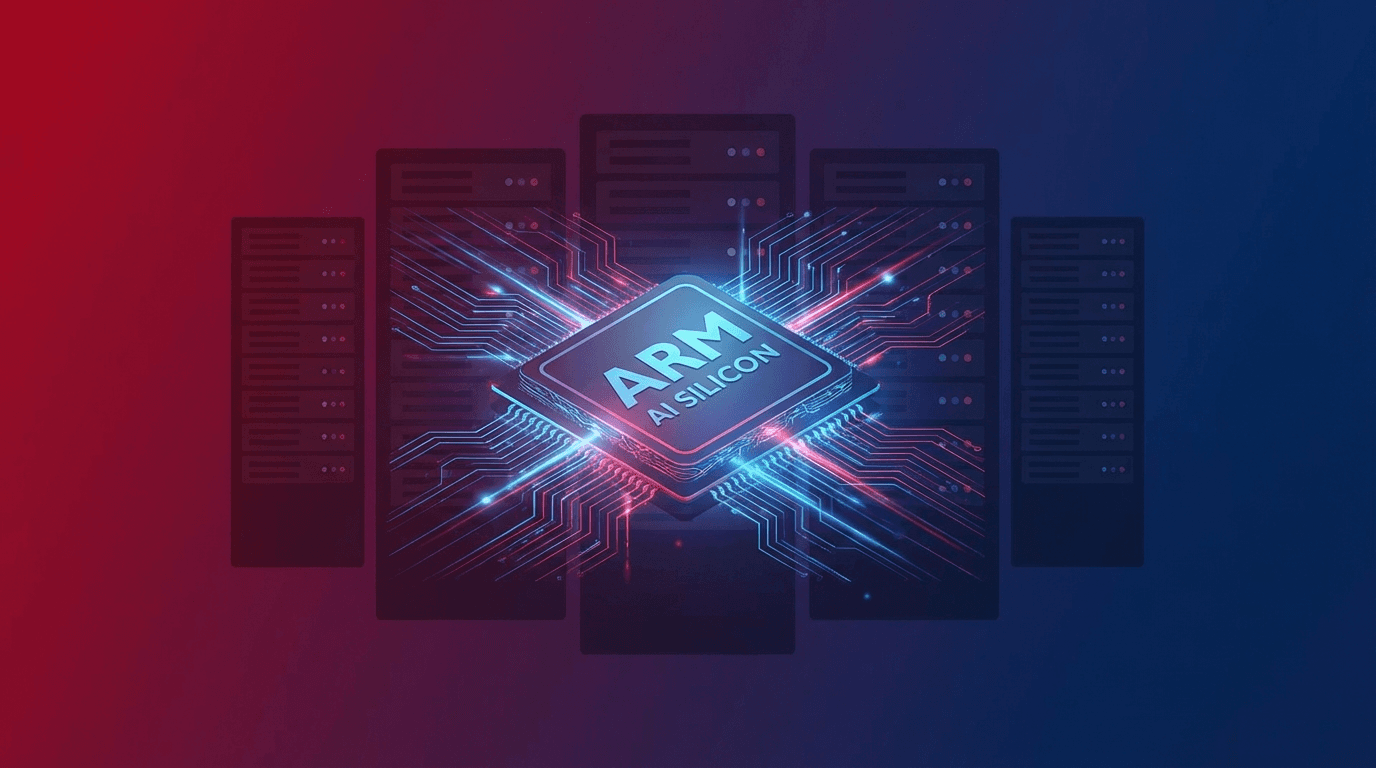
Arm breaks from its licensing-only model with the 136-core AGI CPU, a 3nm data center chip co-developed with Meta for agentic AI infrastructure.
A Historic Pivot for Arm
For 35 years, Arm has operated as the semiconductor industry's most successful IP licensor, designing processor architectures that power virtually every smartphone on the planet while leaving chip manufacturing to partners like Qualcomm, Apple, and Samsung. On March 25, 2026, that model changed. Arm announced the AGI CPU, a production-ready data center processor that the company designed, validated, and will sell as finished silicon. It marks the first time Arm has shipped its own chip product, a move that repositions the company from IP supplier to direct competitor in the lucrative data center market.
The timing is deliberate. As AI workloads explode in data centers worldwide, the demand for CPU-side orchestration power, the silicon that coordinates accelerators, manages data movement, and runs inference pre- and post-processing, has outstripped what existing x86 platforms can efficiently deliver. Arm is betting that its power-efficient architecture, proven in mobile, can capture this emerging "agentic AI infrastructure" layer.
Technical Specifications
The AGI CPU is built on TSMC's 3nm process node and features up to 136 Neoverse V3 cores arranged across two chiplets. The cores run at up to 3.2 GHz all-core frequency with a 3.7 GHz single-core boost, all within a 300-watt thermal design power (TDP) envelope.
Memory bandwidth is substantial: the chip supports 12 channels of DDR5 memory at speeds up to 8,800 MT/s, delivering aggregate bandwidth exceeding 800 GB/s. This is critical for AI workloads where data movement between CPU and accelerator is often the bottleneck.
| Specification | Details |
|---|---|
| Cores | Up to 136 Neoverse V3 |
| Process Node | TSMC 3nm |
| Clock Speed | 3.2 GHz all-core / 3.7 GHz boost |
| TDP | 300W |
| Memory | 12-channel DDR5 @ 8,800 MT/s |
| Memory Bandwidth | 800+ GB/s |
| Die Configuration | Dual chiplet |
Rack-Scale Density
Arm is not just selling chips; it is selling a rack-scale story. A standard air-cooled 36kW rack holds 30 AGI CPU blades, totaling 8,160 cores. For hyperscalers willing to invest in liquid cooling, Arm has partnered with Supermicro on a 200kW configuration that packs 336 chips and more than 45,000 cores into a single rack. Arm claims this delivers more than twice the performance per rack compared to the latest x86 platforms.
Partners and Early Commitments
Meta is the lead development partner, having co-designed the chip with Arm. The partnership reflects Meta's massive AI infrastructure buildout and its desire to diversify beyond x86-only server fleets. Additional commercial commitments come from Cerebras, Cloudflare, F5, OpenAI, Positron, Rebellions, SAP, and SK Telecom, a list that spans cloud infrastructure, AI accelerator companies, and enterprise software.
The breadth of this partner list signals that Arm's move is not speculative. These are binding commitments from companies already operating at hyperscale.
Competitive Implications
The AGI CPU puts Arm in direct competition with Intel and AMD in the data center CPU market. While Amazon's Graviton and Ampere's Altra have already demonstrated that Arm-based servers can compete on performance-per-watt, neither chip was designed or sold by Arm itself. The AGI CPU changes this dynamic: Arm now competes with its own licensees as well as the x86 incumbents.
For Intel and AMD, the threat is real but nuanced. Arm is specifically targeting the AI orchestration workload, not general-purpose server computing. However, workload boundaries in data centers are fluid, and a successful AGI CPU could expand into adjacent markets over time.
Outlook
Arm's entry into direct silicon sales is the most significant strategic shift in the company's history. If the AGI CPU delivers on its performance and efficiency claims at scale, it could reshape how AI data centers are architected, shifting the CPU layer from a commodity afterthought to a purpose-built component of the AI stack. The partnership with Meta and commitments from OpenAI and Cerebras lend credibility, but production ramp and real-world benchmarks will be the ultimate test.
Conclusion
The Arm AGI CPU represents a calculated bet that the AI data center market is large enough and differentiated enough to justify Arm building its own silicon. With a 136-core, 3nm design delivering over 800 GB/s memory bandwidth at 300W, the specs are competitive. The real question is execution: can Arm manufacture, sell, and support a production chip at data center scale? The answer will determine whether this historic pivot becomes a template for the next era of semiconductor competition.
Editor's Verdict
Arm Unveils AGI CPU: Its First In-House Silicon in 35 Years Targets AI Data Centers earns a solid recommendation within the it news space.
The strongest case for paying attention is industry-leading core density (136 cores) and memory bandwidth (800+ GB/s) at competitive TDP, which raises the bar for what readers should now expect from peers in this space. Reinforcing that, purpose-built for AI orchestration workloads where Arm's efficiency advantage is most pronounced adds practical value rather than just headline appeal. The broader signal worth registering is straightforward: arm's shift from IP licensing to selling finished silicon represents the most significant strategic pivot in the company's 35-year history. On the other side of the ledger, arm has no track record in chip manufacturing, sales, or enterprise support at data center scale is a real constraint, not a marketing footnote, and it should factor into any serious decision. Layered on top of that, competing with its own licensees creates potential ecosystem friction narrows the set of teams for whom this is an obvious yes.
For AI industry watchers, strategy teams, and decision-makers tracking platform shifts, this is a serious evaluation candidate, not just a curiosity to bookmark. For everyone else, the safer posture is to monitor coverage and revisit once the use cases that matter to your team are demonstrated in the wild.
Pros
- Industry-leading core density (136 cores) and memory bandwidth (800+ GB/s) at competitive TDP
- Purpose-built for AI orchestration workloads where Arm's efficiency advantage is most pronounced
- Strong partner ecosystem from day one, including Meta, OpenAI, Cerebras, and major cloud providers
- TSMC 3nm manufacturing ensures leading-edge power efficiency
Cons
- Arm has no track record in chip manufacturing, sales, or enterprise support at data center scale
- Competing with its own licensees creates potential ecosystem friction
- Pricing and availability timeline not yet disclosed publicly
- Software ecosystem for Arm-based data center workloads still maturing compared to x86
References
Comments0
Key Features
1. First in-house silicon from Arm in 35 years, marking a pivot from pure IP licensing to direct chip sales 2. 136 Neoverse V3 cores on TSMC 3nm with dual-chiplet design running at 3.2 GHz all-core 3. 12-channel DDR5 memory with 800+ GB/s bandwidth for AI data movement bottlenecks 4. Rack-scale configurations: 8,160 cores (air-cooled) or 45,000+ cores (liquid-cooled with Supermicro) 5. Co-developed with Meta, with commercial commitments from OpenAI, Cerebras, Cloudflare, and SAP
Key Insights
- Arm's shift from IP licensing to selling finished silicon represents the most significant strategic pivot in the company's 35-year history
- The 136-core design targets a specific emerging workload: CPU-side orchestration for agentic AI, not general-purpose server computing
- Meta's role as co-development partner signals that hyperscalers want alternatives to x86-only data center architectures
- 300W TDP with 800+ GB/s memory bandwidth positions the chip competitively against Intel and AMD on performance-per-watt
- Commercial commitments from OpenAI, Cerebras, and Cloudflare indicate genuine market demand, not just a technology demonstration
- The liquid-cooled 200kW rack with 45,000+ cores shows Arm is thinking at hyperscale, not just individual server SKUs
- Arm now competes directly with its own licensees (Qualcomm, Ampere) in the data center, creating complex ecosystem dynamics
Was this review helpful?
Share
Related AI Reviews

Judge Dismisses Chegg, Penske Suits Over Google AI Overviews
Judge Mehta granted Google's motions to dismiss both suits over AI Overviews on Sept 30; the court declined to rule on the state-law claim.

Reddit Ends RSS Feeds Nov 13 and Closes Public API by March
Reddit will stop RSS on Nov 13, 2026 and close public API access by March 2027, citing scraping and abuse. Registered apps can migrate to Devvit.
AMD to Acquire Fei-Fei Li's World Labs for $8.2B in Stock
AMD agreed to acquire World Labs for about $8.2 billion in stock; Fei-Fei Li would become AMD's chief scientist. Closing is expected by end of 2026.

Apple Reference Image: How iPhone 18 Pro Proves Photos Real
Apple's new iPhone 18 Pro camera signs sensor data at capture, letting users compare an unalterable reference image to verify a photo wasn't edited.