
Open Source
Explore the latest AI open-source projects from GitHub and HuggingFace.
Explore the latest AI open-source projects from GitHub and HuggingFace.
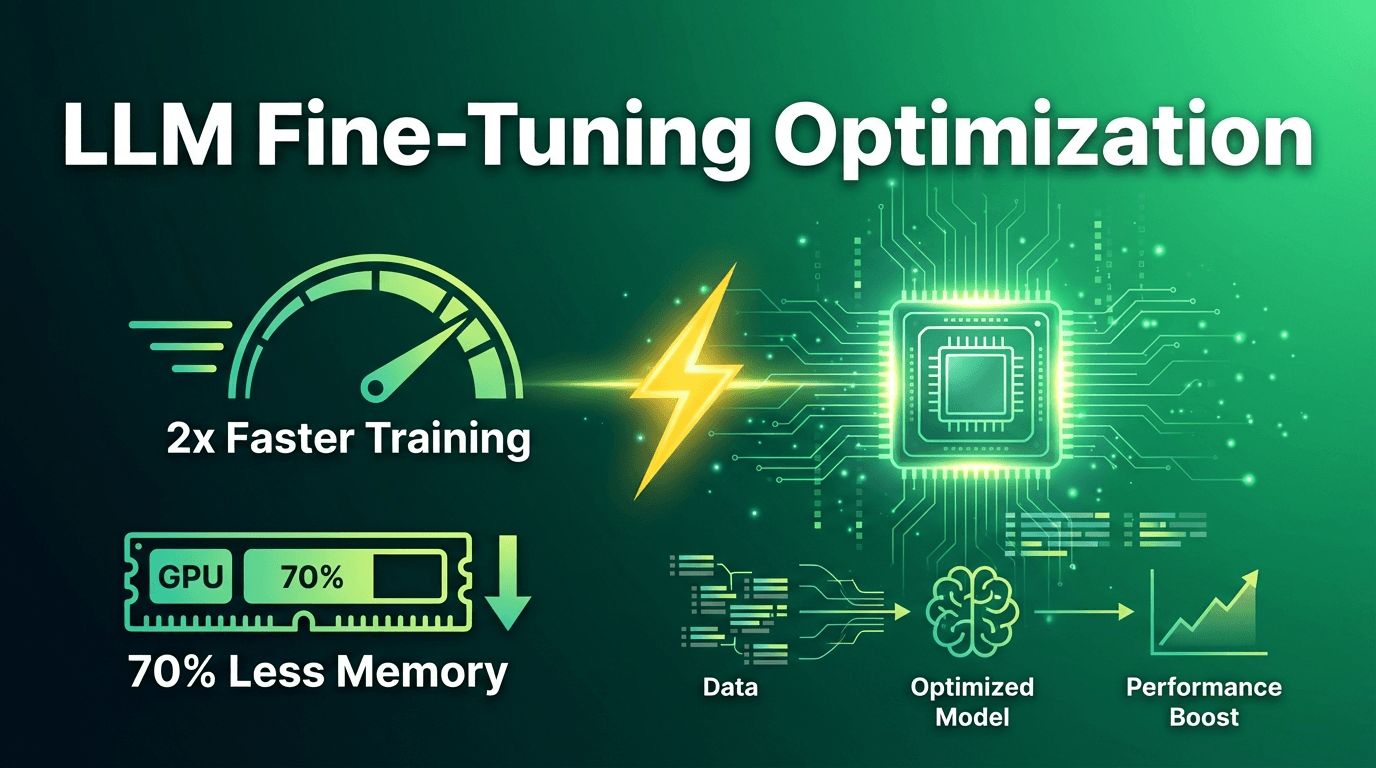
Unsloth is an open-source library that dramatically accelerates large language model fine-tuning, delivering 2x faster training speeds while reducing VRAM consumption by up to 70%. Developed by the Unsloth AI team, the project has earned over 52,400 GitHub stars and established itself as the leading optimization tool for anyone fine-tuning LLMs on limited hardware. It supports a broad range of models including GPT-OSS, DeepSeek, Qwen, Llama, and Gemma, with zero accuracy loss compared to standard training.
Fine-tuning large language models is one of the most resource-intensive tasks in applied AI. A single fine-tuning run on a 70B parameter model can require multiple high-end GPUs and hours of compute time. Unsloth directly attacks this bottleneck through custom Triton kernels and advanced batching algorithms that reduce both computation time and memory footprint without any approximation methods. The "zero accuracy loss" guarantee is critical: unlike quantization-based speedups that trade quality for efficiency, Unsloth achieves exact mathematical equivalence with standard training.
For individual researchers, startups, and teams operating with limited GPU budgets, Unsloth effectively doubles the number of experiments that can be run within the same time and cost constraints. This has made it an essential tool in the LLM fine-tuning ecosystem.
Unsloth supports multiple training precision formats including full fine-tuning, 4-bit quantized training (QLoRA), 16-bit LoRA, and FP8 training. Each format is optimized with dedicated kernels. The 4-bit mode is particularly impactful, enabling fine-tuning of 70B parameter models on a single 48GB GPU that would normally require multiple GPUs. Users can switch between formats with a single configuration change.
The library supports an extensive range of model architectures beyond standard text LLMs. This includes text-to-speech models, multimodal vision-language models, and embedding models. Recent updates added support for Mixture-of-Experts (MoE) architectures with 12x faster training and 35% less VRAM compared to standard MoE fine-tuning. This breadth of compatibility means teams can use a single tool regardless of which model architecture they are working with.
Unsloth includes optimized implementations of GRPO (Group Relative Policy Optimization) and GSPO reinforcement learning algorithms, consuming 80% less VRAM than standard implementations. The system supports 7x longer context windows during RL training compared to competing setups, which is particularly valuable for training models on tasks that require processing long documents or complex reasoning chains. Vision RL support enables reinforcement learning on multimodal models.
Unsloth runs on NVIDIA GPUs from 2018 onward (Turing architecture and newer), AMD GPUs, and Intel GPUs. Multi-GPU training is supported through standard distributed training protocols. The cross-platform GPU support is notable because most LLM training optimizations target only NVIDIA hardware. Teams with AMD or Intel accelerators can benefit from the same speedups without needing to switch hardware.
One of the most impressive capabilities is support for training with context lengths up to 500,000 tokens on a single 80GB GPU. Standard training frameworks would require multiple GPUs for context lengths beyond 32K tokens. This is achieved through memory-efficient attention implementations and gradient checkpointing optimizations specific to long sequences. Extended context is increasingly important as LLM applications move toward processing entire documents, codebases, and conversation histories.
Unsloth integrates directly with the HuggingFace Transformers and TRL (Transformer Reinforcement Learning) libraries. Existing training scripts typically require only a few lines of code change to enable Unsloth optimizations. The library handles all kernel dispatch and memory management automatically. Trained models can be exported in standard formats compatible with any inference framework, including GGUF for llama.cpp, GGML, and standard HuggingFace format.
Unsloth's optimizations are specific to fine-tuning and do not accelerate inference. The custom Triton kernels require a compatible GPU, excluding CPU-only environments. While the library supports many model architectures, newly released models may require updates before they are compatible. The Apache 2.0 license covers the open-source version, but some advanced features are available only through the Unsloth Pro offering.