
Open Source
Explore the latest AI open-source projects from GitHub and HuggingFace.
Explore the latest AI open-source projects from GitHub and HuggingFace.
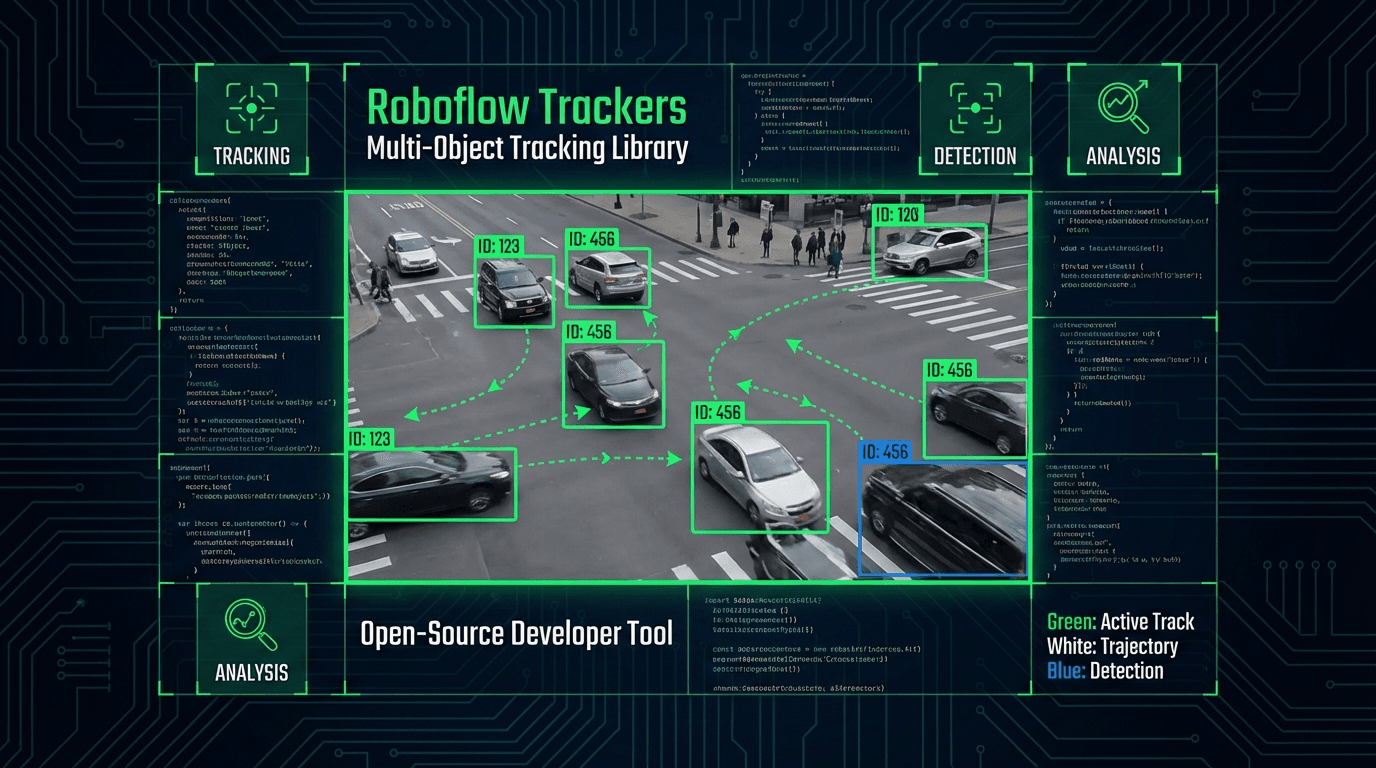
Roboflow Trackers is an open-source Python library providing clean, modular re-implementations of leading multi-object tracking (MOT) algorithms under the Apache 2.0 license. The library is built around a single key insight: most tracking algorithms are tightly coupled to specific detection models, making it difficult to swap components or benchmark fairly. Trackers decouples detection from tracking entirely, allowing developers to combine any detector with any tracker through a unified interface.
Multi-object tracking is one of the most practically important problems in computer vision: given a sequence of video frames, assign persistent identities to detected objects across time. A surveillance system must recognize that object #42 in frame 100 is the same person as object #42 in frame 200, even after occlusions, direction changes, or temporary disappearances. The quality of this association directly determines the usefulness of systems built on top — sports analytics, autonomous vehicles, retail foot traffic analysis, and robotics all depend on reliable tracking.
Until recently, most production tracking solutions were either tightly coupled to specific detection models or required significant engineering effort to benchmark and compare algorithms. Roboflow Trackers addresses both pain points.
The library currently implements five major tracking algorithms: SORT (Simple Online and Realtime Tracking), ByteTrack, OC-SORT, BoT-SORT, and McByte. Each is a clean-room re-implementation following the original published algorithm, enabling fair comparison without implementation-specific advantages.
Among these, ByteTrack demonstrates the strongest benchmark results in independent testing, achieving 60.1 MOTA on MOT17 and 73.0 MOTA on SportsMOT. OC-SORT offers improved performance in crowded scenes by addressing the observation-centric modeling shortcomings of SORT-based approaches. BoT-SORT extends ByteTrack with camera motion compensation, making it better suited for mobile camera scenarios.
The library's core strength is its unified interface. Every tracker exposes the same API, making algorithm replacement a one-line change. Developers can run SORT on their video pipeline and switch to ByteTrack simply by changing the tracker class instantiation, with no other code modifications. This design pattern enables rapid experimentation during development and clean production deployments.
from trackers import ByteTrack

tracker = ByteTrack()
for frame in video_frames:
    detections = detector(frame)  # any detection model
    tracks = tracker.update(detections)
Trackers ships with built-in evaluation tooling against standard MOT benchmarks including MOT17, SportsMOT, and SoccerNet. This allows researchers and practitioners to measure tracker performance on their specific domain without writing custom evaluation scripts. The benchmarking tools output standard MOTA, MOTP, and IDF1 metrics, facilitating direct comparison with published results.
Trackers integrates seamlessly with Roboflow's broader computer vision ecosystem, including the Supervision library for visualization and annotation management. Users can leverage Roboflow's model hub to access fine-tuned detection models specific to their domain (sports analytics, retail, industrial inspection) and combine them with Trackers for complete video understanding pipelines.
An interactive playground at trackers.roboflow.com allows browser-based testing against webcam streams or uploaded videos without any local installation, lowering the barrier to evaluating tracker performance on real data.
The February 2026 release of version 2.2.0 brings improved stability and expanded documentation. The project has grown to 2,800 GitHub stars and 15 active contributors since its initial release. The library targets Python 3.10+ and installs via standard pip. Documentation is available at trackers.roboflow.com with quickstart guides, algorithm explanations, and benchmark comparison tables.
For computer vision practitioners building production video intelligence systems, Roboflow Trackers provides a well-maintained, benchmarked foundation for multi-object tracking without the overhead of managing algorithm implementations from scratch.