
Open Source
Explore the latest AI open-source projects from GitHub and HuggingFace.
Explore the latest AI open-source projects from GitHub and HuggingFace.
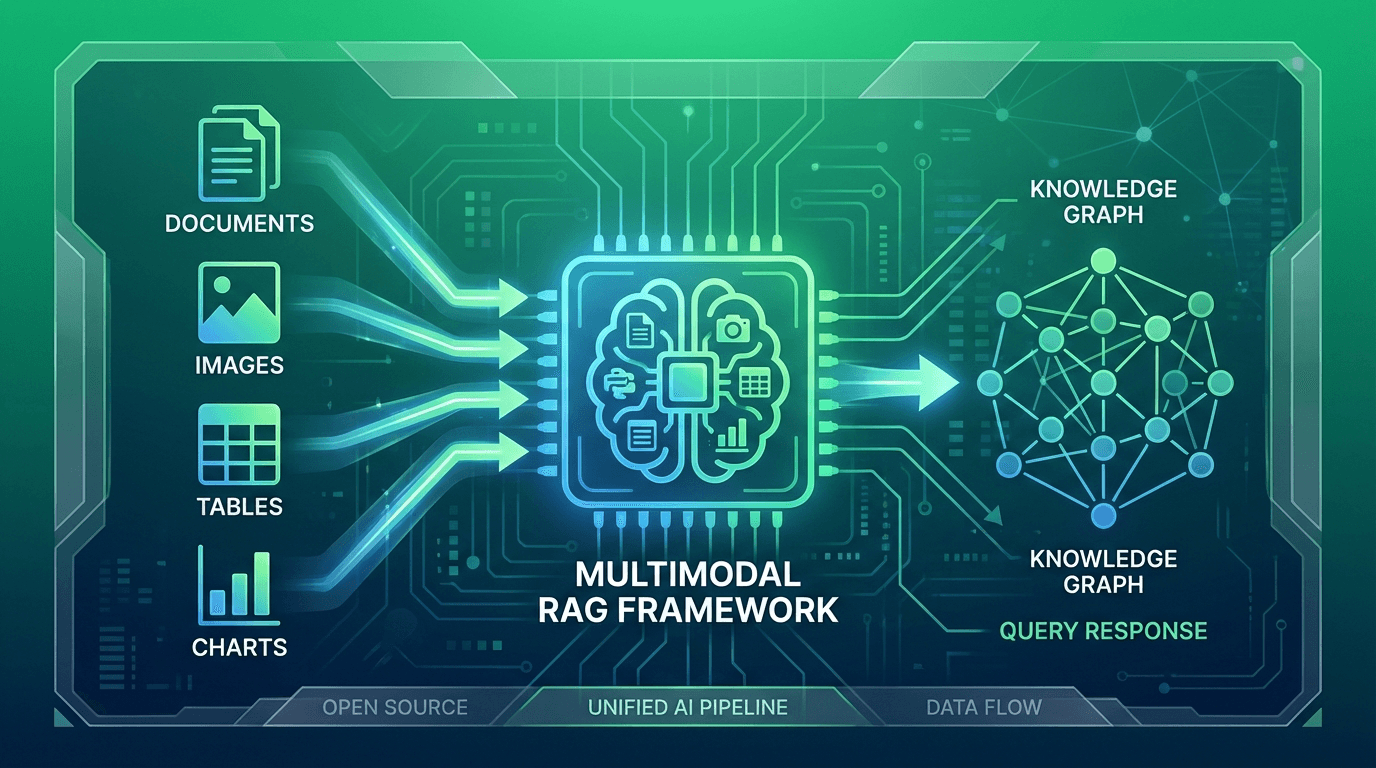
RAG-Anything is an open-source, all-in-one Retrieval-Augmented Generation framework developed by researchers at the Hong Kong University of Science and Technology (HKUDS). It addresses a fundamental limitation of traditional RAG systems: the inability to seamlessly handle multiple content modalities within a single pipeline. While conventional RAG tools excel at text retrieval, they struggle with images, tables, equations, and charts embedded in real-world documents. RAG-Anything eliminates this gap by providing a unified multimodal pipeline that processes every content type natively.
Enterprise and research documents rarely contain plain text alone. A financial report includes tables and charts. A scientific paper contains equations, figures, and structured data. A product manual has diagrams and specifications. Traditional RAG systems require multiple specialized tools to handle these different modalities, leading to fragmented pipelines, lost context across modalities, and increased engineering complexity. RAG-Anything solves this by treating all content types as first-class citizens within a single coherent framework.
With over 13,600 GitHub stars and 1,600 forks, the project has rapidly established itself as a go-to solution for developers building production RAG applications that need to handle real-world document complexity.
RAG-Anything accepts virtually any document format as input, including PDFs, Word documents, PowerPoint presentations, Excel spreadsheets, and raw images. The framework integrates MinerU for document parsing, which handles layout detection, text extraction, table recognition, and figure identification automatically. This means developers do not need to build separate ingestion pipelines for different file types.
The framework includes dedicated analyzers for different content modalities. Visual elements such as charts and diagrams are processed through a VLM (Vision-Language Model) enhanced pipeline that extracts semantic meaning from images. Tables are parsed with structure-aware algorithms that preserve row-column relationships. Mathematical equations are recognized and indexed as searchable content. Each analyzer produces standardized representations that feed into the unified knowledge graph.
Rather than storing content in flat vector databases, RAG-Anything constructs a multimodal knowledge graph with cross-modal relationship discovery. Built on the LightRAG foundation, this graph captures connections between text passages, figures, tables, and equations within and across documents. When a user queries about data shown in a chart, the system can retrieve both the chart and related textual analysis from the same or different documents.
RAG-Anything combines vector similarity search with graph traversal for retrieval. Vector similarity handles semantic matching, while graph traversal follows relationship edges to find contextually relevant content that pure embedding similarity might miss. This hybrid approach consistently outperforms single-method retrieval in benchmarks, particularly for complex queries that span multiple modalities.
The VLM-enhanced query mode, introduced in August 2025, allows users to ask questions about visual content directly. When a query relates to a chart, diagram, or figure, the system routes the question through a vision-language model that can interpret the visual content and generate detailed answers. This eliminates the need for manual chart-to-text conversion or OCR preprocessing.
RAG-Anything follows an async-first architecture built on Python 3.10 and above. It supports OpenAI-compatible APIs for both LLM inference and embeddings, making it compatible with GPT-4o and similar models out of the box. The MIT license ensures unrestricted commercial use. Configuration is handled through a simple Python API, and the framework includes direct content list insertion for programmatic document ingestion.
The framework requires external LLM and embedding API access, which introduces latency and cost dependencies. Knowledge graph construction is computationally intensive for large document collections, and initial indexing times can be significant. The reliance on MinerU for document parsing means that parsing quality is bounded by MinerU's capabilities, which can struggle with highly complex or unusual document layouts. Additionally, the VLM-enhanced mode requires access to a vision-language model, adding another API dependency.