
Open Source
Explore the latest AI open-source projects from GitHub and HuggingFace.
Explore the latest AI open-source projects from GitHub and HuggingFace.
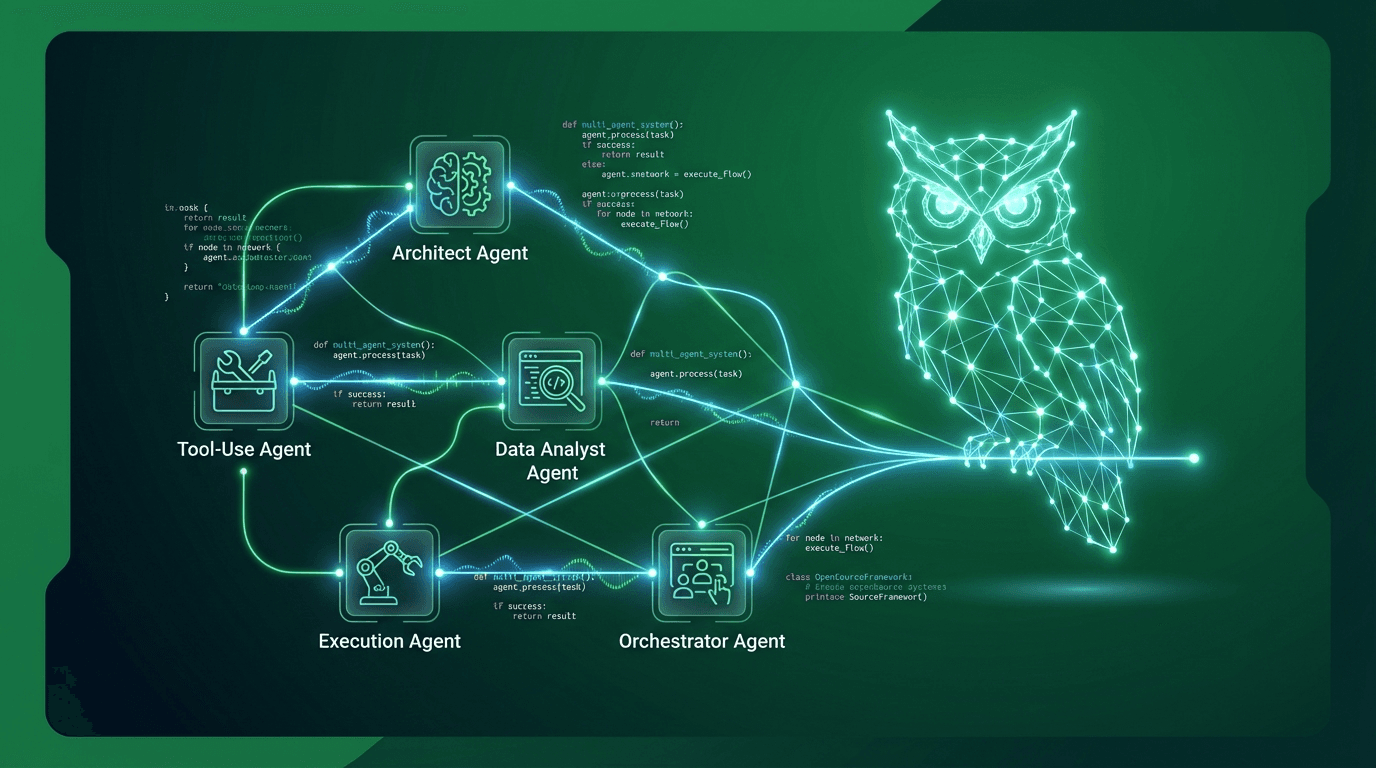
OWL (Optimized Workforce Learning) is a cutting-edge open-source multi-agent collaboration framework developed by the CAMEL-AI community. It achieves a GAIA benchmark score of 69.09%, ranking first among all open-source multi-agent frameworks. With 19,100 GitHub stars and 2,200 forks, OWL has earned strong community traction since its public release in March 2025.
OWL is built on the CAMEL framework and takes inspiration from human workforce collaboration models. Rather than relying on a single monolithic agent, OWL orchestrates specialized agents that each handle distinct subtasks, then combines their outputs into a coherent final result.
The GAIA (General AI Assistants) benchmark evaluates AI agents on real-world tasks requiring multi-step reasoning, web interaction, file handling, and tool use. OWL's score of 69.09% places it at the top of all open-source contenders. This is not a narrow, specialized result — GAIA tests general problem-solving capability across diverse domains.
OWL ships with over 30 integrated toolkits including web search engines (Google, DuckDuckGo, Wikipedia, Baidu), browser automation via Playwright, a Python code execution environment, document parsing for Word, Excel, PDF, and PowerPoint, and the Model Context Protocol (MCP) toolkit. The MCP integration means OWL can connect directly to the growing ecosystem of MCP servers.
OWL implements a two-tier agent structure: planning agents responsible for task decomposition and strategy formulation, and execution agents that carry out specific operations through tool calls. This mirrors how a human team might split work between a project manager and specialists.
Beyond text, OWL supports multimodal inputs including video, images, and audio data. The framework integrates with multimodal LLMs to interpret visual content within agent reasoning loops.
Recent updates added native support for Google's Gemini 2.5 Pro and OpenRouter platform, giving developers flexibility to route tasks through the most cost-effective or capable model for each subtask. The project was accepted at NeurIPS 2025, validating the technical rigor of its design.
OWL supports four installation methods — uv (recommended), venv/pip, Conda, and Docker — catering to developers with different environment preferences. A web UI was recently launched alongside the CLI interface.
OpenClaw is an open-source, local-first AI gateway with 366K GitHub stars that routes AI responses through WhatsApp, Telegram, Slack, Discord, iMessage, Teams, and 15+ other platforms — zero cloud dependency.

OpenClaw
Open-source personal AI assistant connecting to 13+ messaging platforms with local gateway architecture, voice support, and multi-agent routing.