
Open Source
Explore the latest AI open-source projects from GitHub and HuggingFace.
Explore the latest AI open-source projects from GitHub and HuggingFace.
The promise of AI agents — autonomous systems that can reason, plan, and act to accomplish complex tasks — has captured the imagination of developers and researchers alike. But building these systems has historically required deep expertise in prompt engineering, orchestration frameworks, and software engineering. AutoAgent, developed by the HKUDS (Hong Kong University Data Science) lab, challenges this assumption directly: it is a fully-automated, zero-code LLM agent framework where users construct and deploy sophisticated multi-agent systems entirely through natural language dialogue.
With nearly 9,000 GitHub stars and 1,300 forks, AutoAgent has established itself as one of the most-starred LLM agent frameworks from the academic community. Backed by peer-reviewed research (arXiv:2502.05957) and validated against the rigorous GAIA benchmark, it offers a compelling open-source alternative to expensive proprietary research and agent platforms.
Most agent frameworks — LangChain, CrewAI, AutoGen, and others — still require developers to write Python code to configure agents, define tools, and wire together workflows. AutoAgent's design philosophy takes a fundamentally different stance: the natural language description IS the program.
Rather than asking users to understand class hierarchies, callback patterns, or YAML configuration schemas, AutoAgent allows them to describe what they want in plain English. The system interprets this description, designs the appropriate agent architecture, configures the necessary tools, and orchestrates execution — all without human-written code.
This positions AutoAgent as the most accessible entry point into LLM agent development available today, while still delivering production-grade results on established benchmarks.
AutoAgent is organized around three primary modes of interaction:
User Mode (Deep Research Agent) The most immediately usable mode, User Mode deploys a ready-to-run multi-agent research system. Users describe a research question or information-gathering task in natural language, and AutoAgent assembles a team of agents to retrieve information, synthesize findings, and produce comprehensive reports. This is positioned as an open-source alternative to commercial deep research services, offering similar capabilities at zero cost beyond API usage.
Agent Editor For users who want to create custom agents for specific tasks, the Agent Editor allows definition of individual agents with custom tools using conversational prompts. The system handles the underlying tool configuration, prompt design, and integration logic.
Workflow Editor The most powerful mode, the Workflow Editor enables construction of complex multi-agent orchestration systems through conversation. Users describe the high-level workflow — which agents should collaborate, in what sequence, and under what conditions — and AutoAgent generates the complete orchestration logic.
Automation in AutoAgent goes deeper than a simple UI layer over existing frameworks. The system uses a self-managing workflow generation approach: given a high-level task description, it dynamically creates and adapts the agent workflow in real time, without requiring users to specify implementation details upfront.
This involves intelligent resource orchestration — the system identifies what tools, data sources, and sub-agents are needed for a given task and provisions them automatically. It also supports self-play agent customization, where agents iteratively refine their own behavior through code generation and testing loops.
AutoAgent maintains compatibility with the full spectrum of major LLM providers through LiteLLM abstraction:
This provider-agnostic design means AutoAgent can be used with whatever model best fits a team's cost, capability, or privacy requirements.
AutoAgent supports multi-hop Retrieval-Augmented Generation (RAG) — a form of RAG where the system iteratively retrieves, reasons about, and queries additional context across multiple steps. This makes it particularly effective for complex research tasks where a single retrieval pass is insufficient, and the agent must navigate a web of related information sources.
AutoAgent uses Docker containerization to manage the sandboxed environments in which agents execute code. This provides security isolation for agent-generated code, reproducibility across deployment environments, and automatic environment setup based on detected machine architecture (ARM/x86). Users do not need to manually configure execution environments.
Unlike many open-source agent frameworks that rely on anecdotal demonstrations, AutoAgent's capabilities are validated against the GAIA benchmark — an evaluation suite specifically designed to measure real-world task-completion abilities of AI agents across complex, multi-step scenarios. Published results in arXiv:2502.05957 provide a rigorous baseline for comparison against other agent systems.
AutoAgent targets two distinct audiences simultaneously. For non-technical users, the zero-code interface makes agent deployment genuinely accessible — there is no requirement to understand Python, APIs, or orchestration patterns. For technical users and researchers, the framework provides sufficient depth for custom agent construction and workflow design.
The Docker-based setup adds a dependency but significantly improves reproducibility. Installation follows standard Python patterns, and the repository includes interactive notebooks and documentation for onboarding.
The multi-provider LLM support means teams are not locked to any single vendor, and costs can be managed by routing different agent roles to models of appropriate capability and cost.
AutoAgent enters a crowded field — LangChain, CrewAI, AutoGen, Agno, and dozens of others compete for developer mindshare in the LLM agent space. Its differentiation is clear: while competitors require code, AutoAgent requires only language. This positions it uniquely for enterprise adoption scenarios where non-technical subject-matter experts need to build custom agent workflows without engineering support.
The HKUDS lab has a strong track record in the LLM space (also responsible for LightRAG, DeepTutor, and other notable projects), lending credibility to AutoAgent's technical foundations. The GAIA benchmark results provide objective evidence of real-world capability that many competing frameworks lack.
As the shift toward agent-native software development accelerates in 2026, frameworks that lower the barrier to entry — without sacrificing capability — are likely to see significant growth. AutoAgent's zero-code positioning and academic backing make it a project worth watching closely.
AutoAgent represents a genuine architectural bet: that the future of AI agent development is conversational, not programmatic. With nearly 9,000 stars, peer-reviewed validation, and a clean MIT license, it is one of the most compelling zero-code agent frameworks available today. For teams exploring LLM agents without deep engineering resources, or for researchers studying natural language-driven automation, AutoAgent offers a uniquely accessible and research-grounded starting point.
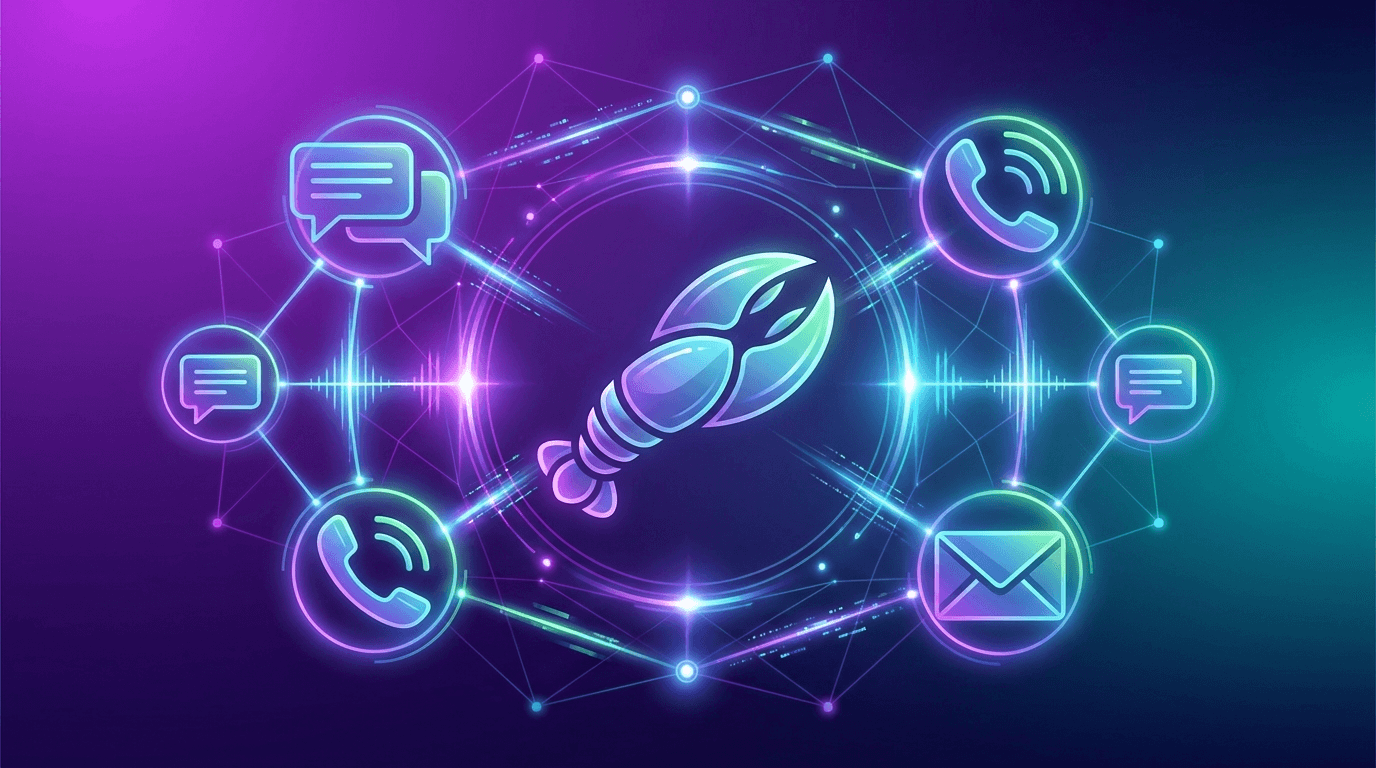
OpenClaw is an open-source, local-first AI gateway with 366K GitHub stars that routes AI responses through WhatsApp, Telegram, Slack, Discord, iMessage, Teams, and 15+ other platforms — zero cloud dependency.
OpenClaw
Open-source personal AI assistant connecting to 13+ messaging platforms with local gateway architecture, voice support, and multi-agent routing.