
Open Source
Explore the latest AI open-source projects from GitHub and HuggingFace.
Explore the latest AI open-source projects from GitHub and HuggingFace.
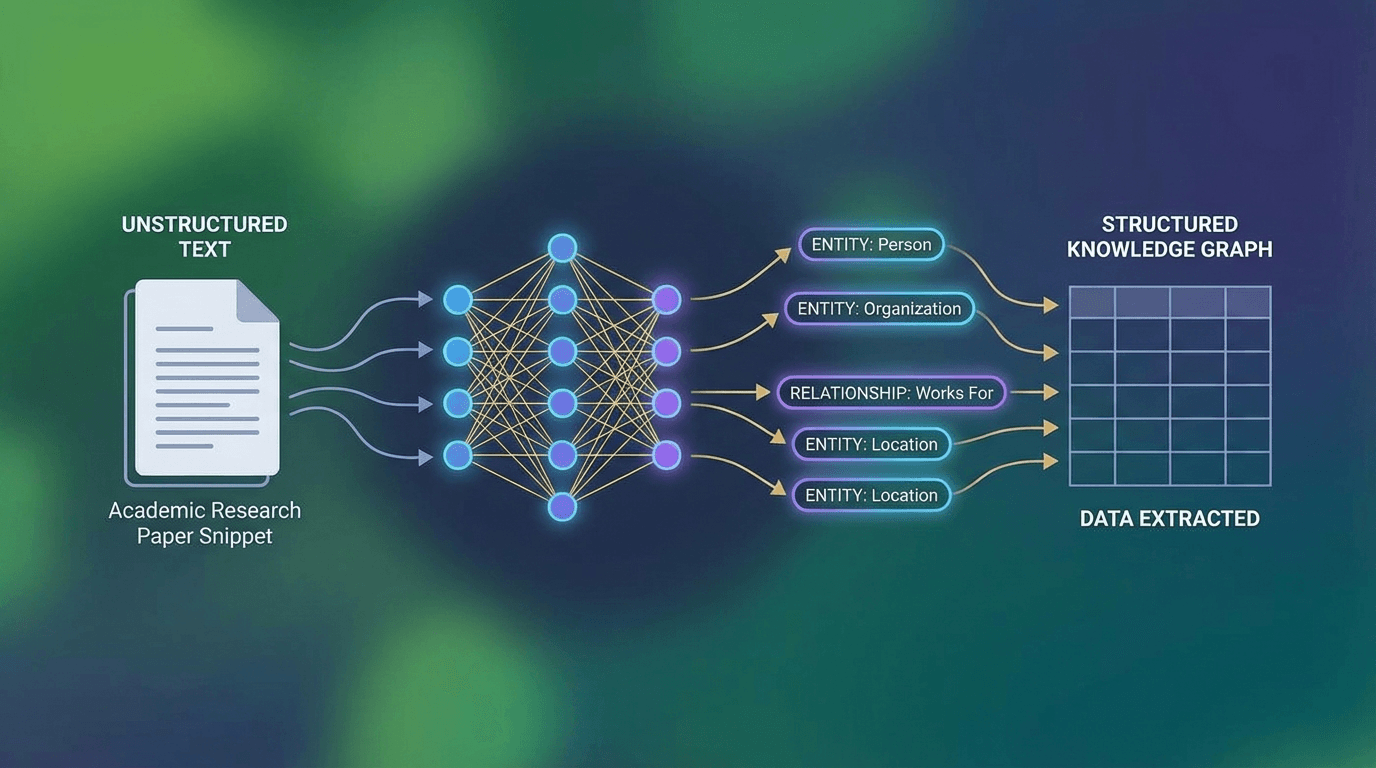
GLiNER2 is a compact yet powerful information extraction model that unifies Named Entity Recognition (NER), Text Classification, Structured Data Extraction, and Relation Extraction into a single 205M parameter model. Developed by Fastino AI, it achieves performance competitive with GPT-4o on several extraction benchmarks while running entirely on CPU without any external API dependencies. The project has reached 1,079 GitHub stars and is gaining traction as a privacy-focused, cost-effective alternative to API-based extraction pipelines.
Information extraction is a foundational capability for AI applications ranging from document processing to knowledge graph construction. Traditional approaches require separate specialized models for each task, resulting in complex pipelines that are expensive to deploy and maintain. GLiNER2 collapses this complexity into a single model that can be installed with pip install gliner2 and runs on any machine with a CPU.
GLiNER2 handles four distinct extraction tasks through a single schema-based interface:
| Task | Description | Example |
|---|---|---|
| Entity Extraction | Identify named entities with confidence scores and spans | People, organizations, locations |
| Text Classification | Single and multi-label classification with configurable thresholds | Sentiment, intent, topic |
| Structured Data Extraction | Parse complex JSON structures from unstructured text | Forms, invoices, specifications |
| Relation Extraction | Extract directional relationships between entities | "Tim Cook CEO-of Apple" |
All four tasks can be composed in a single forward pass through unified schemas, eliminating the need for multiple model calls.
The base model runs at 205M parameters, small enough for efficient CPU inference. This design choice makes GLiNER2 deployable on standard servers, edge devices, and development machines without GPU requirements. The larger 340M parameter variant offers enhanced accuracy for applications where precision is critical.
from gliner2 import GLiNER2

extractor = GLiNER2.from_pretrained("fastino/gliner2-base-v1")
result = extractor.extract_entities(
    "Apple CEO Tim Cook announced iPhone 15 in Cupertino.",
    ["company", "person", "product", "location"]
)
Rather than hardcoding entity types, GLiNER2 accepts custom schemas with entity descriptions that improve extraction accuracy for domain-specific tasks. This flexibility means a single model deployment can serve multiple use cases by simply changing the schema definition.
All processing happens locally with zero data leaving the machine. This makes GLiNER2 suitable for sensitive domains like healthcare, legal, and financial document processing where data privacy is non-negotiable.
GLiNER2 closely matches GPT-4o in overall F1 score:
| Metric | GLiNER2 | GPT-4o |
|---|---|---|
| Overall F1 | 0.590 | 0.599 |
| AI Domain F1 | 0.547 | 0.526 |
| Literature F1 | 0.564 | 0.561 |
| SNIPS Intent | 0.83 | - |
| Banking77 Intent | 0.70 | - |
For intent classification specifically, GLiNER2 scores 0.83 on SNIPS and 0.70 on Banking77, outperforming DeBERTa's 0.77 and 0.42 respectively.
GLiNER2 supports LoRA (Low-Rank Adaptation) for parameter-efficient fine-tuning on domain-specific data. The adapter switching capability allows maintaining multiple domain-specific adapters on a single base model, and custom regex validators can filter extracted spans based on pattern matching.
GLiNER2 represents a significant step toward making production-grade information extraction accessible without cloud API dependencies. Its unified multi-task architecture eliminates pipeline complexity, while CPU-efficient inference makes deployment straightforward. For teams that need NER, classification, and relation extraction without sending data to external services, GLiNER2 offers a compelling alternative to API-based solutions at a fraction of the operational cost.