
Open Source
Explore the latest AI open-source projects from GitHub and HuggingFace.
Explore the latest AI open-source projects from GitHub and HuggingFace.
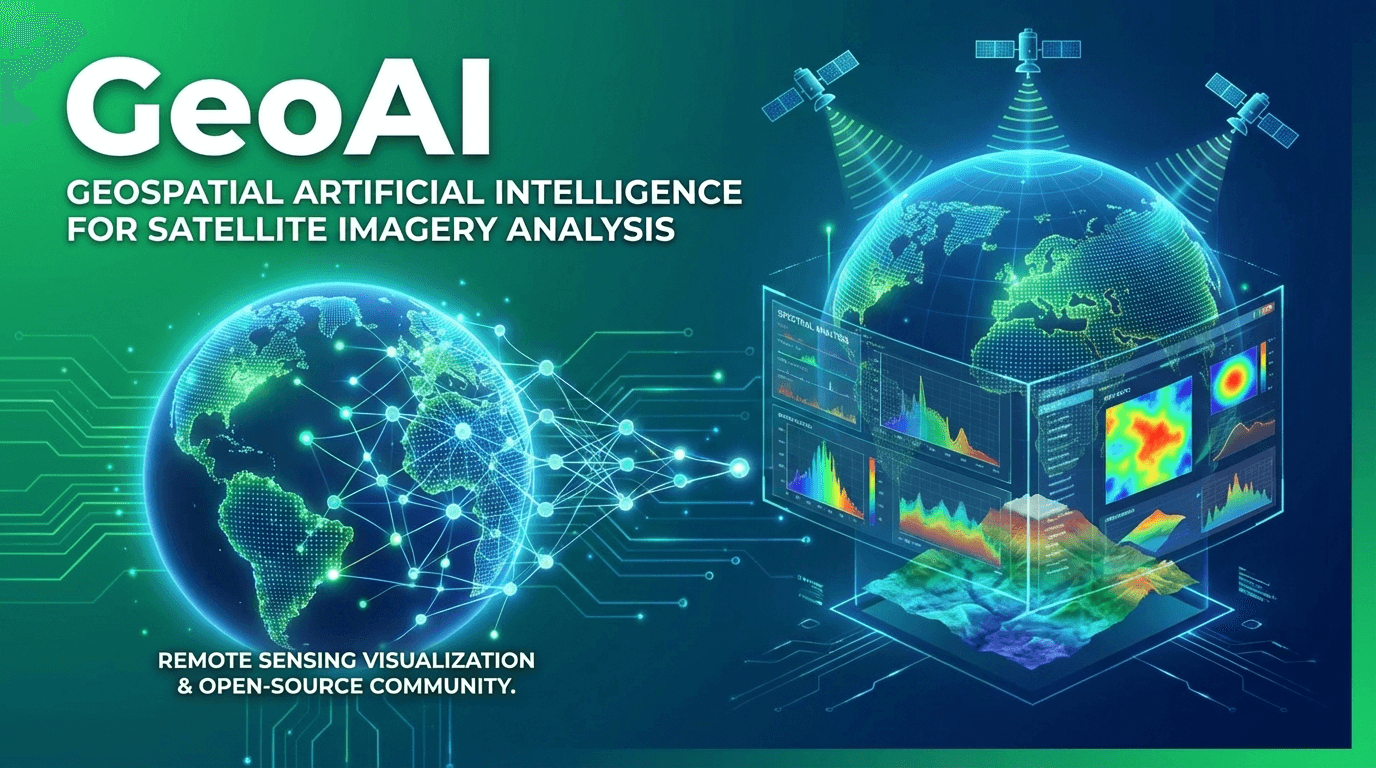
GeoAI is a Python package that bridges artificial intelligence with geospatial data analysis and visualization. Developed by the Open Geospatial Solutions (opengeos) community and published in the Journal of Open Source Software (2026), it provides a unified framework for applying deep learning models to satellite imagery, aerial photographs, and vector data. The project reached version 0.30.0 on February 23, 2026, with 70 total releases demonstrating rapid development pace.
Geospatial analysis and deep learning have traditionally existed as separate technical domains, each with its own tools, data formats, and workflows. GeoAI eliminates this gap by integrating popular AI frameworks including PyTorch, Hugging Face Transformers, and PyTorch Segmentation Models with geospatial-specific libraries. The result is a package where loading a satellite image, training a land cover classifier, and exporting results as a GeoJSON file can happen in a single workflow without format conversion headaches.
The package supports four primary AI workflows for geospatial data. Image segmentation identifies regions within satellite or aerial imagery, enabling applications like land use classification, building footprint extraction, and flood mapping. Object detection locates and classifies specific features such as vehicles, trees, or infrastructure. Change detection compares multi-temporal imagery to identify landscape transformations over time. Classification assigns labels to image tiles or vector features based on learned patterns.
Each workflow includes automated dataset preparation with image chip generation and label creation, reducing the manual preprocessing that typically consumes a large portion of geospatial ML projects.
GeoAI provides interactive multi-layer visualization for both raster and vector data, enabling researchers to inspect training data, model predictions, and ground truth labels in an interactive map interface. This visual feedback loop is essential for diagnosing model performance and identifying areas where additional training data is needed.
A dedicated GeoAI plugin enables QGIS desktop users to run AI-powered geospatial workflows directly within the QGIS environment without writing code. This significantly lowers the barrier to entry for GIS professionals who may not have deep learning expertise but want to leverage AI capabilities in their existing workflows.
The package handles the full range of geospatial formats including GeoTIFF, JPEG2000, GeoJSON, Shapefile, GeoPackage, and GeoParquet. Vector-to-raster and raster-to-vector conversion utilities are optimized specifically for AI workflows, and data augmentation techniques are tailored for geospatial data characteristics such as rotational invariance and scale variation.
GeoAI integrates with Overture Maps and other open datasets, providing ready-to-use data sources for training and evaluation. Pre-trained models for common tasks like land cover classification are included, allowing users to get started with minimal setup.
Installation is available via pip (pip install geoai-py), conda, or mamba. Comprehensive documentation, tutorials, and video resources are hosted at the project website, making it accessible to both researchers and practitioners.