
Open Source
Explore the latest AI open-source projects from GitHub and HuggingFace.
Explore the latest AI open-source projects from GitHub and HuggingFace.
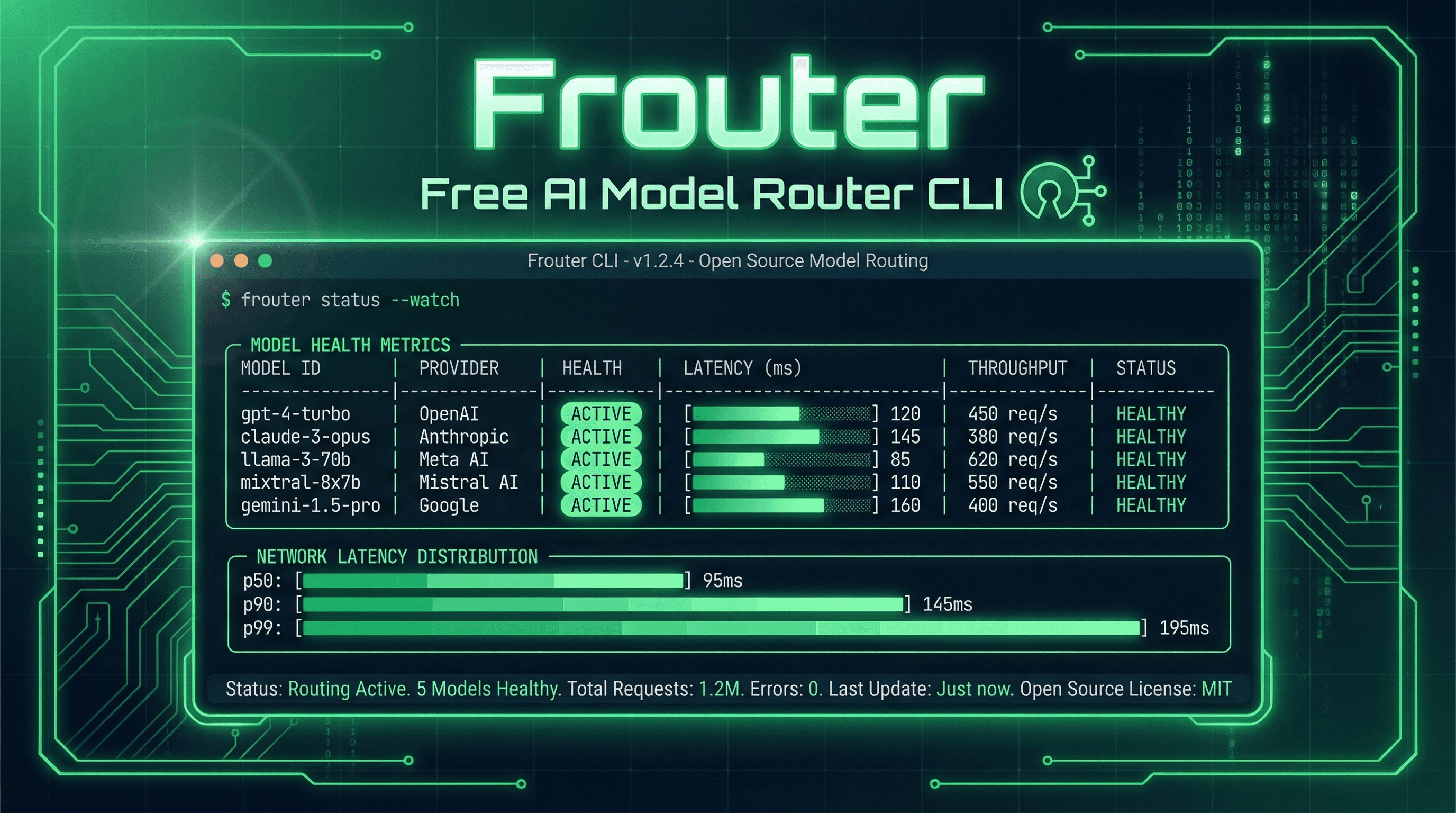
As the number of free and open-weight AI models continues to grow, developers face an increasingly common problem: which model should they use right now? Availability fluctuates, latency varies by region and time of day, and keeping track of which free endpoints are actually responsive is a chore nobody wants. Frouter, a new open-source CLI tool created by developer jyoung105, tackles this head-on by providing a live, interactive terminal UI that pings free AI models in parallel, ranks them by availability and capability, and automatically rewrites your AI agent's configuration to use the best one available.
Frouter has gained traction in the developer community, particularly among users of OpenCode and OpenClaw, as it solves the practical pain of model failover without requiring any cloud infrastructure or paid APIs.
Frouter's terminal UI refreshes every two seconds, pinging all configured free model endpoints in parallel. The interface displays ten columns of data for each model, including tier ranking (from S+ to C scale), provider name, context window size, Arena Elo score, measured latency, uptime percentage, and a health status indicator.
Models are ranked using a three-tier priority system: availability first, then capability tier, then response latency. This means Frouter always prefers a model that is actually responsive over one that scores higher on benchmarks but is currently down or overloaded.
The most compelling feature is Frouter's ability to automatically rewrite your AI agent's configuration file when a model fails. If the model your agent is currently using goes offline or becomes overloaded, Frouter detects this and switches to the next best available model without any manual intervention.
Frouter integrates with multiple free model providers, including NVIDIA NIM and OpenRouter. On first run, a setup wizard prompts users for API keys, with the option to skip any provider.
For scripted workflows and CI/CD pipelines, Frouter offers a --best flag that outputs the optimal model selection without launching the interactive TUI.
Frouter is built entirely in TypeScript with JavaScript and a small amount of Astro for documentation. It runs on both Node.js and Bun runtimes.
| Method | Command |
|---|---|
| npx (no install) | npx frouter-cli |
| npm global | npm install -g frouter-cli |
| bunx (no install) | bunx frouter-cli |
| bun global | bun install -g frouter-cli |
The project maintains its model catalog through automated GitHub Actions workflows with daily sync and weekly Arena Elo refresh.
Frouter fills a surprisingly underserved niche in the AI developer toolchain. As free model availability becomes more fragmented across providers, having an automated system that monitors, ranks, and switches between models is genuinely useful.