
Open Source
Explore the latest AI open-source projects from GitHub and HuggingFace.
Explore the latest AI open-source projects from GitHub and HuggingFace.
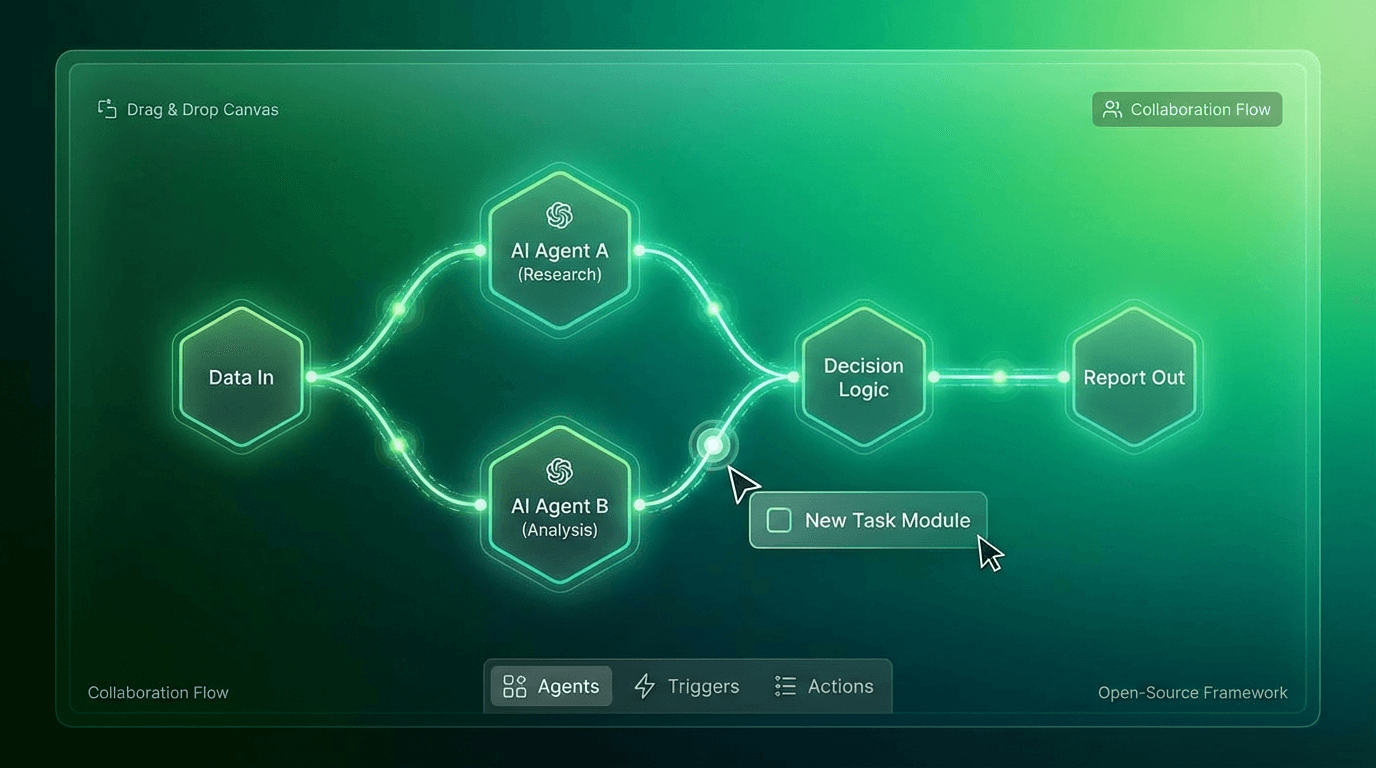
ChatDev 2.0 (DevAll) is a zero-code multi-agent orchestration platform from OpenBMB that enables users to build and execute customized multi-agent systems through visual configuration, requiring no programming expertise. Officially released on January 7, 2026, it represents a major evolution from the original ChatDev, which simulated a virtual software company with role-playing AI agents.
With 31,200 GitHub stars and 3,900 forks, ChatDev 2.0 has become one of the most popular multi-agent frameworks in the open-source ecosystem.
The centerpiece of ChatDev 2.0 is a drag-and-drop visual workflow canvas where users design multi-agent systems by connecting agent nodes, defining communication channels, and specifying task flows. This removes the programming barrier entirely -- users who cannot write Python can still orchestrate complex multi-agent scenarios for data analysis, content generation, research, and more.
While ChatDev 1.0 focused specifically on automating software development with role-playing agents (CEO, CTO, Programmer), ChatDev 2.0 generalizes to arbitrary domains. The platform supports data visualization, 3D generation, game development, deep research, and any workflow that benefits from coordinated multi-agent collaboration. This expansion is captured in the tagline 'Dev All.'
Alongside the visual interface, ChatDev 2.0 provides a Python SDK for developers who prefer programmatic automation. The SDK supports batch processing, workflow templating, and integration with existing codebases, making it suitable for both interactive exploration and production deployment.
The web console provides real-time logging and artifact inspection during workflow execution. Users can observe each agent's reasoning, inter-agent messages, and intermediate outputs as they are produced. Human-in-the-loop feedback allows users to intervene and redirect agent behavior mid-execution.
The platform's orchestration approach is informed by the research paper 'Multi-Agent Collaboration via Evolving Orchestration,' accepted to NeurIPS 2025. This work introduced a puppeteer-style paradigm where a learnable central orchestrator, optimized with reinforcement learning, dynamically activates and sequences agents to construct efficient, context-aware reasoning paths.
The frontend is built with Vue 3, providing a modern reactive interface for the workflow canvas. The backend orchestration engine is implemented in Python, with WebSocket communication enabling real-time updates between the execution engine and the browser-based UI.
OpenClaw is an open-source, local-first AI gateway with 366K GitHub stars that routes AI responses through WhatsApp, Telegram, Slack, Discord, iMessage, Teams, and 15+ other platforms — zero cloud dependency.
OpenClaw
Open-source personal AI assistant connecting to 13+ messaging platforms with local gateway architecture, voice support, and multi-agent routing.