
WordPress Launches Official AI Plugins for Claude, Gemini, and ChatGPT
WordPress.org releases three first-party AI provider plugins with a unified PHP AI Client SDK, bringing native Claude, Gemini, and ChatGPT integration to 40% of the web.
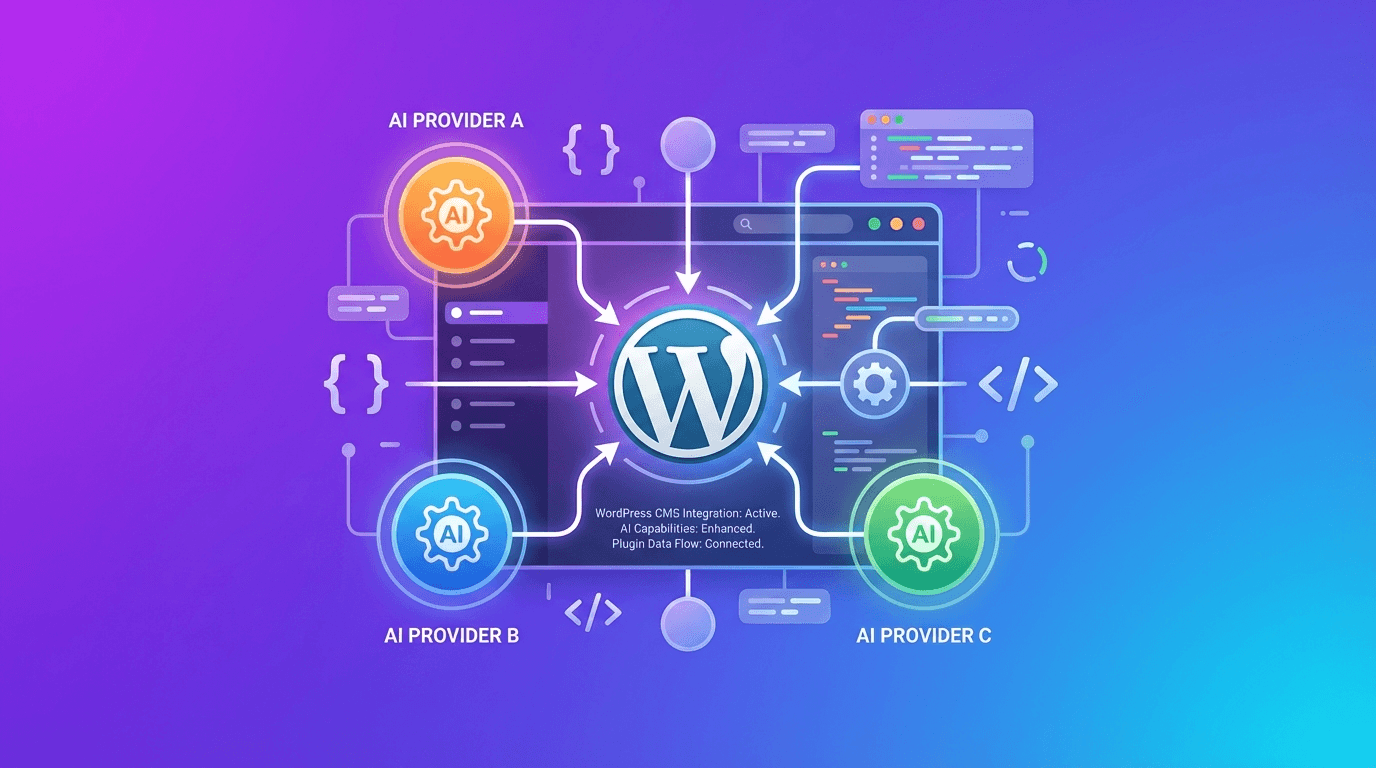
WordPress.org releases three first-party AI provider plugins with a unified PHP AI Client SDK, bringing native Claude, Gemini, and ChatGPT integration to 40% of the web.
WordPress Enters the AI Platform Race
On March 5, 2026, WordPress.org officially released three first-party AI provider plugins, establishing direct connections between the world's most popular content management system and the three leading AI model providers: Anthropic's Claude, Google's Gemini, and OpenAI's ChatGPT. The release marks a watershed moment for the web, given that WordPress powers approximately 43% of all websites globally.
Unlike the hundreds of third-party AI plugins already available in the WordPress ecosystem, these three plugins are maintained under WordPress.org's open-source governance and built on a new unified infrastructure called the PHP AI Client SDK. The move signals that AI integration is no longer a premium add-on but a foundational capability for web publishing.
The Three Plugins and Their Capabilities
WordPress introduced three distinct connectors, each named with a consistent convention: AI Provider for Anthropic, AI Provider for Google, and AI Provider for OpenAI. While all three share the same underlying SDK infrastructure, each plugin exposes capabilities specific to its respective provider.
AI Provider for OpenAI
The OpenAI plugin offers the broadest feature set at launch. It supports text generation using GPT models, image generation via DALL-E, function calling for structured tool use, web search capability, dynamic model discovery from the API, and text-to-speech functionality. This breadth reflects OpenAI's mature API surface area and makes the plugin suitable for content creation, visual asset generation, and interactive experiences.
AI Provider for Google (Gemini)
Google's Gemini connector supports text generation with Gemini models, image generation using Imagen, and function calling. The multimodal capabilities of Gemini make this plugin particularly relevant for sites that need both text and visual content generation in a single workflow. Site operators can generate article illustrations, product descriptions, and visual summaries through a unified interface.
AI Provider for Anthropic (Claude)
Anthropic's Claude plugin differentiates itself with extended thinking support for complex reasoning tasks, alongside standard text generation and function calling. The extended thinking feature allows Claude to work through multi-step problems with visible reasoning chains, making it especially valuable for sites that need high-quality analytical content, technical documentation, or educational materials.
The PHP AI Client SDK: Unified Infrastructure
The technical foundation underpinning all three plugins is the PHP AI Client SDK, a new open-source library that provides a unified interface across all AI providers. This architecture is arguably more significant than the plugins themselves.
The SDK abstracts away provider-specific API differences, allowing developers to write AI-powered features once and switch between providers with minimal code changes. It supports simple text generation, complex multimodal operations, streaming responses, and long-running tasks through a consistent API surface.
For WordPress 6.9, the SDK must be installed separately. However, WordPress 7.0, scheduled for early April 2026, will include the SDK as a built-in component. This means that from April onward, every new WordPress installation will ship with AI integration infrastructure ready to use.
Technical Requirements
The plugins require PHP 7.4 or higher and a valid API key from the chosen provider. Each plugin handles automatic provider registration, meaning that once installed and configured with an API key, the AI capabilities become available to any compatible WordPress plugin or theme that uses the SDK.
Credential management is centralized, so users configure their API keys once and all SDK-compatible plugins can leverage them. This eliminates the common problem of managing API keys across multiple disparate AI plugins.
Why This Matters for the Web
The significance of this release extends beyond convenience. WordPress powers 43% of websites, from personal blogs to Fortune 500 corporate sites. By making AI integration a first-class, officially supported feature, WordPress is effectively democratizing access to advanced AI capabilities for millions of site operators who may not have the technical resources to implement custom AI integrations.
| Feature | OpenAI Plugin | Gemini Plugin | Claude Plugin |
|---|---|---|---|
| Text Generation | Yes | Yes | Yes |
| Image Generation | DALL-E | Imagen | No |
| Function Calling | Yes | Yes | Yes |
| Web Search | Yes | No | No |
| Extended Thinking | No | No | Yes |
| Text-to-Speech | Yes | No | No |
The unified SDK also creates a competitive dynamic where AI providers must continuously improve their offerings to remain the preferred choice for WordPress developers. Site operators can compare providers side-by-side and switch without rewriting their integration code.
Impact on the Plugin Ecosystem
The release has significant implications for the existing WordPress AI plugin ecosystem. Hundreds of third-party plugins currently provide various AI capabilities, but they each implement their own API connections, credential management, and provider abstractions. The official SDK standardizes these patterns, which could consolidate the market around plugins that build on the official infrastructure rather than maintaining custom implementations.
Plugin developers who adopt the SDK gain automatic support for all three providers and any future providers that WordPress adds. This reduces maintenance burden and broadens their potential user base.
Pros
- Official WordPress.org support ensures long-term maintenance, security updates, and compatibility with WordPress core
- Unified PHP AI Client SDK allows developers to write provider-agnostic code and switch between Claude, Gemini, and ChatGPT easily
- WordPress 7.0 will include the SDK by default, making AI integration zero-configuration for new installations
- Centralized credential management eliminates the complexity of configuring API keys across multiple plugins
- Open-source governance ensures transparency and community-driven development
Cons
- API costs are borne entirely by site operators, with no WordPress-managed pricing tier or free credits
- Claude plugin lacks image generation capabilities that OpenAI and Gemini plugins offer
- WordPress 6.9 users must manually install the SDK as a separate dependency
- No built-in usage monitoring or cost tracking tools for API consumption
Outlook
The WordPress AI plugins release represents a fundamental shift in how AI capabilities reach end users on the web. Rather than requiring developers to build custom integrations, the official SDK makes AI a plug-and-play capability for the platform that runs nearly half of all websites.
The real test will come with WordPress 7.0 in April, when the SDK ships as a built-in component. At that point, every WordPress site will have AI infrastructure available by default, and the question shifts from "can I add AI to my site" to "which provider should I choose." This could drive significant API adoption for all three providers and establish WordPress as the primary distribution channel for AI capabilities on the open web.
Conclusion
WordPress's official AI plugins are a pragmatic, well-architected addition to the web's most widely used CMS. By building a unified SDK that abstracts provider differences and shipping official plugins for Claude, Gemini, and ChatGPT, WordPress has positioned itself as a neutral platform where AI providers compete on capability rather than integration convenience. For the 43% of the web that runs on WordPress, AI just became a first-class citizen.
Editor's Verdict
WordPress Launches Official AI Plugins for Claude, Gemini, and ChatGPT earns a solid recommendation within the ai tools space.
The strongest case for paying attention is official WordPress.org support guarantees long-term maintenance, security patches, and WordPress core compatibility, which raises the bar for what readers should now expect from peers in this space. Reinforcing that, unified SDK enables provider-agnostic AI development, reducing vendor lock-in for WordPress developers adds practical value rather than just headline appeal. The broader signal worth registering is straightforward: wordPress powers 43% of all websites, making official AI integration a potential inflection point for mainstream AI adoption on the open web. On the other side of the ledger, API costs are fully borne by site operators with no managed pricing or free tier is a real constraint, not a marketing footnote, and it should factor into any serious decision. Layered on top of that, claude plugin lacks image generation that OpenAI (DALL-E) and Gemini (Imagen) plugins provide narrows the set of teams for whom this is an obvious yes.
For product teams, content creators, and knowledge workers looking to upgrade a specific workflow, this is a serious evaluation candidate, not just a curiosity to bookmark. For everyone else, the safer posture is to monitor coverage and revisit once the use cases that matter to your team are demonstrated in the wild.
Pros
- Official WordPress.org support guarantees long-term maintenance, security patches, and WordPress core compatibility
- Unified SDK enables provider-agnostic AI development, reducing vendor lock-in for WordPress developers
- WordPress 7.0 will ship with built-in SDK, making AI integration zero-configuration for new sites
- Centralized credential management simplifies multi-plugin API key configuration
- Open-source plugins ensure transparency and allow community contributions
Cons
- API costs are fully borne by site operators with no managed pricing or free tier
- Claude plugin lacks image generation that OpenAI (DALL-E) and Gemini (Imagen) plugins provide
- WordPress 6.9 users must manually install the SDK as a separate dependency before using plugins
- No built-in usage dashboards or cost tracking for API consumption
References
Comments0
Key Features
WordPress.org released three official AI provider plugins on March 5, 2026, for Anthropic Claude, Google Gemini, and OpenAI ChatGPT. All three are built on the new PHP AI Client SDK, which provides a unified interface across providers. The OpenAI plugin supports text, image (DALL-E), web search, and TTS. The Gemini plugin offers text and image (Imagen) generation. The Claude plugin features extended thinking for complex reasoning. WordPress 7.0 (April 2026) will include the SDK by default.
Key Insights
- WordPress powers 43% of all websites, making official AI integration a potential inflection point for mainstream AI adoption on the open web
- The PHP AI Client SDK is provider-agnostic, allowing developers to switch between Claude, Gemini, and ChatGPT with minimal code changes
- WordPress 7.0 (April 2026) will ship with the SDK built in, making every new installation AI-ready by default
- Each plugin exposes provider-specific strengths: OpenAI offers the broadest features, Claude excels at reasoning, Gemini provides multimodal generation
- Centralized credential management eliminates the fragmented API key problem that plagues current third-party AI plugins
- The release creates competitive pressure among AI providers to optimize their WordPress offerings for the largest CMS market
- Open-source governance ensures community oversight and long-term sustainability of the AI integration infrastructure
- Third-party plugin developers can now build on a standardized AI layer rather than maintaining custom provider integrations
Was this review helpful?
Share
Related AI Reviews

AWS TorchNeuron Runs PyTorch on Trainium With One Change
AWS's TorchNeuron registers Trainium as a native PyTorch device, so existing code runs on it by switching one device setting, AWS says.

Replit Makes OpenAI Its Default Over Anthropic, CEO Says
Replit CEO Amjad Masad says OpenAI replaces Anthropic as the default model provider; Claude stays available to users on the platform.

Figma Specs: Markdown Spec Docs on the Canvas for Agents
Figma Specs puts Markdown specs on the canvas with GitHub and Hex connectors, agent comments and MCP handoff. Open beta on paid plans from Oct 15.

Daydream Adds iOS 27 Photo Shopping and Siri Search
Fashion app Daydream uses Apple's iOS 27 tools to turn saved outfit photos into shoppable matches, plus Siri natural-language search.