
Google's TurboQuant Compresses LLM Memory by 6x With Zero Accuracy Loss
Google Research introduces TurboQuant, a 3-bit KV cache compression algorithm delivering 6x memory reduction and up to 8x speedup on H100 GPUs without any accuracy degradation.
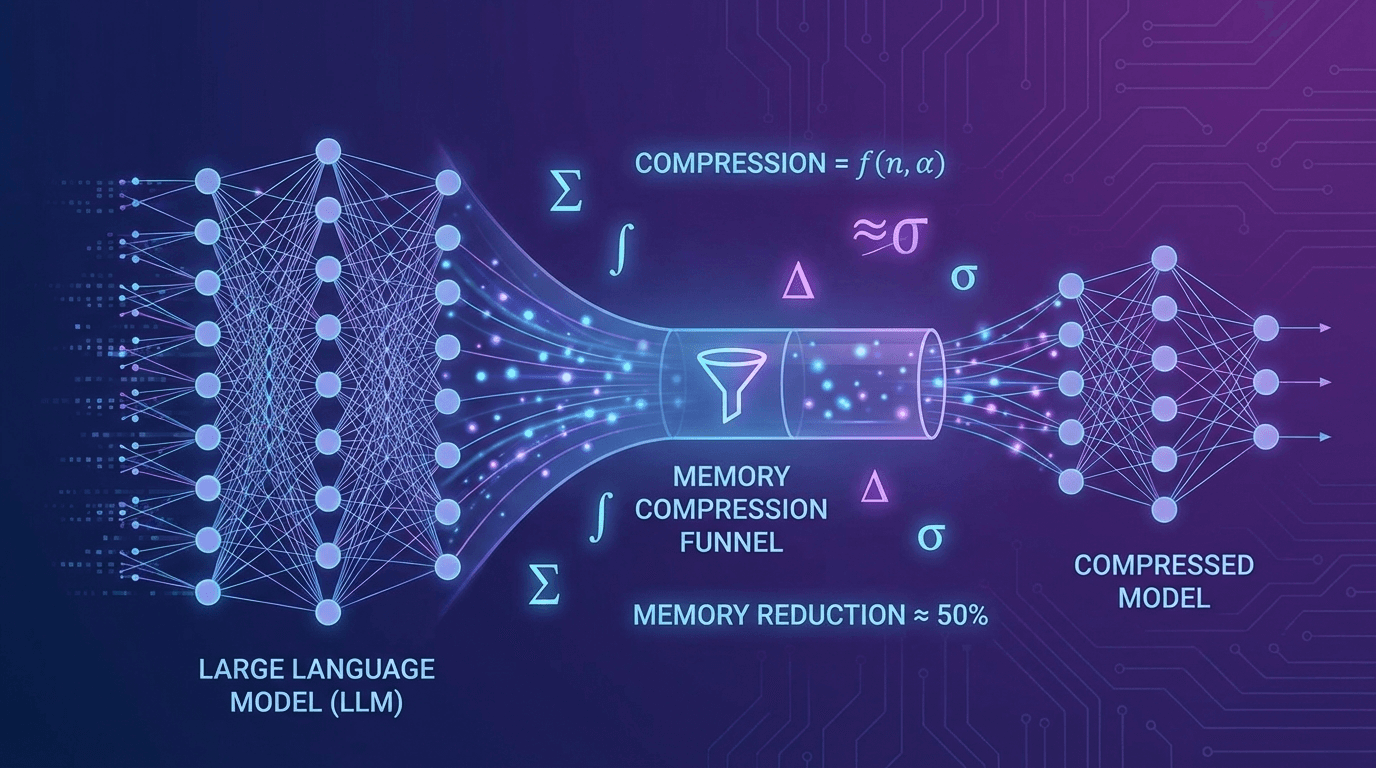
Google Research introduces TurboQuant, a 3-bit KV cache compression algorithm delivering 6x memory reduction and up to 8x speedup on H100 GPUs without any accuracy degradation.
The Memory Bottleneck Problem
Large language models are hungry for memory. Every conversation turn, every document analyzed, every agent action adds to the key-value (KV) cache, the data structure that stores attention state and allows the model to remember what came before. On production hardware, the KV cache frequently consumes more GPU memory than the model weights themselves, limiting batch sizes, context lengths, and ultimately the number of users a single GPU can serve.
Google Research has now published TurboQuant, a compression algorithm that reduces KV cache memory requirements by 6x while maintaining zero accuracy loss. The work, presented at ICLR 2026, achieves this by compressing cache values to just 3 bits per number, a level of compression that previous methods could not reach without degrading model outputs.
How TurboQuant Works
TurboQuant operates in two stages, each addressing a different aspect of the compression challenge.
Stage 1: PolarQuant
The first stage converts data vectors from standard Cartesian coordinates to polar coordinates, replacing X-Y-Z distance measurements with radius (data magnitude) and angle (semantic direction) pairs. This geometric transformation simplifies the data distribution, making it more amenable to aggressive quantization. Critically, PolarQuant eliminates the expensive data normalization step that most quantization methods require, mapping data onto a predictable circular grid instead.
Stage 2: QJL (Quantized Johnson-Lindenstrauss)
The second stage applies the Johnson-Lindenstrauss Transform to compress high-dimensional data while preserving essential distance relationships. Each vector component is reduced to a single sign bit (+1 or -1), achieving near-zero memory overhead for the error correction layer. A specialized estimator maintains accuracy for attention score calculations, ensuring that the compressed representation produces identical results to the uncompressed original.
The combination is powerful: PolarQuant handles the bulk compression efficiently, while QJL corrects any residual errors that would otherwise accumulate and degrade output quality.
Performance Results
The numbers are compelling across multiple dimensions.
| Metric | Result |
|---|---|
| KV Cache Compression | 3-bit (from 16/32-bit) |
| Memory Reduction | 6x |
| Speedup (4-bit on H100) | Up to 8x |
| Accuracy Loss | Zero |
| Training Required | None |
TurboQuant was evaluated on Gemma, Mistral, and Llama-3.1-8B-Instruct across six benchmarks: LongBench, Needle In A Haystack, ZeroSCROLLS, RULER, L-Eval, and GloVe. Across all models and benchmarks, the compressed models matched the accuracy of uncompressed baselines. The 4-bit variant achieved up to 8x performance improvement over 32-bit unquantized keys on NVIDIA H100 GPUs.
Why This Matters
TurboQuant's practical impact extends beyond benchmark scores. The algorithm works on existing models without any training or fine-tuning, meaning it can be applied as a post-processing step to any compatible LLM. This is a critical distinction from methods that require quantization-aware training, which adds weeks of compute cost and complexity.
For deployment operators, 6x memory reduction means a model that previously required 6 GPUs for a given context length can now run on 1, or that a single GPU can serve 6x more concurrent users. On expensive hardware like H100s (which rent for $2-3 per hour on cloud platforms), the cost savings are substantial.
The technique is also model-agnostic. Google tested it on both their own Gemma models and external models like Mistral and Llama, demonstrating portability across architectures.
Broader Context
TurboQuant arrives at a moment when the AI industry is grappling with inference cost as a strategic concern. As models grow larger and context windows extend to millions of tokens, the memory footprint of the KV cache scales linearly, making compression not just desirable but necessary for economic viability.
Previous compression methods like standard quantization (INT8, INT4) and pruning offered partial solutions but typically required accuracy trade-offs or model-specific calibration. TurboQuant's contribution is achieving extreme compression (3 bits) with zero accuracy loss and zero retraining, a combination that was previously considered impractical.
The publication timing, just ahead of its ICLR 2026 presentation, suggests Google views this as a significant contribution. The related PolarQuant paper will also be presented at AISTATS 2026, while the underlying QJL algorithm was published at AAAI 2025.
Limitations and Open Questions
As of March 2026, Google has published the research papers but has not yet released open-source code. The ICLR presentation is expected to coincide with or precede code availability, but until independent researchers can reproduce the results, the claims remain Google-verified only.
Additionally, the benchmarks focused on models up to 8B parameters. Performance characteristics at larger scales (70B+) may differ, and real-world serving environments introduce variables like batching strategies and multi-tenant interference that controlled benchmarks do not capture.
Conclusion
TurboQuant represents a meaningful advance in LLM inference efficiency. By combining PolarQuant's geometric compression with QJL's error correction, Google has achieved 3-bit KV cache compression with zero accuracy degradation and no retraining requirement. For anyone operating LLM inference at scale, whether on cloud GPUs or local hardware, this technique could significantly reduce costs and expand what is possible with existing silicon. The research community and deployment operators should watch closely for the open-source release.
Editor's Verdict
Google's TurboQuant Compresses LLM Memory by 6x With Zero Accuracy Loss stands out as one of the more compelling research developments we've covered recently.
The strongest case for paying attention is achieves extreme compression (3-bit) with verified zero accuracy loss across multiple models and benchmarks, which raises the bar for what readers should now expect from peers in this space. Reinforcing that, requires no retraining or fine-tuning, enabling immediate deployment on existing models adds practical value rather than just headline appeal. The broader signal worth registering is straightforward: 3-bit quantization with zero accuracy loss was previously considered impractical, making TurboQuant a genuine research breakthrough. On the other side of the ledger, open-source code not yet released as of March 2026, limiting independent verification is a real constraint, not a marketing footnote, and it should factor into any serious decision. Layered on top of that, benchmarks limited to models up to 8B parameters; performance at 70B+ scale unconfirmed narrows the set of teams for whom this is an obvious yes.
For ML researchers, technical leads, and readers tracking the underlying science behind new capabilities, the answer here is to pilot now and plan for production use. For everyone else, the safer posture is to monitor coverage and revisit once the use cases that matter to your team are demonstrated in the wild.
Pros
- Achieves extreme compression (3-bit) with verified zero accuracy loss across multiple models and benchmarks
- Requires no retraining or fine-tuning, enabling immediate deployment on existing models
- Up to 8x performance improvement on H100 GPUs translates to significant cost savings
- Model-agnostic design works across Google (Gemma), Meta (Llama), and Mistral architectures
Cons
- Open-source code not yet released as of March 2026, limiting independent verification
- Benchmarks limited to models up to 8B parameters; performance at 70B+ scale unconfirmed
- Real-world serving environments may introduce variables not captured in controlled benchmarks
- Depends on specific GPU hardware capabilities for maximum speedup gains
References
Comments0
Key Features
1. 3-bit KV cache compression achieving 6x memory reduction with zero accuracy loss across multiple LLM architectures 2. Two-stage compression: PolarQuant (geometric simplification) + QJL (error correction via Johnson-Lindenstrauss Transform) 3. Up to 8x inference speedup on NVIDIA H100 GPUs with 4-bit variant 4. No training or fine-tuning required -- applies as post-processing to existing models 5. Validated on Gemma, Mistral, and Llama-3.1-8B across six standard benchmarks
Key Insights
- 3-bit quantization with zero accuracy loss was previously considered impractical, making TurboQuant a genuine research breakthrough
- The no-retraining requirement makes this immediately deployable on existing production models without additional compute investment
- 6x memory reduction means inference costs could drop proportionally, reshaping the economics of LLM serving
- Model-agnostic design (tested on Gemma, Mistral, Llama) suggests broad applicability across the LLM ecosystem
- The KV cache bottleneck becomes more severe as context windows grow to millions of tokens, making compression increasingly critical
- Google's decision to present at ICLR 2026 signals confidence in reproducibility and academic rigor
- Until open-source code is released, independent verification remains pending, an important caveat for production adoption
Was this review helpful?
Share
Related AI Reviews

Ataraxos: Stratego AI Trained for Under $8,000, per Nature
Nature reports Ataraxos won 15 of 20 Stratego games against a four-time world champion, on a training run costing under $8,000 at 2025 prices.

Stanford HomeBody: A Frontier VLM Skips the VLA Layer
HomeBody lets GPT-6 Astra directly call a Unitree G1's skill library, skipping the usual learned VLA layer, to tidy an unfamiliar kitchen.
Google's Project Suncatcher Set for October 1 Test Launch
Google will launch a prototype satellite carrying four TPUs on October 1 to test AI compute in orbit, built with Planet.

Runway's Research Path to Real-Time AI Video Generation
Runway detailed how it's training Gen-4.5 to stream video frame by frame as you prompt it, cutting GPU cost per clip. No release date yet.