
DeepSeek Suffers Record 13-Hour Outage Affecting 355 Million Users
DeepSeek went offline for up to 13 hours on March 30, its longest outage ever. 355 million users were locked out as V4 delays mount.
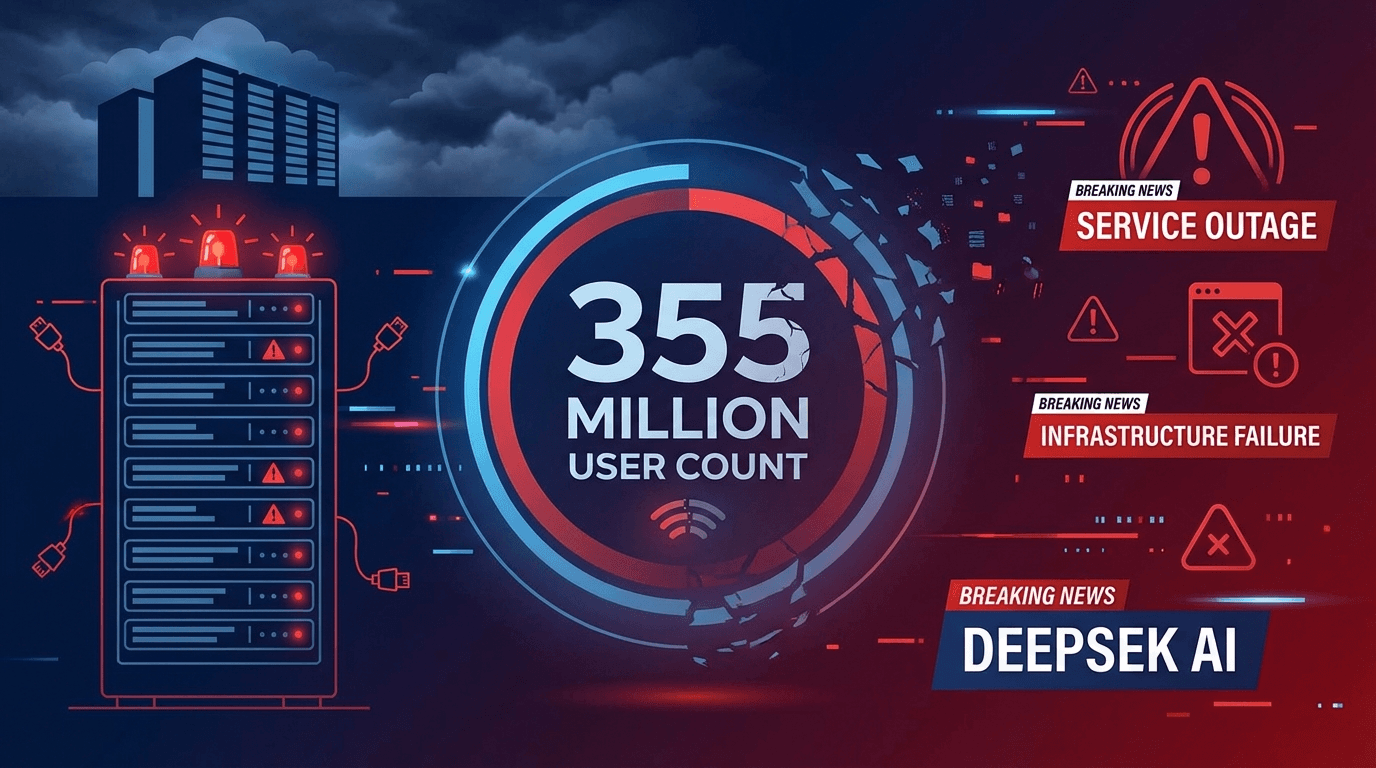
DeepSeek went offline for up to 13 hours on March 30, its longest outage ever. 355 million users were locked out as V4 delays mount.
The Longest Downtime Since DeepSeek's Viral Rise
On the evening of March 29, 2026 (China Standard Time), DeepSeek's AI chatbot began experiencing what would become the longest service disruption in the company's history. The outage stretched across multiple incidents, with reports varying from 7 hours to as long as 13 hours depending on the source, making it far worse than any previous downtime since DeepSeek's viral debut in January 2025.
DeepSeek's status page recorded the first incident at 9:35 p.m. CST on Sunday, March 29. Engineers initially marked it resolved at 11:23 p.m., but just 57 minutes later at 12:20 a.m. Monday, a second incident opened. The chatbot's web and mobile app services were not fully restored until 10:33 a.m. on Monday, March 30.
With 355 million registered users depending on the service, the disruption locked people out of active conversations, chat histories, and daily workflows overnight. Chinese social media flooded with complaints as users discovered they could not access the tool they had integrated into their professional and personal routines.
What Went Down
Both web-based and mobile app chatbot services were unavailable during the outage. Users attempting to access DeepSeek were met with error messages and could not retrieve their existing conversation histories. The API service status during the outage period has not been separately confirmed, though developer communities reported intermittent API failures as well.
This was not an isolated incident. DeepSeek experienced a 40-minute disruption on March 5, 2026, making the March 30 event the second major outage within 25 days. The pattern suggests systemic infrastructure challenges rather than one-off failures.
No Root Cause Disclosed
DeepSeek has not publicly disclosed the root cause of the outage. The company published updates on its status monitoring page throughout the incident but offered no technical explanation for what triggered the failure or why the initial fix at 11:23 p.m. did not hold.
Speculation among developers and industry observers centers on three possibilities.
The first theory points to infrastructure upgrades related to a new model release. DeepSeek has been working on its next-generation V4 model for months, and backend architectural changes in preparation for a new model could have destabilized the production environment.
The second theory attributes the outage to demand-driven capacity failure. China's AI usage has surged dramatically, with average daily AI token calls topping 140 trillion by March 2026, representing a 1,000-fold increase from early 2024. DeepSeek's rapid user growth from a viral curiosity to a platform with 355 million users may have outpaced its infrastructure scaling.
The third possibility involves hardware-related issues. Reports indicate that DeepSeek has been working more closely with Huawei's Ascend 910B chips as an alternative to NVIDIA GPUs, which are restricted by U.S. export controls. Hardware reliability challenges during this transition could contribute to instability.
V4 Remains Delayed
The outage arrives amid growing questions about DeepSeek V4's release timeline. The model has been anticipated for months, with prediction markets at one point giving a March 31 release a significant probability. That deadline has now passed without a release.
DeepSeek's current flagship model remains DeepSeek-V3.2, which emphasizes agentic reasoning capabilities. Brief official teases have hinted that V4 will be multimodal, supporting text, image, and video generation within a single model. However, persistent reports of Huawei Ascend 910B hardware failures during training have contributed to repeated delays.
Prediction market data as of late March 2026 shows the leading outcome for a V4 release shifted to May 15, 2026 at 86% probability, with an April 30 release at 73%. The market consensus suggests V4 is at least six weeks away.
Competitive Pressure Is Intensifying
DeepSeek's outage occurs against a backdrop of intense competition in China's AI market. During the same period, Alibaba released new Qwen models, ByteDance and Tencent matched with their own updates, and competitors including Zhipu AI, MiniMax, and Moonshot AI all shipped improvements to their respective platforms.
The competitive dynamic creates a double bind for DeepSeek. Rushing V4 to market risks additional instability, as the outage demonstrates. But delaying further allows competitors to capture users and enterprise contracts during a period of rapid market formation in China's AI sector.
Globally, the pressure is equally intense. March 2026 saw the release of GPT-5.4 from OpenAI, Gemini 3.1 from Google, and continued iteration on Claude from Anthropic. DeepSeek's value proposition as a high-performance open-source alternative depends on staying within competitive range of these Western frontier models, and V4 delays risk falling behind.
Infrastructure Scale vs. Growth Reality
DeepSeek's outage highlights a challenge facing every AI company that achieves rapid user growth: the gap between user acquisition speed and infrastructure scaling speed. Growing from zero to 355 million users in approximately 14 months is extraordinary, but supporting that user base requires infrastructure investment and operational maturity that typically takes much longer to develop.
The company's reliance on Huawei Ascend chips rather than NVIDIA hardware adds a layer of complexity. While necessary due to U.S. export restrictions, the Ascend ecosystem is less mature than NVIDIA's CUDA-based infrastructure, with fewer optimization tools, less community knowledge, and reportedly lower reliability in large-scale training workloads.
DeepSeek's technical team has demonstrated remarkable efficiency in model development, achieving competitive performance with fewer resources than Western labs. But infrastructure reliability at scale is a different engineering challenge than model architecture, and the March 30 outage suggests this remains an area requiring significant investment.
Conclusion
DeepSeek's record outage is a growing-pains story as much as a technical failure. The company built one of the most impressive AI platforms in the world on limited hardware resources, attracted 355 million users, and produced models that compete with offerings from organizations spending 10 to 50 times more on compute. But sustaining that growth requires infrastructure that matches the ambition of the models running on it. With V4 delayed and competitors shipping updates, the pressure to scale both capability and reliability simultaneously has never been higher. The next few months will determine whether DeepSeek can close the infrastructure gap before the competitive window narrows further.
Editor's Verdict
DeepSeek Suffers Record 13-Hour Outage Affecting 355 Million Users is a workable proposition that fills a clear gap, even if it doesn't fundamentally change the landscape.
The strongest case for paying attention is deepSeek has achieved frontier-competitive AI performance with significantly fewer resources than Western labs, which raises the bar for what readers should now expect from peers in this space. Reinforcing that, 355 million user base validates strong product-market fit and demonstrates genuine demand for open-source AI adds practical value rather than just headline appeal. The broader signal worth registering is straightforward: two major outages within 25 days suggest systemic infrastructure challenges rather than isolated incidents. On the other side of the ledger, record-breaking outage duration raises serious questions about infrastructure reliability at current scale is a real constraint, not a marketing footnote, and it should factor into any serious decision. Layered on top of that, no official root cause disclosure limits user confidence in the company's incident response transparency narrows the set of teams for whom this is an obvious yes.
For multi-model deployment teams, cost-conscious operators, and developers willing to evaluate beyond the major labs, the smart move is to track its trajectory and revisit once the rough edges are filed down. For everyone else, the safer posture is to monitor coverage and revisit once the use cases that matter to your team are demonstrated in the wild.
Pros
- DeepSeek has achieved frontier-competitive AI performance with significantly fewer resources than Western labs
- 355 million user base validates strong product-market fit and demonstrates genuine demand for open-source AI
- V3.2's agentic reasoning capabilities remain competitive during the V4 development period
- Transparent status page updates during the outage provided real-time visibility into recovery progress
Cons
- Record-breaking outage duration raises serious questions about infrastructure reliability at current scale
- No official root cause disclosure limits user confidence in the company's incident response transparency
- V4 delays amid hardware challenges risk losing competitive positioning to rapidly advancing domestic and global rivals
- Huawei Ascend chip dependency introduces supply chain and reliability risks not faced by competitors using NVIDIA hardware
References
Comments0
Key Features
1. Record 13-hour outage across two incidents on March 29-30, the longest since DeepSeek's January 2025 viral debut 2. 355 million registered users affected, locked out of chat histories and active conversations 3. No root cause officially disclosed; speculation centers on infrastructure upgrades, demand surge, or Huawei Ascend hardware issues 4. DeepSeek V4 release delayed past the March 31 prediction market deadline, with May 2026 now the consensus estimate 5. Second major outage within 25 days following a 40-minute disruption on March 5
Key Insights
- Two major outages within 25 days suggest systemic infrastructure challenges rather than isolated incidents
- China's 140 trillion daily AI token calls represent a 1,000-fold surge from 2024, straining all domestic AI providers
- The Huawei Ascend 910B transition introduces reliability risks as the ecosystem is less mature than NVIDIA's CUDA infrastructure
- DeepSeek V4 prediction market consensus shifting to May 2026 indicates at least six more weeks of delay
- 355 million users in 14 months demonstrates extraordinary growth that has outpaced infrastructure scaling
- Competitive pressure from Alibaba, ByteDance, Tencent, and global labs creates a double bind between speed and stability
- The outage underscores that infrastructure reliability at scale is a distinct engineering challenge from model architecture innovation
Was this review helpful?
Share
Related AI Reviews

Meta Expands Muse Agent With Video Chat, Glasses, Charm
Meta expanded its Muse AI agent at Connect 2026 with video chat, smart glasses, Mac control, and a Muse Charm wearable shipping in December.

Grok 4.7 Review: Same Price, Trails Fable 5.1 and GPT-6
xAI's Grok 4.7 keeps Grok 4.6's $2/$6 pricing on a larger base model, but Artificial Analysis scores it 46 versus 53 for Fable 5.1 and GPT-6.

Qwen3.8-Omni-Flash Undercuts Gemini Flash on Price
Alibaba's new omnimodal model prices at $0.15/$0.47 per million tokens, far below Gemini 3.8 Flash, with benchmarks that are close but mixed.

TypeSafe AI Launches Jev, a New System One Model
Ex-OpenAI researcher Diogo Almeida's TypeSafe AI released Jev in early access, a structured-decision model priced at $0.042 per million input tokens.