
Claude Fable 5.2 Paints With Code, Not Diffusion
Anthropic staff demos show Fable 5.2 painting by writing code for a simulated paint engine, with roughly 700,000 strokes in one photorealistic piece.
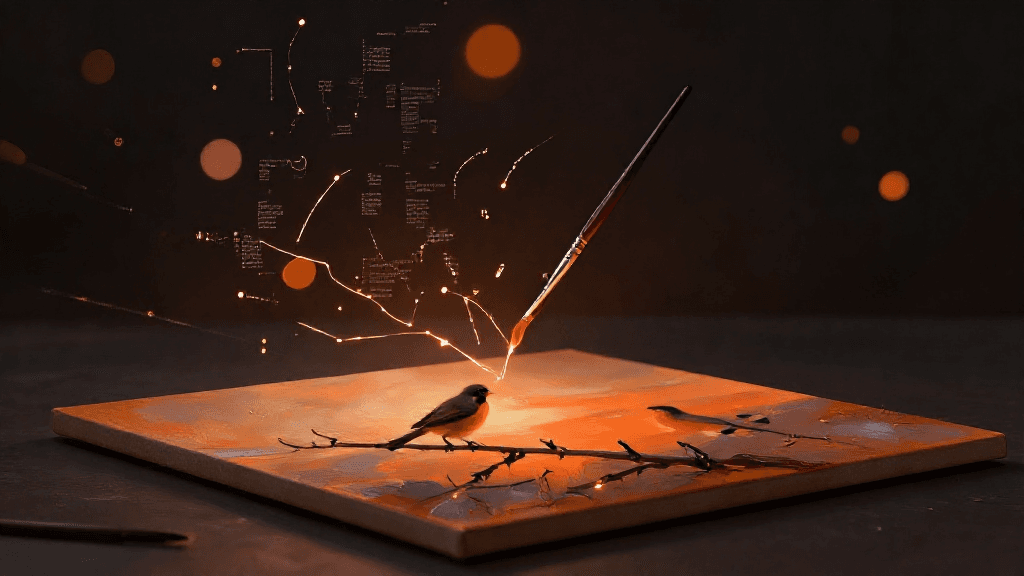
Anthropic staff demos show Fable 5.2 painting by writing code for a simulated paint engine, with roughly 700,000 strokes in one photorealistic piece.
Introduction
On November 15, 2026, The Decoder reported that Claude Fable 5.2 can produce complex, even photorealistic paintings without calling an image model. Instead, the model writes a Python program that drives a simulated paint engine and places individual brush strokes on a virtual canvas. The demos come from Anthropic staff posting on X, and The Decoder is the source for how they are described here. They are not a shipped "painting feature". Anthropic's launch page for Fable 5.2 and Mythos 5.2, dated November 9, 2026, does not list painting among its features.
The capability is worth a closer look because it is a different way of making an image. A diffusion model, such as the ones behind Midjourney, refines noise into a picture. Here the language model commits to each stroke as a line of code and then looks at the result.
What the demos show
According to The Decoder, Jake Eaton, who works at Anthropic, asked Fable 5.2 for a painting as hard to tell from a photograph as possible. The model produced a shopping cart in a parking garage using roughly 700,000 simulated brush strokes. Per Eaton, as reported by The Decoder, the model works without an external image model and without pre-rendered or traced source images. Each piece is a Python program of 1,000 to 2,000 lines that drives the paint engine. The engine simulates bristle texture and how the paint goes on, and the model has to paint over its own mistakes.
Eaton also dealt with a criticism of earlier work. According to The Decoder, attempts with Opus 5.5 were criticised as imitations of existing art, so he had Fable 5.2 develop its own artist personas, each with a fictional backstory and a consistent style.
| Demo | Reported by | Key detail |
|---|---|---|
| Shopping cart in a parking garage | Jake Eaton, via The Decoder | About 700,000 simulated strokes, photorealistic goal |
| Bird at sunrise | Michael Graczyk, via The Decoder | 111 strokes, no undo, 21-second video |
| Two people painting at dusk | Michael Graczyk, via The Decoder | 280 strokes, objects repainted after a lighting effect smeared them |
Stroke by stroke: the bird at sunrise
Michael Graczyk, an Anthropic engineer, shared a chat log and video of a bird at sunrise. The Decoder reports that the model could use code only to simulate bristles, wet paint and canvas texture. It had to output each stroke as its own coordinate line and could not undo a stroke once placed.
The 21-second video counts up to exactly 111 strokes. For the first stroke, the model output the color code #30346a, a width of 90 pixels and five slightly wobbling waypoints. According to The Decoder, Fable 5.2 said it added the roughly seven-pixel wobble on purpose because a human arm does not draw a perfectly straight line either. When the bird's back came out too thin and scraggly, the model laid a bolder stroke over it, and the stray bristle marks now read as ruffled feathers.
In the 280-stroke dusk piece, a late lighting effect accidentally smeared paint tubes and a cup on the table, and the model repainted those objects afterward. The Decoder also notes that the model followed the prompt's request that both painters use their outer hands so their inner shoulders could touch.
The robotics connection
The Decoder links the painting demos to physical control, arguing that planning step by step and self-correcting under constraints is not limited to a virtual canvas. Anthropic's own table lists a robotics row, RoboDojo Sim, marked with a double dagger. Anthropic's footnote says that score shows the highest-available effort and was run internally. Anthropic's page describes RoboDojo as a test of controlling a simulated two-arm robot from camera images. It is not a painting benchmark. The same section of Anthropic's page shows robots controlled by Fable 5.2 solving a puzzle cube, unscrewing a bottle cap and drawing a picture of a robot, but it does not mention painting.
| Model | RoboDojo Sim score |
|---|---|
| Fable 5.2 | 64.9% |
| Opus 5.5 | 39.4% |
| GPT-6 Astra | 29.8% |
| Fable 5.1 | 27.6% |
Aris Zhu, identified by The Decoder as an AI researcher, tested the model on real robot arms. Each of Fable 5.2 and GPT-6 Astra used a physical arm to paint Van Gogh's "The Starry Night". According to The Decoder, Astra painted faster, and so far only Astra has managed to stand a domino on end, by slowly loosening its gripper and using gravity as a pivot. That result shows limits in fine motor control.
Usability analysis
There is nothing to use yet. The painting work is a set of demonstrations, and the sources describe no product surface, pricing or availability for it. For context from Anthropic's page, Fable 5.2 costs $8 per million input tokens and $40 per million output tokens, generates output up to 30% faster than Fable 5.1, and offers an optional fast mode that speeds up token generation by up to 2.5 times.
The practical audience is researchers and developers who care about agent behaviour. A painting built from 111 or 280 coordinate lines is a transcript of decisions. Each stroke has a color, a width and a path, and each can be read, replayed and compared with what the model said it intended. The Decoder compares the approach to agentic image editing, where a language model picks tools and evaluates the results.
Pros and cons
The strengths are visible in the demos. The process is legible, the model reacts to its own errors, and the work needs no separate image model, according to Eaton.
The limits are just as clear. The evidence is a handful of staff-posted demos relayed by one outlet, and no cited source measures image quality against diffusion models or against human painters. Zhu's physical test also shows that real-world control remains uneven.
Outlook
The open questions are measurable ones. Do the personas hold a consistent style across many pieces? How does cost scale when one painting needs hundreds of thousands of strokes? Does the stroke-by-stroke reasoning carry over to tasks beyond painting? Anthropic's page reports a RoboDojo gain over Fable 5.1, and The Decoder ties the painting demos to that kind of spatial planning. A controlled comparison would test that link directly, and none of the cited sources provides one.
Conclusion
Fable 5.2's painting demos are a clear illustration of a language model working through a tool loop: write code, look at the canvas, and fix mistakes. They are not evidence that the approach beats diffusion on image quality. They suit readers tracking agentic capabilities, and they are not a signal that a painting product has launched.
Editor's Verdict
Claude Fable 5.2's code-driven painting demos are worth close attention within the Claude space, as long as they are read as demonstrations rather than a product.
The strongest case for paying attention: a transparent process in which every stroke is a coordinate line the model wrote itself. That makes the model's reasoning inspectable in a way a diffusion image is not. Reinforcing that, visible self-correction, such as repainting objects smeared by a late lighting effect — practical value rather than just headline appeal. The broader signal worth registering is straightforward: a code-driven painter records each decision as a coordinate line, so the process can be read and replayed step by step. On the other side of the ledger, one constraint is real rather than a marketing footnote: a set of staff demos on X rather than a shipped feature with documented access. It should factor into any serious decision. Layered on top of that, the absence of any quality comparison with diffusion models in the cited sources — so claims about image quality remain open.
For researchers and developers studying agentic tool use, these demos are a useful case study in how a model plans, commits and corrects through code. Anyone looking for an image-generation tool should wait until Anthropic documents the capability as something users can access.
Pros
- A transparent process in which every stroke is a coordinate line the model wrote itself
- Visible self-correction, such as repainting objects smeared by a late lighting effect
- A pipeline that, per Eaton, needs no external image model and no traced source images
- Persona-driven styles that answer the criticism of imitating existing art
Cons
- A set of staff demos on X rather than a shipped feature with documented access
- The absence of any quality comparison with diffusion models in the cited sources
- Physical-robot results that remain limited, with Astra painting faster in the Starry Night arm test
References
Comments0
Key Features
1. Painting through code: the model writes a 1,000 to 2,000 line Python program that drives a simulated paint engine, per Jake Eaton as reported by The Decoder. 2. Scale: roughly 700,000 simulated strokes for one photorealistic parking-garage scene. 3. Committed strokes: in Michael Graczyk's bird-at-sunrise demo, 111 strokes with no undo, each output as its own coordinate line. 4. Self-correction: the model repainted objects smeared by a late lighting effect in a 280-stroke dusk piece. 5. Robotics context: Anthropic lists 64.9% for Fable 5.2 on RoboDojo Sim, against 29.8% for GPT-6 Astra.
Key Insights
- A code-driven painter records each decision as a coordinate line, so the process can be read and replayed step by step
- The demos come from Anthropic staff posts on X relayed by The Decoder, and Anthropic's launch page does not list painting as a feature
- Persona development was Eaton's response to criticism that Opus 5.5 attempts imitated existing art
- The 111-stroke bird demo shows the model choosing a color code, a 90-pixel width and a deliberate roughly 7-pixel wobble for its first stroke
- RoboDojo Sim measures control of a simulated two-arm robot from camera images, so it is a neighbouring skill and not a painting score
- In Aris Zhu's physical Starry Night test, according to The Decoder, GPT-6 Astra painted faster, which shows limits in fine motor control
- No cited source compares the output with diffusion models, so claims about image quality remain untested
Was this review helpful?
Share
Related AI Reviews

Claude Opus 5.5 Guide: Drop 'Think Hard', Start at Medium
Anthropic's daily-driver guide for Opus 5.5 says to drop 'think hard', start at Medium effort and state the finished goal in one message.

Claude Personal Finance: Read-Only Bank Access in Beta
Personal Finance in Claude links bank and card accounts read-only for Pro, Max and Ultra users in the US, rolling out in beta from this week.

Anthropic FlashProve: Zero-Knowledge Proofs of AI Inference
Anthropic's open-source FlashProve prototype proves a reply came from a committed model without exposing weights, at about 110 tokens/s on one H100.

Anthropic S-1/A Warns RSP Threshold May Be Met 'Imminently'
Revised S-1 says internal estimates for future models may 'imminently' meet its RSP acceleration threshold; no current model is designated above it.