
Claude Code v2.1.90 Ships /powerup: 18-Lesson In-Terminal AI Tutorials
Anthropic's Claude Code v2.1.90 introduces /powerup, the first official in-terminal interactive tutorial system with 18 animated lessons covering beginner to advanced usage.
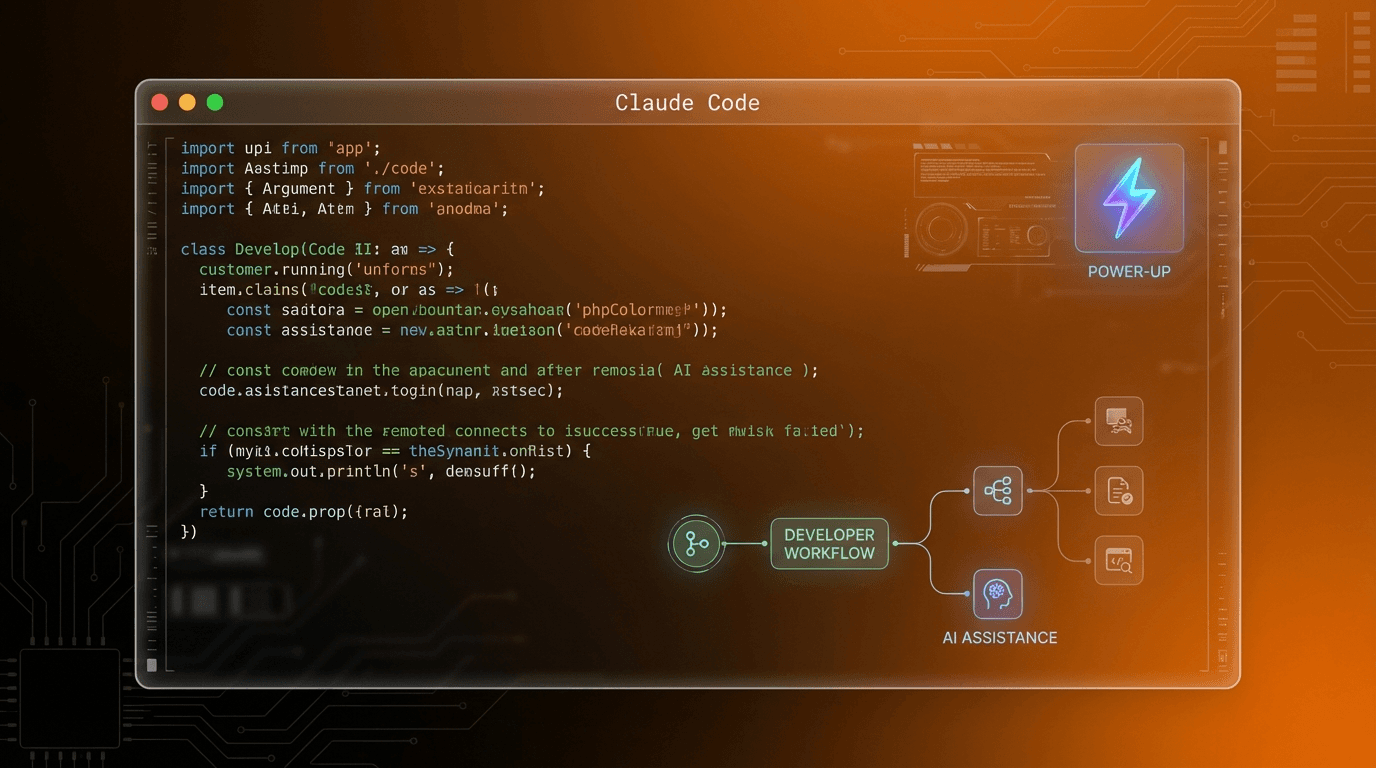
Anthropic's Claude Code v2.1.90 introduces /powerup, the first official in-terminal interactive tutorial system with 18 animated lessons covering beginner to advanced usage.
Claude Code Gets Its First Built-In Tutorial System
On April 1, 2026, Anthropic shipped Claude Code v2.1.90, introducing the /powerup command—the first official, first-party interactive tutorial system built directly into the terminal-based AI coding agent. Over the following three days, versions v2.1.91 and v2.1.92 extended the update with enterprise security controls, expanded MCP result persistence, and a 60% performance improvement to the Write tool.
The release marks a shift in how Anthropic is approaching developer onboarding for Claude Code. Rather than relying on external documentation alone, the team has embedded structured, animated lessons directly into the terminal workflow where developers already spend their time.
/powerup: 18 Lessons Across Three Levels
What It Is
/powerup is a terminal-native curriculum built using the same React + Ink framework that powers the rest of the Claude Code interface. It delivers 18 structured lessons organized into three difficulty levels, each including a conceptual explanation, an animated demonstration running in-terminal, and a guided hands-on exercise.
Curriculum Overview
Beginner (6 lessons): CLAUDE.md configuration, the /clear command, /compact for context management, Plan Mode, and Model Selection. These lessons establish the foundational workflows that make Claude Code effective for everyday use.
Intermediate (6 lessons): Skills, Hooks, Sub-agents, MCP configuration, and the /rewind feature. This tier covers the orchestration and customization layer that transforms Claude Code from a chat tool into an agentic workflow engine.
Advanced (6 lessons): Worktrees for parallel workstreams, Auto Mode, /schedule for background tasks, and SDK Headless Mode for programmatic control. The advanced tier targets developers building automation pipelines and CI/CD integrations on top of Claude Code.
Design Philosophy
Each lesson is self-contained and can be completed in under five minutes. The animated demos run in the same terminal window, meaning developers can immediately replicate what they see without switching context to a browser. Anthropic's decision to build this system in-terminal reflects a broader principle in Claude Code's UX: keep the developer in flow.
v2.1.91: MCP Result Persistence
Released on April 3, Claude Code v2.1.91 raised the MCP tool result size limit to 500,000 characters via the anthropic/maxResultSizeChars metadata field. Previously, large tool results—such as complete database schemas, codebase indexes, or long API responses—would be truncated, forcing developers to work around the limit manually.
The update also allows plugins to ship executable files in a bin/ directory, enabling custom CLI tools to be invoked directly by Claude during agentic sessions without requiring external PATH configuration.
v2.1.92: Enterprise Controls and Performance
On April 4, v2.1.92 added the forceRemoteSettingsRefresh policy, which forces Claude Code to pull fresh configuration from the organization's remote settings server on every startup. This addresses a pain point for enterprise teams managing Claude Code across large developer populations, where configuration drift between local and organizational policies had created compliance inconsistencies.
On the performance side, the Write tool's diff computation speed for large files was improved by approximately 60%. The fix specifically targets files containing tabs, ampersands, and dollar signs—characters that previously caused quadratic-time processing on large buffers.
Usability Analysis
For developers new to Claude Code, /powerup lowers the learning curve significantly. Many of Claude Code's most powerful features—Hooks, Sub-agents, MCP—have previously required reading through external documentation before they could be used effectively. The in-terminal tutorial format removes that friction.
For experienced users, the advanced lessons on Worktrees and SDK Headless Mode offer a structured path into capabilities that are often underutilized. The curriculum is dense enough to provide value even to developers who have been using Claude Code for months.
The enterprise controls in v2.1.92 will be particularly relevant for organizations deploying Claude Code at scale. Consistent configuration enforcement has been a recurring concern as teams grew, and forceRemoteSettingsRefresh directly addresses it.
Pros and Cons
Pros:
- In-terminal tutorial format reduces context-switching during onboarding
- Three-tier curriculum accommodates beginner through advanced users
- MCP result persistence at 500k characters eliminates truncation for large data payloads
- 60% Write tool speed improvement is meaningful for large-codebase workflows
- Enterprise configuration policy provides better compliance control
Cons:
/tagand/vimcommands were removed in v2.1.92, which may affect users who relied on them- The tutorial system requires active participation—passive reading is not supported
- Advanced lessons assume familiarity with agentic concepts that may overwhelm newcomers who rush through levels
Outlook
The /powerup system positions Claude Code to grow its developer base without proportional increases in support overhead. As Claude Code expands into enterprise and team environments—where new users are onboarded constantly—an embedded curriculum that runs in the same tool is a scalable approach to education.
The MCP improvements in v2.1.91 are equally significant for the broader agentic ecosystem. Larger tool result payloads mean Claude Code can now ingest and act on more complex real-world data sources without truncation workarounds, expanding the range of automation tasks it can handle reliably.
Conclusion
Claude Code v2.1.90 through v2.1.92 represent a coherent product push: better onboarding via /powerup, stronger agentic data handling via MCP persistence, and improved enterprise governance via configuration enforcement. Developers already using Claude Code should update immediately, particularly for the Write tool performance gains. New users should start with /powerup before diving into the documentation—it is the fastest path to effective use.
Editor's Verdict
Claude Code v2.1.90 Ships /powerup: 18-Lesson In-Terminal AI Tutorials earns a solid recommendation within the claude space.
The strongest case for paying attention is in-terminal tutorial eliminates context-switching during onboarding and skill development, which raises the bar for what readers should now expect from peers in this space. Reinforcing that, 18-lesson curriculum with animated demos covers the full Claude Code feature surface from basics to advanced automation adds practical value rather than just headline appeal. The broader signal worth registering is straightforward: anthropic released Claude Code v2.1.90 on April 1, 2026, introducing /powerup—the first built-in in-terminal interactive tutorial system for the AI coding agent. On the other side of the ledger, /tag and /vim commands were removed, potentially disrupting existing workflows for users who relied on them is a real constraint, not a marketing footnote, and it should factor into any serious decision. Layered on top of that, the tutorial system requires active engagement—there is no passive reading mode narrows the set of teams for whom this is an obvious yes.
For Anthropic and Claude users, alignment-focused teams, and developers already invested in the Claude ecosystem, this is a serious evaluation candidate, not just a curiosity to bookmark. For everyone else, the safer posture is to monitor coverage and revisit once the use cases that matter to your team are demonstrated in the wild.
Pros
- In-terminal tutorial eliminates context-switching during onboarding and skill development
- 18-lesson curriculum with animated demos covers the full Claude Code feature surface from basics to advanced automation
- MCP 500k character persistence enables real-world agentic workflows with large data payloads
- Enterprise configuration policy enforcement improves compliance management for organizational deployments
- 60% faster Write tool reduces friction in large-codebase editing sessions
Cons
- /tag and /vim commands were removed, potentially disrupting existing workflows for users who relied on them
- The tutorial system requires active engagement—there is no passive reading mode
- Advanced lessons assume prior agentic workflow knowledge and may overwhelm users who skip beginner levels
References
Comments0
Key Features
1. /powerup command: 18-lesson in-terminal curriculum with animated demos, organized into beginner, intermediate, and advanced tiers. 2. Hands-on exercises: Each lesson includes guided practice within the terminal, removing the need to switch to external documentation. 3. MCP result persistence: v2.1.91 raises the tool result size limit to 500,000 characters, eliminating truncation for large database schemas and codebase indexes. 4. Plugin bin/ directory: Plugins can now ship custom CLI executables invocable directly by Claude during agentic sessions. 5. Enterprise policy enforcement: v2.1.92 adds forceRemoteSettingsRefresh to ensure consistent configuration across organizational deployments. 6. Write tool performance: 60% faster diff computation for large files containing special characters.
Key Insights
- Anthropic released Claude Code v2.1.90 on April 1, 2026, introducing /powerup—the first built-in in-terminal interactive tutorial system for the AI coding agent
- /powerup delivers 18 lessons across beginner, intermediate, and advanced tiers using animated terminal demos built with the React + Ink framework
- The intermediate and advanced levels cover Sub-agents, Hooks, MCP configuration, Worktrees, and SDK Headless Mode—features frequently underutilized due to documentation friction
- v2.1.91 raised MCP tool result persistence to 500,000 characters, enabling Claude to handle full database schemas and codebase indexes without truncation
- v2.1.92 added forceRemoteSettingsRefresh, addressing enterprise configuration drift across large developer teams
- The Write tool received a 60% performance improvement for large files, directly reducing latency in high-volume coding sessions
- The /tag and /vim commands were removed in v2.1.92, representing a deliberate simplification of the command surface
Was this review helpful?
Share
Related AI Reviews

Anthropic IPO Draft: $4.6B Revenue, $42B Net Loss in 2025
Reports on Anthropic's draft IPO prospectus cite $4.6B 2025 revenue, a $42B net loss, $518B in obligations and existential-risk warnings.

Claude Sonnet 5.5: 30% Faster, Up to 30% Cheaper per Task
Claude Sonnet 5.5 keeps Sonnet 5 pricing, runs 30%+ faster, and cuts per-task cost up to 30%, per Anthropic; Opus 5.5 still leads most benchmarks.

D.C. Circuit Lets Pentagon Exclude Anthropic's Claude, 2-1
A divided D.C. Circuit panel ruled 2-1 that the Department of War can exclude Anthropic's Claude from its supply chain under a 2018 security law.

Anthropic Signs $11.6B, 7-Year Cloud Deal With Akamai
Anthropic committed $11.6B over seven years to Akamai Cloud, with a stock warrant tied to spending and room to expand toward $20B.