
Cerebras Unveils CS-4: Up to 30x Faster Than GPU Systems
Cerebras unveiled the CS-4 wafer-scale inference system, claiming up to 30x faster tokens-per-second-per-user than production GPU systems.
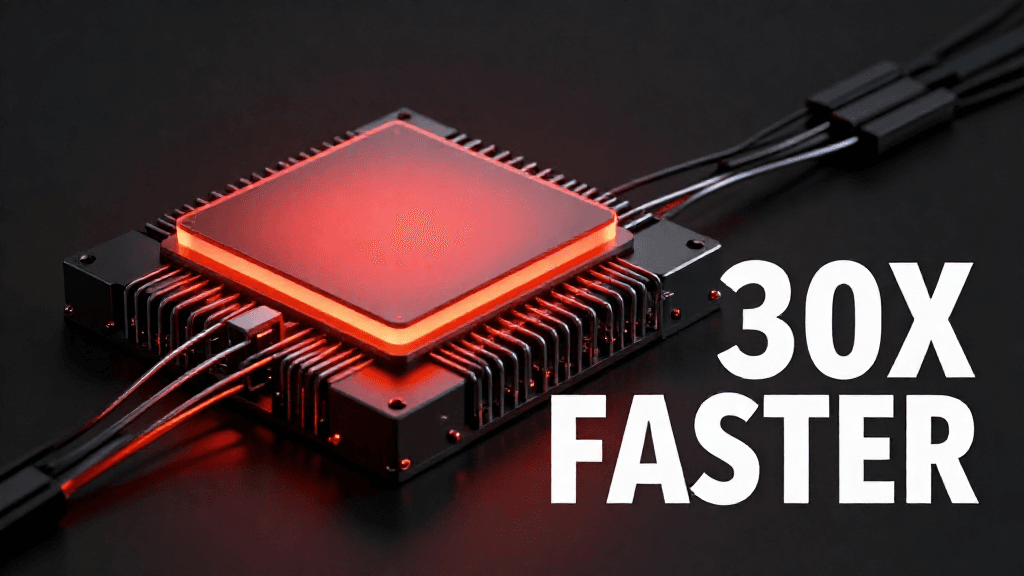
Cerebras unveiled the CS-4 wafer-scale inference system, claiming up to 30x faster tokens-per-second-per-user than production GPU systems.
Introduction
Cerebras Systems unveiled the CS-4 on Tuesday, August 18, 2026, a rack-scale wafer-scale inference system built on the company's new Nexus Platform Architecture. The announcement introduces the WSE-3 Turbo, an upgraded wafer-scale processor, and repackages Cerebras' entire system design around three modular subsystems: Compute, Power, and I/O. "In AI, speed is productivity," said Cerebras CEO and co-founder Andrew Feldman. "Cerebras CS-4 delivers industry-leading speeds on the largest frontier models, fundamentally changing the paradigm." Cerebras says CS-4 delivers up to 30 times faster tokens-per-second-per-user than production GPU systems, a claim benchmarked on the open-weight GPT-OSS-120B model. The company positions CS-4 as a direct challenge to Nvidia's dominance in AI inference hardware, arriving months after Cerebras completed its initial public offering earlier in 2026. First CS-4 shipments begin this quarter, Q3 2026.
Feature Overview
Three WSE-3 Turbo Wafers Per Rack
Each CS-4 rack houses three WSE-3 Turbo (WSE-3T) wafer-scale processors. Every WSE-3T packs 4 trillion transistors and 900,000 AI-optimized cores onto a single 46,225 mm² wafer, with 44 GB of on-chip SRAM. Cerebras' wafer-scale approach keeps model weights on-chip rather than shuttling them to and from external memory during inference, a design choice the company says eliminates the memory-bandwidth bottleneck that limits token generation speed on conventional GPU clusters.
Compute, Memory, and I/O Gains Over CS-3
Cerebras says each WSE-3T wafer delivers 250 PFLOPS of compute, for 750 PFLOPS per three-wafer CS-4 system, six times the 125 PFLOPS of the previous CS-3 system. Memory bandwidth reaches 129.6 PB/s, also six times the CS-3's 21.6 PB/s, while on-chip fabric bandwidth climbs to 160.5 PB/s from 26.7 PB/s. System I/O bandwidth increases to 7.2 Tbit/s from 1.2 Tbit/s, and I/O latency drops to 2 microseconds from 5 microseconds. Cerebras also says each wafer runs up to twice as fast as the previous generation, and that CS-4 delivers 10 times more throughput per watt than CS-3.
Wafer I/O Module and Direct Wafer Links
A new Wafer I/O Module supports RoCE v2 RDMA over Ethernet and enables what Cerebras calls Direct Wafer Links: wafer-to-wafer connections within and across racks that bypass a switch entirely, at latencies as low as 2 microseconds. The module doubles aggregate off-wafer bandwidth to 2.4 Tbit/s per wafer. On its product page, Cerebras separately states that the Wafer I/O Module is built to support models exceeding 50 trillion parameters, distinct from the company's claim elsewhere that CS-4 sustains more than 1,000 tokens per second on models exceeding 10 trillion parameters.
Physical Redesign: Wafer-Scale Backpack
CS-4 also reworks the physical packaging around each wafer. Power conversion circuitry now sits just 0.5 mm from the processor, compared with roughly 50 mm on conventional GPU boards, a roughly 100-times reduction in distance that Cerebras says improves power delivery efficiency. The wafer and its supporting electronics are consolidated into a pluggable, rear-mounted design Cerebras calls the Wafer-Scale Backpack, which the company says uses 50% fewer components, is 60% more automated to manufacture, and cuts deployment time from days to hours.
Comparison: CS-4 vs. CS-3
| Metric | CS-3 | CS-4 |
|---|---|---|
| Compute (per system) | 125 PFLOPS | 750 PFLOPS |
| Memory bandwidth | 21.6 PB/s | 129.6 PB/s |
| On-chip fabric bandwidth | 26.7 PB/s | 160.5 PB/s |
| System I/O bandwidth | 1.2 Tbit/s | 7.2 Tbit/s |
| I/O latency | 5 microseconds | 2 microseconds |
| Throughput per watt | Baseline | 10x (Cerebras claim) |
Usability Analysis
Cerebras says CS-4 delivers more than 4,400 tokens per second per user on GPT-OSS-120B, a figure it frames as up to 30 times faster tokens-per-second-per-user than production GPU systems. Cerebras CTO and co-founder Sean Lie framed the practical implication in the announcement: "Being 30 times faster doesn't just make a response feel fast. It gives an agentic system room for more than an order of magnitude as much reasoning, verification, or tool use in the same wall-clock time." That framing targets a specific customer: teams running agentic workflows, where a model calls tools, verifies its own output, or reasons through multi-step tasks, all of which multiply the number of inference calls per user request.
Cerebras hardware already underpins fast-inference offerings from at least one major model provider; OpenAI's Ultrafast tier for GPT-5.6 Sol, previewed earlier in August 2026, runs on Cerebras' Wafer-Scale Engine architecture. CS-4's named customers and partners span AI infrastructure and cloud: Cerebras has a Master Relationship Agreement with OpenAI, and lists Group 42 Holding Ltd, the Mohamed bin Zayed University of Artificial Intelligence, and AWS among its named partners. For disaggregated inference deployments, Cerebras names AMD Helios and AWS Trainium as ecosystem partners. The rear-mounted Wafer-Scale Backpack design, and Cerebras' claimed days-to-hours deployment time, are aimed squarely at data center operators who need to install and swap capacity quickly, not at individual developers.
Pros and Cons
Pros
- Cerebras publishes detailed six-times gains in compute, memory bandwidth, and on-chip fabric bandwidth over CS-3
- Direct Wafer Links cut wafer-to-wafer latency to as low as 2 microseconds by eliminating a network switch
- Wafer-Scale Backpack redesign claims 50% fewer components and days-to-hours deployment time
- Named partnerships, including a Master Relationship Agreement with OpenAI, provide early enterprise validation
Cons
- The 30x speed and 4,400+ tokens/second claims are Cerebras' own GPT-OSS-120B benchmark, not independently verified
- Manufacturing process node for the WSE-3 Turbo has not been disclosed
- Pricing has not been announced, and shipments do not begin until Q3 2026
Outlook
CS-4 sharpens Cerebras' pitch against Nvidia, shifting the inference hardware conversation from raw model capability to inference speed as its own competitive axis, an argument that gained relevance after Cerebras' IPO earlier in 2026. If the 30x tokens-per-second-per-user claim holds up in independent testing, it would especially reward the agentic AI systems Lie described, workloads that make many inference calls per completed task rather than one long response. Named partners like AWS, Group 42, and MBZUAI, plus the ecosystem tie-ins with AMD Helios and AWS Trainium for disaggregated deployments, suggest Cerebras is positioning CS-4 as infrastructure other providers build on top of, similar to how OpenAI's Ultrafast tier already uses Cerebras silicon, rather than a system aimed at end users directly. Whether that model scales will depend on production availability once shipments begin, and how Cerebras prices CS-4 racks relative to comparable GPU capacity.
Conclusion
CS-4 is a substantial hardware upgrade, not a new AI model or software feature. Cerebras backs it with detailed, specific figures, six times the compute, memory bandwidth, and fabric bandwidth of CS-3, alongside a rack redesign meant to cut deployment time. Its core speed claims, including the 30x figure, are still Cerebras' own benchmarks pending independent verification, and pricing has not been announced. CS-4 will matter most to cloud providers, AI labs, and infrastructure partners deploying agentic AI at scale, once shipments begin this quarter.
Editor's Verdict
Cerebras Unveils CS-4: Up to 30x Faster Than GPU Systems earns a solid recommendation within the IT news space.
The strongest case for paying attention: Cerebras publishes detailed six-times gains in compute, memory bandwidth, and on-chip fabric bandwidth over CS-3. That alone raises the bar for what readers should expect in this space. Reinforcing that, Direct Wafer Links cut wafer-to-wafer latency to as low as 2 microseconds by eliminating a network switch — practical value rather than just headline appeal. The broader signal worth registering is straightforward: CS-4's headline claim, 4,400+ tokens per second per user on GPT-OSS-120B, is a Cerebras benchmark rather than an independently verified figure. On the other side of the ledger, one constraint is real rather than a marketing footnote: the 30x speed and 4,400+ tokens/second claims are Cerebras' own GPT-OSS-120B benchmark, not independently verified. It should factor into any serious decision. Layered on top of that, manufacturing process node for the WSE-3 Turbo has not been disclosed — which narrows the set of teams for whom this is an obvious yes.
For AI industry watchers, strategy teams, and decision-makers tracking platform shifts, this is a serious evaluation candidate, not just a curiosity to bookmark. For everyone else, the safer posture is to monitor coverage and revisit once the use cases that matter to your team are demonstrated in the wild.
Pros
- Cerebras publishes detailed six-times gains in compute, memory bandwidth, and on-chip fabric bandwidth over CS-3
- Direct Wafer Links cut wafer-to-wafer latency to as low as 2 microseconds by eliminating a network switch
- Wafer-Scale Backpack redesign claims 50% fewer components and days-to-hours deployment time
- Named partnerships, including a Master Relationship Agreement with OpenAI, provide early enterprise validation
Cons
- The 30x speed and 4,400+ tokens/second claims are Cerebras' own GPT-OSS-120B benchmark, not independently verified
- Manufacturing process node for the WSE-3 Turbo has not been disclosed
- Pricing has not been announced, and shipments do not begin until Q3 2026
References
Comments0
Key Features
CS-4 pairs three WSE-3 Turbo wafers (4T transistors, 900K cores each) in a rack-scale system built on Cerebras' new Nexus Platform Architecture, delivering 750 PFLOPS, 129.6 PB/s memory bandwidth, and Direct Wafer Links at 2-microsecond latency via a new Wafer I/O Module.
Key Insights
- CS-4's headline claim, 4,400+ tokens per second per user on GPT-OSS-120B, is a Cerebras benchmark rather than an independently verified figure
- The six-times jump in compute, memory bandwidth, and fabric bandwidth over CS-3 stems from a physical redesign, not just a faster wafer
- Direct Wafer Links removing a network switch between wafers signals Cerebras is optimizing for agentic workloads that make many rapid inference calls
- Cerebras' Master Relationship Agreement with OpenAI, whose Ultrafast tier already runs on Cerebras hardware, suggests CS-4 will extend that partnership
- The Wafer-Scale Backpack's claimed days-to-hours deployment time targets data center operators, not individual developers
- Cerebras has not disclosed CS-4 pricing or the chip's manufacturing process node, leaving key cost and supply-chain questions open
- CS-4 arrives months after Cerebras' 2026 IPO, positioning the company's next hardware generation directly against Nvidia on inference speed
- Cerebras separately claims over 1,000 tokens/second on 10T+ parameter models and Wafer I/O Module support for 50T+ parameter models, two distinct scale claims
Was this review helpful?
Share
Related AI Reviews

Judge Dismisses Chegg, Penske Suits Over Google AI Overviews
Judge Mehta granted Google's motions to dismiss both suits over AI Overviews on Sept 30; the court declined to rule on the state-law claim.

Reddit Ends RSS Feeds Nov 13 and Closes Public API by March
Reddit will stop RSS on Nov 13, 2026 and close public API access by March 2027, citing scraping and abuse. Registered apps can migrate to Devvit.
AMD to Acquire Fei-Fei Li's World Labs for $8.2B in Stock
AMD agreed to acquire World Labs for about $8.2 billion in stock; Fei-Fei Li would become AMD's chief scientist. Closing is expected by end of 2026.

Apple Reference Image: How iPhone 18 Pro Proves Photos Real
Apple's new iPhone 18 Pro camera signs sensor data at capture, letting users compare an unalterable reference image to verify a photo wasn't edited.